PostsFromWikipedia
joined 9 months ago
Hearty, K. (2025). ‘Standing with Soldier F’: Bloody Sunday, disrupting the degradation ceremony and the court of public opinion. Punishment & Society, 27(1), 109-128. https://doi.org/10.1177/14624745241264297
There's an edit war taking place about putting Soldier F's name in the article. It's pretty easy to find with web search including in an Irish magazine that editorializes against him but is still probably RS. I won't get into it here myself but the magazine also accuses the trial judge of presiding over a cover-up. ~2026-38271-65 (talk) 19:36, 4 July 2026 (UTC)
Edit war would imply wrongdoing on both sides, when only one side is at fault. The name is a BLP violation per Talk:Bloody Sunday (1972)/Archive 5#RfC about naming "Soldier F" in the Bloody Sunday (1972) article, and will not be mentioned in any article without explicit consensus (meaning a new RFC, but given the not guilty verdict it's unlikely the result will change from before). FDW777 (talk) 19:39, 4 July 2026 (UTC)
The RFC was about a single article, not "any" article, and it was inconclusive, but thanks for the link. I'd say that if the name becomes widely published (right now it's published but not widely) then continuing to suppress it would be pointless. On a separate matter, I'd be interested to see more in the article about the legal particulars in the trial (I'm in the US and don't know how UK trials work). E.g. why wasn't there a jury? Anyway I just heard about this case and don't want to linger on it too much since it's outside my usual topic areas, but there are things that could be said. It's interesting that Soldier G's name is also still suppressed. Soldier G participated in the incident alongside Soldier F, but he died sometime later. ~2026-38271-65 (talk) 20:05, 4 July 2026 (UTC)
Per WP:ONUS it's up to those wishing to include to obtain consensus, and the idea that the RFC somehow doesn't apply to another directly related article won't fly. The trial was non-jury as a result of the Justice and Security (Northern Ireland) Act 2007. Essentially, there was a fear that any nationalists would automatically vote to convict whereas any unionists would vote to acquit. So rather than end up with a deadlocked jury it's seen as fairer to let a judge decide. FDW777 (talk) 20:15, 4 July 2026 (UTC)
https://en.wikipedia.org/wiki/Talk%3ATrial_of_Soldier_F#Research_article
Public naming
Soldier F was granted anonymity by a judge concluding that "a real risk does exist" to Soldier F's life and that he was right to "feel genuine fear".^[36]^
SDLP leader Colum Eastwood controversially used parliamentary privilege to name Soldier F in the House of Commons on 13 July 2021, stating that "for 50 years he has been granted anonymity and now the government want to grant him an amnesty", and that "no one involved in murder during the Troubles should be granted an amnesty."^[37][38]^ Eastwood stated that he received death threats for doing so.^[39]^ Lindsay Hoyle, Speaker of the House of Commons, said that Eastwood "broke no rules" in doing so.^[38]^ Soldier F's name "appeared on the Bogside's iconic Free Derry Corner and was widely known in Derry" when Eastwood named him.^[40]^
On 9 February 2022, Peadar Tóibín named Soldier F in the Dáil Éireann, stating that "we need to make sure that people know" the names of "the alphabet of British Army perpetrators of murder".^[41]^ Dáil privilege protects him from being sued for defamation.^[42]^
News media such as the BBC and The Journal did not name Soldier F for legal reasons.^[38][41]^
Bloody Sunday, or the Bogside Massacre,^[1]^ occurred on 30 January 1972 when British soldiers shot 26 unarmed civilians during a protest march in the Bogside area of Derry,^[a]^ Northern Ireland. Thirteen men were killed outright, while the death of another man four months later has been attributed to his gunshot injuries. Many of the victims were shot while fleeing from the soldiers and some were shot while trying to help the wounded. All of those shot were Catholics. The march had been organised by the Northern Ireland Civil Rights Association (NICRA) to protest against internment without trial. The soldiers were from the 1st Battalion of the Parachute Regiment ("1 Para"), the same battalion implicated in the Ballymurphy massacre several months earlier.
Quick facts Location, Date ...
The incident became one of the most significant events of the Troubles. It was the highest number of people killed in a single shooting during the conflict and is regarded as the worst mass shooting in Northern Irish history. Bloody Sunday fuelled Catholic and Irish nationalist hostility towards the British Army, intensified the conflict and led to a surge of support for the Provisional Irish Republican Army (IRA), especially in Derry. The Republic of Ireland held a national day of mourning and crowds besieged and burnt down the chancery of the British Embassy in Dublin.
Two investigations were held by the Government of the United Kingdom. The Widgery Tribunal, conducted shortly after the event, largely accepted the soldiers' accounts and was widely criticised as a whitewash. In 1998, the Saville Inquiry was established to reinvestigate the killings. Its 2010 report concluded that the shootings were "unjustified" and "unjustifiable", that none of those shot posed a threat and that soldiers had given false accounts to justify their actions. British Prime Minister David Cameron formally apologised on behalf of the United Kingdom.
Following the Saville Report, police opened a murder investigation. One former soldier was charged; after a series of legal challenges the case was resumed. In 2025, the former paratrooper known as "Soldier F" went on trial for two murders and five attempted murders and was found not guilty.
Chewbacca defense
Nonsensical diversionary legal defense
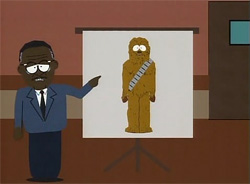
In a jury trial, the Chewbacca defense is a legal strategy in which a criminal defense lawyer tries to confuse the jury rather than refute the case of the prosecutor. It is an intentional distraction or obfuscation. As a Chewbacca defense distracts and misleads, it is an example of a red herring. It is also an example of an irrelevant conclusion, a type of informal fallacy in which one making an argument fails to address the issue in question.^[1][2]^ Often an opposing counsel can legally object to such arguments by declaring them irrelevant, character evidence, or argumentative.
Johnnie Cochran uses the Chewbacca defense against Chef in the South Park episode "Chef Aid".
The name "Chewbacca defense" comes from "Chef Aid", an episode of the American animated series South Park.^[3]^ The episode, which premiered on October 7, 1998, satirizes the O. J. Simpson murder trial, particularly attorney Johnnie Cochran's closing argument for the defense. In the episode, a fictionalized version of Cochran bases his argument on a false premise about the 1983 film Return of the Jedi. He asks the jury why a Wookiee like Chewbacca would want to live on Endor with the much smaller Ewoks when "it does not make sense". He argues that if Chewbacca living on Endor does not make sense—and if even mentioning Chewbacca in the case does not make sense—then the jury must acquit.
What3words (stylized as what3words) is a proprietary^[4]^ geocode system designed to identify any location on the surface of Earth with a resolution of approximately 3 metres (9.8 ft). It is owned by What3words Limited, based in London, England. The system encodes geographic coordinates into three permanently fixed dictionary words. For example, the front door of 10 Downing Street in London is identified by
///slurs.this.shark.^[5]^
Susie Wiles
Chief of Staff to President of the United States
Susan L. Wiles is an American political consultant and lobbyist who has served as the 32nd White House chief of staff since January 2025. Wiles graduated from the University of Maryland, College Park, in 1978 Continued in Wikipedia
The Ruby Ridge standoff was the siege of a cabin occupied by the Weaver family in Boundary County, Idaho, in August 1992. On August 21, deputies of the United States Marshals Service (USMS) came to arrest Randy Weaver under a bench warrant for his failure to appear on federal firearms charges after he was given the wrong court date.^[1]^ The charges stemmed from Weaver's sale of a sawed-off shotgun to an undercover federal informant, who had entrapped him to modify the firearm below the legal barrel length.^[2]^
Operation Northwoods was a proposed false flag operation which originated within the Department of Defense of the US government in 1962. The proposals called for Central Intelligence Agency (CIA) operatives to both stage and commit acts of terrorism against US military and civilian targets, blame them on the Cuban government, and use them to justify a war against Cuba.
Project Mockingbird was a wiretapping operation initiated by United States President John F. Kennedy to identify the sources of government leaks by eavesdropping on the communications of journalists.^[1]^^[2]^
Arthur Schopenhauer (/ˈʃoʊpənhaʊər/ SHOH-pən-how-ər;^[9]^ German: [ˈaʁtuːɐ̯ ˈʃoːpn̩haʊɐ] ^ⓘ^; 22 February 1788 – 21 September 1860) was a German philosopher. He is known for his 1818 work The World as Will and Representation (expanded in 1844), which characterizes the phenomenal world as the manifestation of a blind and irrational noumenal will.^[10]^^[11]^^[12]^ Building on the transcendental idealism of Immanuel Kant, Schopenhauer developed an atheistic metaphysical and ethical system that rejected the contemporaneous ideas of German idealism.^[7]^^[8]^
[...]
Races and religions
Schopenhauer attributed civilizational primacy to the northern "white races" due to their sensitivity and creativity (except for the ancient Egyptians and Hindus, whom he saw as equal):
The highest civilization and culture, apart from the ancient Hindus and Egyptians, are found exclusively among the white races; and even with many dark peoples, the ruling caste or race is fairer in colour than the rest and has, therefore, evidently immigrated, for example, the Brahmans, the Incas, and the rulers of the South Sea Islands. All this is due to the fact that necessity is the mother of invention because those tribes that emigrated early to the north, and there gradually became white, had to develop all their intellectual powers and invent and perfect all the arts in their struggle with need, want and misery, which in their many forms were brought about by the climate. This they had to do in order to make up for the parsimony of nature and out of it all came their high civilization.^[80]^
Schopenhauer was fervently opposed to slavery. Speaking of the treatment of slaves in the slave-holding states of the United States, he condemned "those devils in human form, those bigoted, church-going, strict sabbath-observing scoundrels, especially the Anglican parsons among them" for how they "treat their innocent black brothers who through violence and injustice have fallen into their devil's claws". The slave-holding states of North America, Schopenhauer writes, are a "disgrace to the whole of humanity".^[81]^
Schopenhauer also maintained a marked metaphysical and political anti-Judaism. He argued that Christianity constituted a revolt against what he styled the materialistic basis of Judaism, exhibiting an Indian-influenced ethics reflecting the Aryan-Vedic theme of spiritual self-conquest. He saw this as opposed to the ignorant drive toward earthly utopianism and superficiality of a worldly "Jewish" spirit:
[Judaism] is, therefore, the crudest and poorest of all religions and consists merely in an absurd and revolting theism. It amounts to this that the κύριος ['Lord'], who has created the world, desires to be worshipped and adored; and so above all he is jealous, is envious of his colleagues, of all the other gods; if sacrifices are made to them he is furious and his Jews have a bad time ... It is most deplorable that this religion has become the basis of the prevailing religion of Europe; for it is a religion without any metaphysical tendency. While all other religions endeavor to explain to the people by symbols the metaphysical significance of life, the religion of the Jews is entirely immanent and furnishes nothing but a mere war-cry in the struggle with other nations.^[82]^
Women
In his 1851 essay "On Women", Schopenhauer expressed opposition to what he called "Teutonico-Christian stupidity" of "reflexive, unexamined reverence for the female (abgeschmackten Weiberveneration)".^[83]^ He wrote: "Women are directly fitted for acting as the nurses and teachers of our early childhood by the fact that they are themselves childish, frivolous and short-sighted; in a word, they are big children all their life long—a kind of intermediate stage between the child and the full-grown man." He opined that women are deficient in artistic faculties and sense of justice, and expressed his opposition to monogamy.^[84]^ He claimed that "woman is by nature meant to obey". The essay does give some compliments: "women are decidedly more sober in their judgment than [men] are", and are more sympathetic to the suffering of others.
Schopenhauer's writings influenced many, from Friedrich Nietzsche to nineteenth-century feminists,^[85]^ and continue to inspire sexist views today. His biological analysis of the difference between the sexes, and their separate roles in the struggle for survival and reproduction, anticipates some of the claims that were later ventured by sociobiologists and evolutionary psychologists.^[86]^
When the elderly Schopenhauer sat for a sculpture portrait by the Prussian sculptor Elisabet Ney in 1859, he was much impressed by the young woman's wit and independence, as well as by her skill as a visual artist.^[87]^ After his time with Ney, he told Richard Wagner's friend Malwida von Meysenbug: "I have not yet spoken my last word about women. I believe that if a woman succeeds in withdrawing from the mass, or rather raising herself above the mass, she grows ceaselessly and more than a man."^[88]^
Pederasty
In the third, expanded edition of The World as Will and Representation (1859), Schopenhauer added an appendix to his chapter on the Metaphysics of Sexual Love. He wrote that pederasty has the benefit of preventing ill-begotten children. Concerning this, he stated that "the vice we are considering appears to work directly against the aims and ends of nature, and that in a matter that is all important and of the greatest concern to her it must in fact serve these very aims, although only indirectly, as a means for preventing greater evils."^[89]^ Schopenhauer ends the appendix with the statement that "by expounding these paradoxical ideas, I wanted to grant to the professors of philosophy a small favour. I have done so by giving them the opportunity of slandering me by saying that I defend and commend pederasty."^[90]^
Heredity and eugenics
Schopenhauer at age 58 on 16 May 1846
Schopenhauer viewed personality and intellect as inherited. He quotes Horace's saying, "From the brave and good are the brave descended" (Odes, iv, 4, 29) and Shakespeare's line from Cymbeline, "Cowards father cowards, and base things sire base" (IV, 2) to reinforce his hereditarian argument.^[91]^ Mechanistically, Schopenhauer believed that a person inherits his intellect through his mother, and personal character through the father.^[92]^ This belief in heritability of traits informed Schopenhauer's view of love—placing it at the highest level of importance. For Schopenhauer the "final aim of all love intrigues, be they comic or tragic, is really of more importance than all other ends in human life. What it all turns upon is nothing less than the composition of the next generation. ... It is not the weal or woe of any one individual, but that of the human race to come, which is here at stake." This view of the importance for the species of whom we choose to love was reflected in his views on eugenics or good breeding. Here Schopenhauer wrote:
With our knowledge of the complete unalterability both of character and of mental faculties, we are led to the view that a real and thorough improvement of the human race might be reached not so much from outside as from within, not so much by theory and instruction as rather by the path of generation. Plato had something of the kind in mind when, in the fifth book of his Republic, he explained his plan for increasing and improving his warrior caste. If we could castrate all scoundrels and stick all stupid geese in a convent, and give men of noble character a whole harem, and procure men, and indeed thorough men, for all girls of intellect and understanding, then a generation would soon arise which would produce a better age than that of Pericles.^[93]^
In another context, Schopenhauer reiterated his eugenic thesis: "If you want Utopian plans, I would say: the only solution to the problem is the despotism of the wise and noble members of a genuine aristocracy, a genuine nobility, achieved by mating the most magnanimous men with the cleverest and most gifted women. This proposal constitutes my Utopia and my Platonic Republic."^[94]^ Analysts (e.g., Keith Ansell-Pearson) have suggested that Schopenhauer's anti-egalitarianist sentiment and his support for eugenics influenced the neo-aristocratic philosophy of Friedrich Nietzsche, who initially considered Schopenhauer his mentor.^[95]^
PSA:
PET is a common imaging technique, a medical scintillography technique used in nuclear medicine. A radiopharmaceutical—a radioisotope attached to a drug—is injected into the body as a tracer. When the radiopharmaceutical undergoes beta plus decay, a positron is emitted, and when the positron interacts with an ordinary electron, the two particles annihilate and two gamma rays are emitted in opposite directions.^[6]^ These gamma rays are detected by two gamma cameras to form a three-dimensional image.

This picture of the dramatic nebula around the bright red supergiant star Betelgeuse was created from images taken with the VISIR infrared camera on ESO’s Very Large Telescope (VLT). This structure, resembling flames emanating from the star, forms because the behemoth is shedding its material into space. The earlier NACO observations of the plumes are reproduced in the central disc. The small red circle in the middle has a diameter about four and half times that of the Earth’s orbit and represents the location of Betelgeuse’s visible surface. The black disc corresponds to a very bright part of the image that was masked to allow the fainter nebula to be seen.
Space time is so strange. If it has "happened already," but the change hasn't propagated to us yet by the speed of light, has it really "already happened" in any actual way?
view more: next ›