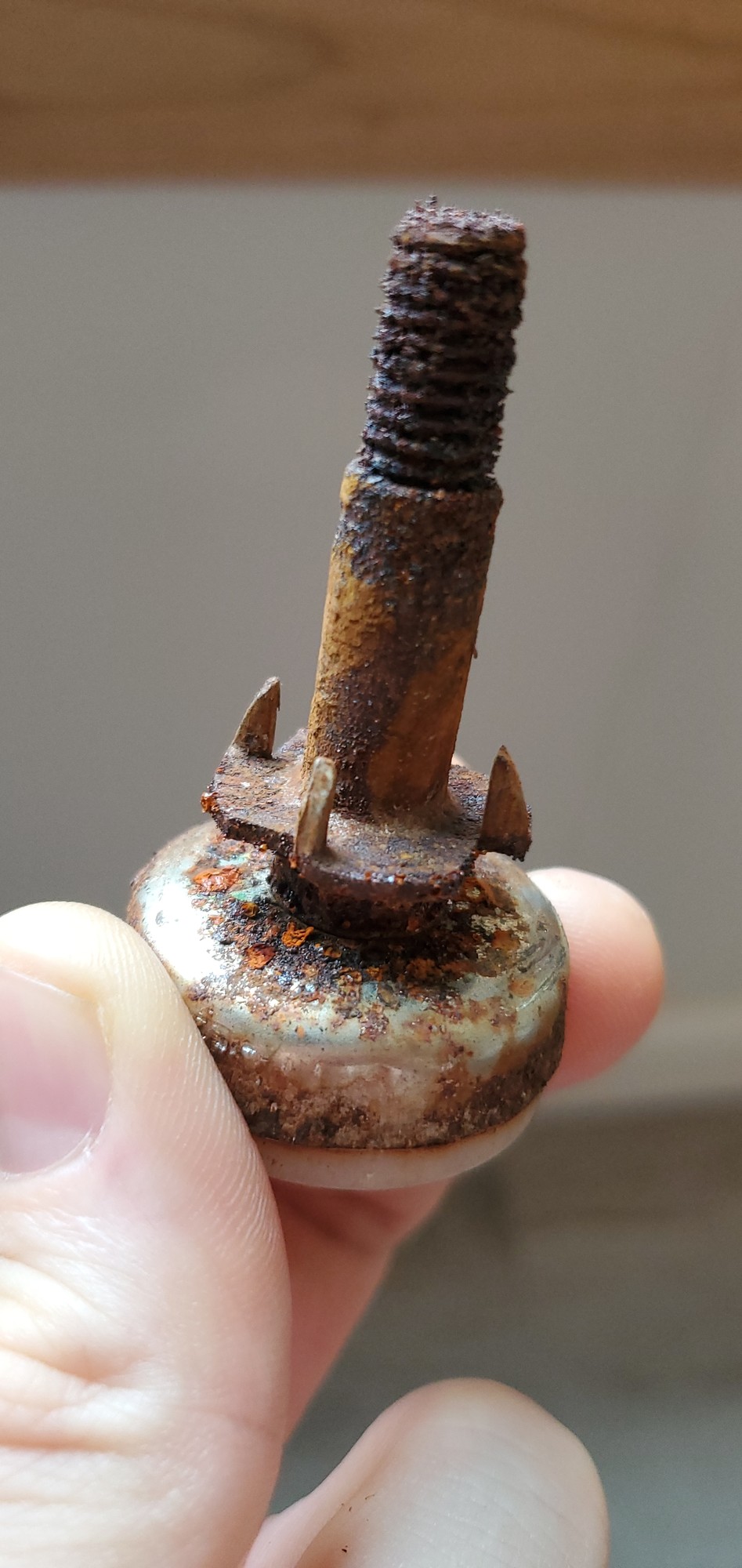
Einschlaghülse
A handmade home for woodworkers and admirers of woodworkers. Our community icon is submitted by @inquanto@lemmy.world, winner of the Christmas 2025 gift contest with a lovely series of hardwood cutting boards.
Einschlaghülse
I think what you've got there is a threaded foot of some kind threaded into a very rusty T nut.
The way this would have been installed is, you drill the pilot hole the OD of the shank of the T nut, hammer the T nut into place, and then thread the foot in. I'll bet if you're in North America those threads will be 1/4-20.
Paige, no!
"Sounding" refers to the sound you'll make when you pop that sucker in
Tetanus
Tetanus
Tetanus
Omg just take the vaccine.
Self-sealing Stem Bolt.
Not a reverse-ratcheting router?
You're thinking about the sonic screwdriver.
Shrapnel, or anti-civilian caltrop.
Too small to damage thick tires or treads. Too rust-prone and prone to binding for their marketted purpose, even in disposable furniture. Sub-in a Nylon sleeve, lock-nut and stainless bolt though...
EDIT: bolded, for the 13 functionally illiterate here. OP's question was answered "properly" before I made this comment. Ingrates.
These are designed to fall out when you’re moving a cheap piece of furniture too many times. They always land spikes up for when you inevitably step on it while rushing to finish up and leave.
They’re like Lego… with tetanus.
You’re supposed to lift something off the ground instead of dragging it. That applies to cheap or expensive furniture, or anything really.
Not if you know what you're doing(invest in some felt pads or sliders, for starters); Seriously, you just defined one of the defining features of disposable versus furniture, and pretending price-at-retail defines it will only lead to tears.
There's also a big difference between re-arranging a single room versus moving through doorways and stairs; housekeepers can move/shift/tilt furniture to clean under it, but aren't expected to lift it.
Among the many obvious steps-up from this product are swivel-casters. Even just using shims for height and levelling-adjustment at least won't damage the furniture if its designed and built right.
Adding swivel casters to furniture doesn’t change that pushing on its side isn’t something it’s ever designed for. The furniture or item needs to designed and built from the ground up with side forces in mind. Which they usually never need to be designed for, so it’s a waste of time, engineering and material to do so. Now obviously “movable” furnitures and items should have that as a basic design. Which is why they cost factors more.
You’re still doing damage, even if it’s not visible.
Maybe the reason why cheap stuff gets broken so easy is because people like you tell them they can do it? Instead of explaining why it doesn’t matter how easy you make it, it’s still the wrong way and damaging it.
Never seen flush-mounted swivel-casters I take it? Honestly belive baroque-era fainting couches and furniture-in-general, the stuff with curved legs at every-which-angle wasn't designed for and couldn't take side-loading?
It's really weird how y'all keep talking at me like this stuff isn't solved problems in these days of engineered wood, carbon-fiber, and even just fiber-glass-or-bake-lite with a little pot-metal thrown in. The fact you can handle disposable furniture like a museum piece in order to beg it to last longer like a patched-up blow-up-doll-as-idol doesn't change what it is; Hopefully soon to be a regrettable foot-note in history.
Chuck it in a closet and bring it out for parades if you love it so much, but don't pretend the rest of us "just don't get it", or its better than the drag-queens' paper-mache dildo float. Both have their place of course, but a prime spot in a dining room, kitchen or living-room ain't it.
No, if you’re using sliders you’re just lazy and cheap. You always lift something to move it. Even if it’s a couple feet.
Sliders can still get debris or slide on the floor scratching it, no company worth their salt uses them. Since it’s damaging to the floor and the equipment or furniture or whatever you’re moving.
Just because you CAN do something, doesn’t mean you should or it’s a smart thing to do. Most stuff isn’t designed to have lateral force applied to it, so to do so, even with sliders, will damage it. If you lift and move cheap furniture instead of sliding it, it won’t break the first time you move it lmfao.
Talking at me like I don't own and use a shoulder-dolley and furniture dolleys, but no, I'm not a professional mover; My ideals are literally anti-thetical to the need for such. Speaking of things furniture wasn't designed for, have you seen the size of people these days?
Doesn't change the fact that the screw-adjust feet you drive-into wood with a hammer, as shown in OP, are the wrong solution for just-about all of the furniture they are found in.
There are sturdier versions out there, as I mentioned in my first comment, and rust-flakes will tear-up a floor.
Now, if you know enough to be so concerned for floors, are you aware you can get felt-pads large-enough to slide the furniture across, rather than sliding the pad across the floor? The furniture I really like is too heavy to lift in one piece anyways, more like a built-in once its situated.
It’s a rusty cabinet handle mate.
How the hell did this claptrap get 3 upvotes?
How did your comment even receive a single one?
Adding a line about furniture after the fact is just sleazy as shit dude. You were wrong, and are now trying to swing it as some stupid joke that’s not even remotely funny.
Nothing in those two paragraphs was added "after the fact", dude - I just went back and bolded the bit that should have caught-up people who took the (actually also true)joke as my entire understanding.
The Nylon sleeve and "rust-prone" bits were un-related to the joke and only applicable to the adjustable foot's intended-use as well; Y'all are just stupid and blind.
It's a leveling foot for a table or cabinet.
Ah, that makes more sense actually, good call. I thought the white was ivory for decoration, but probably teflon.
It's two parts.
The sleeve with the teeth and the adjustable foot. The sleeve is called a captive hammer-in nut, or a blind T-nut.
Like this one: https://deltafix.com/en/product/70936/
So if I'm understanding it correctly, someone would drill a hole in the wood, line up the spiky bit, and then hammer it in. Going by the comments, it sounds like these things fall out a lot. What is the recommended alternative?
What is the recommended alternative?
There are other styles of threaded inserts for wood.


I used some of the first type to make leg extensions for an IKEA coffee table to turn it into a waist-height table. They were picked mostly to match what the piece already used rather than because I thought they were better than the T-nut style ones, but they worked fine.
Normally the weight of the item they're attached to will keep them in place. I suppose you could glue it in place.
It's not that bad, when used correctly they stay put a long time.
When I design furniture that needs one, I usually design it so the t-nut goes in from the other side so the screw secures it in, but honestly unless the wood gets wet, the t-nut will hold fine.
There are similar t-nuts with tiny screws instead of hammer in options. You can chisel out the wood and epoxy in a hex nut. You can just screw the leveling foot directly into the wood. You can put a larger metal plate in place.
But if the wood fails and the t-nut falls out, you can also just repair the wood or epoxy it back in and it'll hold for another few decades.
Most wood furniture won't last forever without repairs anyway, the fixes over the years are part of the charm.
Aren’t these used for adjustability? Meaning you can loosen or tighten them to deal with unevenness?
And if that’s the case, wouldn’t reversing the t nut result in the weight of the furniture pushing the t nut out of place?
You can use t-nuts for a lot of reasons. A t-nut specifically is for screwing machine screws into wood. This particular use case is using that machine screw as a leveler, but it's not the only case.
Sometimes you just want a large, solid bolt to hold things together, but allow them to be taken apart. In those cases I try to put the t-nut the other way around so assembly tightens the nut.
When I design furniture that needs one, I usually design it so the t-nut goes in from the other side so the screw secures it in,
I'm confused - it seems like thats what would happen here? The foot would push the T nut into the wood from below?
Think about what would happen if you just pulled on the foot. The T-nut would come right out.
Compare that to how you would typically use a normal nut and bolt to secure two pieces of material, with the bolt head and nut on opposite sides of the material being secured.
Sure, but wouldnt the normal pressure of the floor pressing into the foot then immediately pop the t nut out of the top of the wood you nailed it into?
Well yeah, but you wouldn't use it that way for an adjustable foot -- that's a weird special case where the bolt is in compression. Normally the bolt is in tension, and that's when you'd want the T-nut on the opposite side of the wood.
It depends what you use them for. If you arange them so the force on the bolt is driving the spikes into the wood, they are very strong, and a handy way to anchor a bolt into wood in a removable way. Where they're not so good is when the force isn't directly along that line. Sideways force tends to loosen them and then they fall off, and force in the opposite direction obviously pushes them out.
That's called a T-nut.

Interesting I thought T-nuts were used on aluminium profiles
Same name, two different types of nuts. (Actually, there are several profiles for t-nuts used with extruded aluminum that I am aware of.)
I used these yesterday for adjustable legs on customers' bathroom counter.