this post was submitted on 09 Jul 2026
327 points (97.7% liked)
Science Memes
20725 readers
252 users here now
Welcome to c/science_memes @ Mander.xyz!
A place for majestic STEMLORD peacocking, as well as memes about the realities of working in a lab.
Rules
- Don't throw mud. Behave like an intellectual and remember the human.
- Keep it rooted (on topic).
- No spam.
- Infographics welcome, get schooled.
Research Committee
Other Mander Communities
Science and Research
Biology and Life Sciences
- !abiogenesis@mander.xyz
- !animal-behavior@mander.xyz
- !anthropology@mander.xyz
- !arachnology@mander.xyz
- !balconygardening@slrpnk.net
- !biodiversity@mander.xyz
- !biology@mander.xyz
- !biophysics@mander.xyz
- !botany@mander.xyz
- !ecology@mander.xyz
- !entomology@mander.xyz
- !fermentation@mander.xyz
- !herpetology@mander.xyz
- !houseplants@mander.xyz
- !medicine@mander.xyz
- !microscopy@mander.xyz
- !mycology@mander.xyz
- !nudibranchs@mander.xyz
- !nutrition@mander.xyz
- !palaeoecology@mander.xyz
- !palaeontology@mander.xyz
- !photosynthesis@mander.xyz
- !plantid@mander.xyz
- !plants@mander.xyz
- !reptiles and amphibians@mander.xyz
Physical Sciences
- !astronomy@mander.xyz
- !chemistry@mander.xyz
- !earthscience@mander.xyz
- !geography@mander.xyz
- !geospatial@mander.xyz
- !nuclear@mander.xyz
- !physics@mander.xyz
- !quantum-computing@mander.xyz
- !spectroscopy@mander.xyz
Humanities and Social Sciences
Practical and Applied Sciences
- !exercise-and sports-science@mander.xyz
- !gardening@mander.xyz
- !self sufficiency@mander.xyz
- !soilscience@slrpnk.net
- !terrariums@mander.xyz
- !timelapse@mander.xyz
Memes
Miscellaneous
founded 3 years ago
MODERATORS
you are viewing a single comment's thread
view the rest of the comments
view the rest of the comments
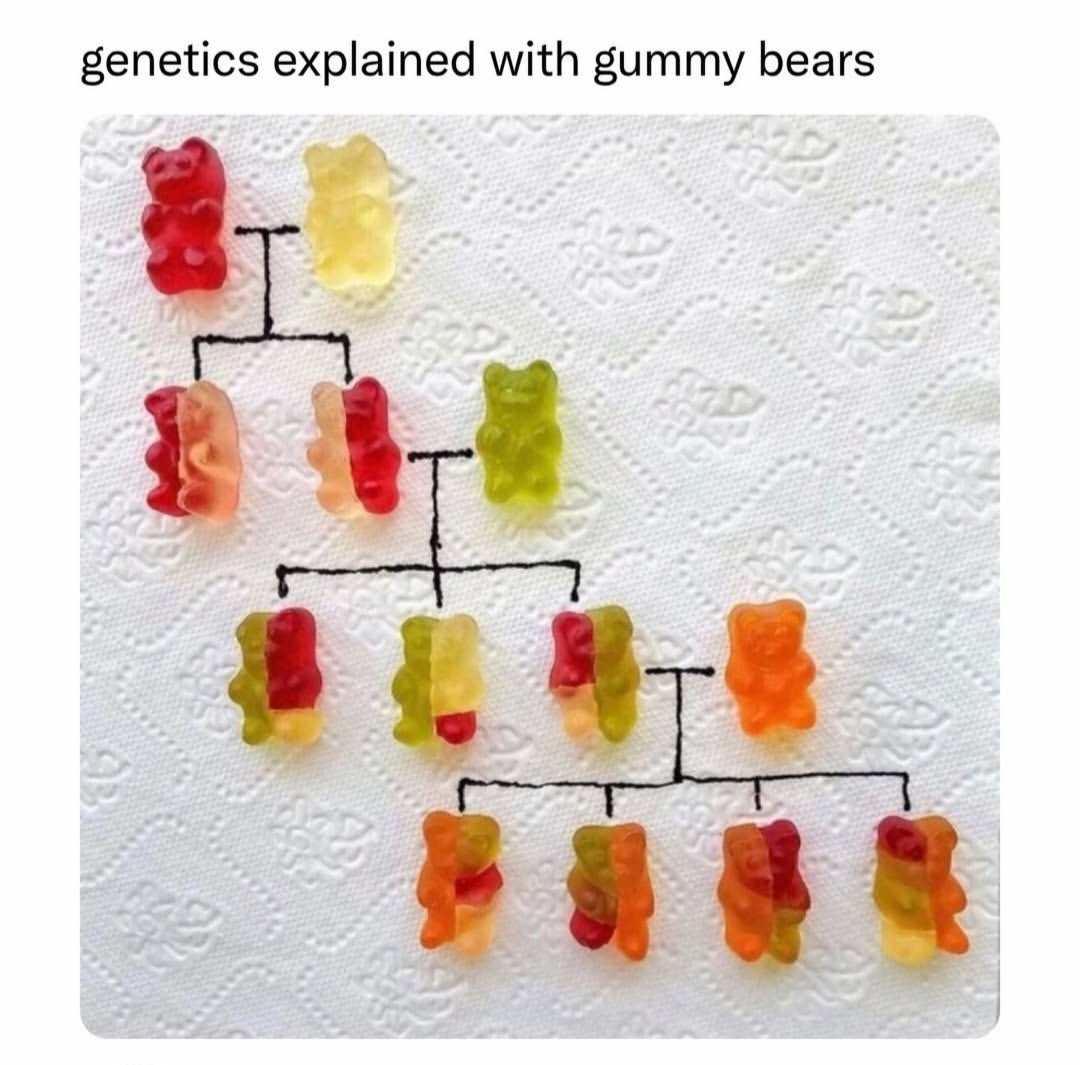
It gets the point across well enough, but there are some issues if you get deeper with it.
First, the colors would swap back and forth much more often, blurring together into a single color at this scale, much like how small alternating black and white dots can be used to make us see a gray color. We can get around that issue by assuming that they're just organized into groups by parent of origin, rather than being actual representation of the exact DNA order, though.
Next, the proportion of colors is off, especially in the last generation. You'll get different amounts of DNA from one progenitor to another, but it's always pretty close to an equal split halved by generation, so the first 2 bears in the 3rd generation would be much closer to the proportions seen in the 3rd than they really are, and the bears in the 4th generation would all be 1/2 orange, 1/4 green, and 1/8 each of red and yellow.
Finally, the first 2 bears of the 3rd generation seem to have been given the "missing" DNA from their red/yellow parent, with one having mostly red and a little yellow, and the other having mostly yellow with a little red. While this is technically possible, it's no more likely than any other of the near-infinite variations 2 separate siblings could have instead. Someone using this as a way to understand inheritance may get the incorrect notion that one sibling inherits what DNA the previous sibling didn't, when it's instead completely random each time.
Ultimately, this is a good way to introduce the concept of genetics and inheritance to someone who may be having trouble picturing it in their mind, but more information would need to be provided for them to truly understand it.
Luckily enough, I had multiple siblings to reference when this came up in school (<'00), so I only went along with it as "close enough for homework", but knew deep down that it was crayon-box BS. 🤪
sorry, what do you mean by this?
Only that their resemblance to one side of the extended family and mine to the other was enough proof of the gummy bear example to make the concept stick in my mind, accurate or no😉.