UrLogicFails

joined 2 years ago
 

Image Transcription

A small stack of Christmas cards, a small stack of envelopes with the back facing the camera, and a single envelope with the flap facing the camera.

The cards have a round grey cat holding a dead mouse with a red bow on the mouse in the cat's mouth. The cat is standing in front of a gold and dark green striped background. The words "Merry Christmas" are printed on the card in maroon cursive. There is a white border around the edge of the card.

The envelopes have parallel squiggly stripes diagonally covering the envelopes. The stripes are a repeating pattern of thick light green, medium thickness light yellow, thin light red, and medium thickness light yellow again. There is a path of paw-prints walking across the envelope in the same light green as the diagonal stripes.

The envelope with the flap facing the camera is printed with the same pattern and reveals the flap to be a flat-edge flap with rounded corners

I have wanted to send out Christmas cards to my friends for some time, but was never able to get a festive photo to use for such purpose; so this year instead of trying to convince my partner to take the appropriate pictures, I decided to illustrate the card instead.

As for the envelopes, I realized I did not have access to any A6 envelopes and it looked like it would take a long time for them to ship to me. Originally I was going to cut the envelopes out of standard construction paper, but I realized if I made flat-flap envelopes instead of triangular-flap envelopes, I would be able to cut the card out of a single 8.5"x11" sized sheet. With this in mind, I decided to design the envelope myself as well since I could print across the entire envelope area.

The pattern for the card was illustrated in Procreate (but the text was added via Illustrator). The envelope pattern was designed entirely in Illustrator (including the cutting template). The cards and envelopes were printed on card-stock and cut out using my vinyl cutter.
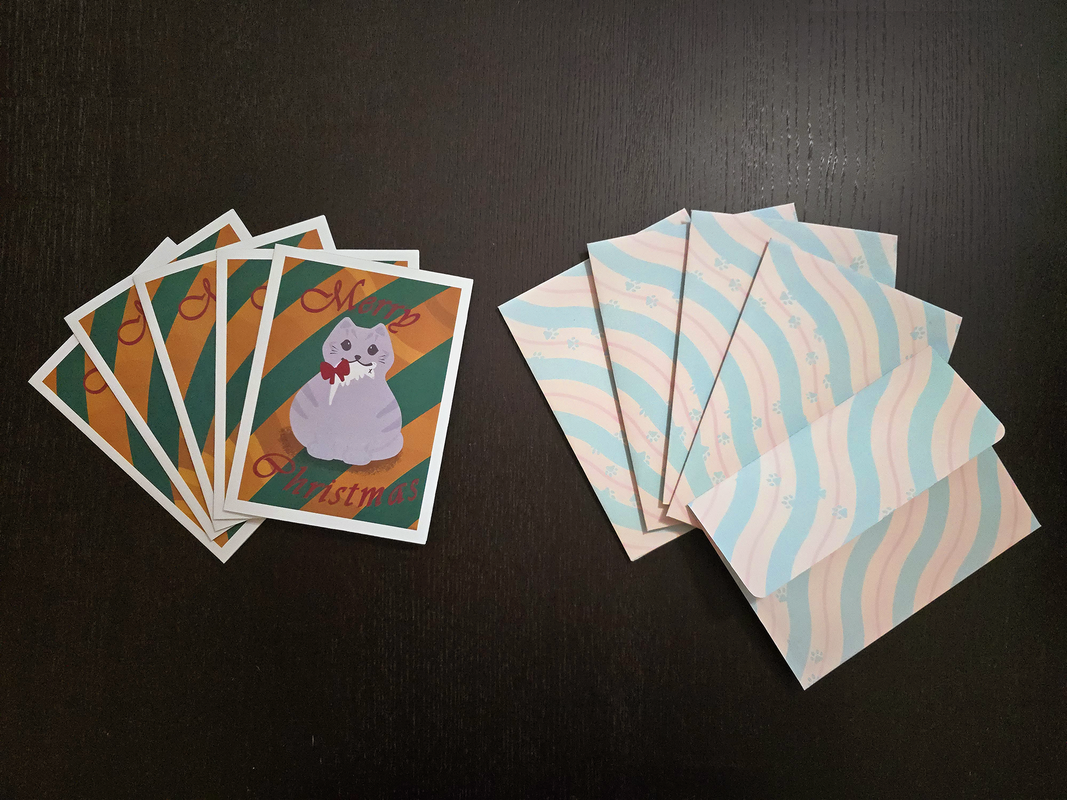
 

Image Transcription

A small stack of Christmas cards, a small stack of envelopes with the back facing the camera, and a single envelope with the flap facing the camera.

The cards have a round grey cat holding a dead mouse with a red bow on the mouse in the cat's mouth. The cat is standing in front of a gold and dark green striped background. The words "Merry Christmas" are printed on the card in maroon cursive. There is a white border around the edge of the card.

The envelopes have parallel squiggly stripes diagonally covering the envelopes. The stripes are a repeating pattern of thick light green, medium thickness light yellow, thin light red, and medium thickness light yellow again. There is a path of paw-prints walking across the envelope in the same light green as the diagonal stripes.

The envelope with the flap facing the camera is printed with the same pattern and reveals the flap to be a flat-edge flap with rounded corners

I have wanted to send out Christmas cards to my friends for some time, but was never able to get a festive photo to use for such purpose; so this year instead of trying to convince my partner to take the appropriate pictures, I decided to illustrate the card instead.

As for the envelopes, I realized I did not have access to any A6 envelopes and it looked like it would take a long time for them to ship to me. Originally I was going to cut the envelopes out of standard construction paper, but I realized if I made flat-flap envelopes instead of triangular-flap envelopes, I would be able to cut the card out of a single 8.5"x11" sized sheet. With this in mind, I decided to design the envelope myself as well since I could print across the entire envelope area.

The pattern for the card was illustrated in Procreate (but the text was added via Illustrator). The envelope pattern was designed entirely in Illustrator (including the cutting template). The cards and envelopes were printed on card-stock and cut out using my vinyl cutter.
 

I've noticed a rise in enamel pins over the past few years and enjoy them as a compact and durable piece of art.

Unfortunately, I don't know how to use the pins I have amassed over the years; hence my question of what you do with your pins.


GIFV TranscriptionA "live" wallpaper featuring one nearby orange planet, one semi-destroyed green planet, and a large grey moon outside a window. They zoom way out then back in closer than they started.

A plain white clock reads out "12:00 Tue, September 24" over the window.

Below that centered above a row of grey app icons is a small sun icon and "33°".

At the bottom of the screen there is a shiny dark computer console styled app dock. The apps in this dock are translucent blue with glowing edges.

The screen is swiped to the side, hiding the clock and weather, and revealing new grey icons. Two icons are then activated to open a dark translucent background over them with additional blue translucent icons contained in the dark background.

The screen is then swiped back to its original position.

I've been watching a lot of Star Trek lately and wanted to make a fun space themed wallpaper (and icon pack) for myself.

For this project, I painted each of the planets and debris on separate layers in Procreate and designed the ship/window wallpaper in Illustrator. While lining up each layer was a pain, having them move independently was crucial to give the wallpaper a sense of depth.

Surprisingly, getting the clock widget and weather widget to look right was much harder than anticipated. I couldn't find any open source customizable clock widgets; and Breezy Weather was not as customizable as I had hoped. In the end I think the results turned out great, though.


Archive.org link

Some key excerpts:

Court filings unsealed last week allege Meta created an internal effort to spy on Snapchat in a secret initiative called “Project Ghostbusters.” Meta did so through Onavo, a Virtual Private Network (VPN) service the company offered between 2016 and 2019 that, ultimately, wasn’t private at all.

It’s Meta’s in-house wiretapping tool to spy on data analytics from Snapchat starting in 2016, later used on YouTube and Amazon. This involved creating “kits” that can be installed on iOS and Android devices, to intercept traffic for certain apps, according to the filings. This was described as a “man-in-the-middle” approach to get data on Facebook’s rivals, but users of Onavo were the “men in the middle.”

Facebook ultimately shut down Onavo in 2019 after Apple booted the VPN from its app store.

Prosecutors also allege that Facebook violated the United States Wiretap Act, which prohibits the intentional procurement of another person’s electronic communications. Onavo could also be considered straight spyware, but also seems to fall under the definition of wiretapping, according to prosecutors.

The court filings show chats and emails that depict Zuckerberg as being directly involved in these communications.

Prosecutors allege Project Ghostbusters harmed competition in the ad industry, adding weight to their central argument that Meta is a monopoly in social media.


Image transcription: A blue stylized shirt with the logo of The Wash from SpongeBob, a sticker of a squashed Plankton, a sticker resembling Squidward's "I really wish I weren't here right now" pin, a sticker resembling Mr. Krabs' mom's underwear, a keychain of Mr. Krabs, SpongeBob, and Patrick playing D&D, a BFF ring (which I didn't make), and a Chum Bucket bucket to hold everything.

[–] UrLogicFails@beehaw.org 1 points 2 years ago (4 children)

I've never been one to play competitive online games since I have the hand/ eye coordination of a house plant, so I can't weigh in on the advantages of blocking controllers that are "unfair"; but as someone who hated button mashing "A" in Animal Crossing, I can say that custom controllers can definitely have a place with a console.

In my opinion, this feels like Microsoft simply wanted more licensing money and is doing it under the guise of fair online play. It reminds me of Apple locking faster charging and data transfer on USB-C to their own proprietary USB cables.

Hopefully this does not negatively affect too many people.


Archive link: https://archive.ph/ajgMB

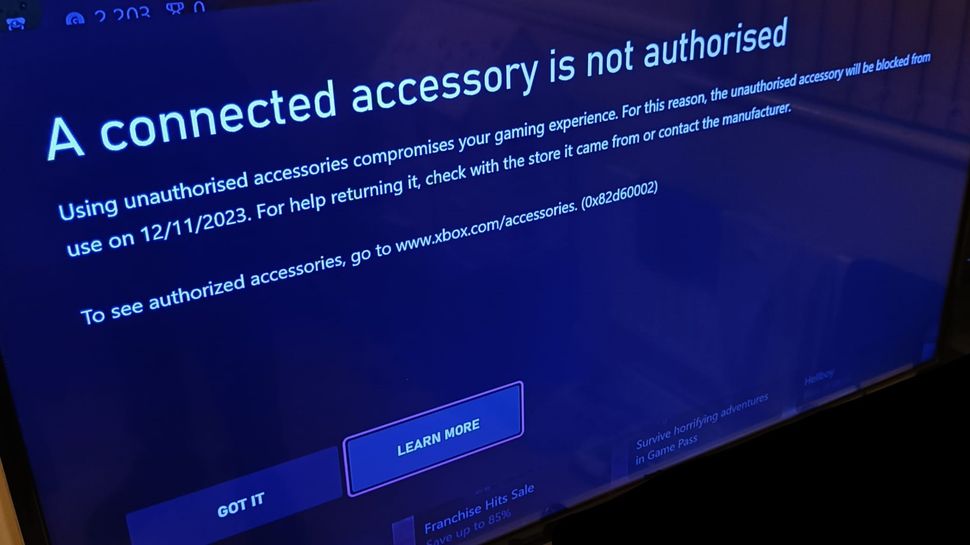
Xbox has taken a definitive stance by instituting a new policy that will block the use of unauthorized accessories with its consoles, effective as of November 17.

This decision has already begun to reverberate amongst the gaming community, and many have already had a warning about it on their consoles in the form of error message 0x82d60002.

Error message shown on Xboc console when plugging in accessory (Image credit: Future)

It's a big shift that's going to impact all those accessories that don't have the Xbox seal of approval. Made more apparent by Xbox redirecting the user to its own official storefront.

Our sources indicate that Microsoft is lifting restrictions on the ability for third-party hardware manufacturers to build wireless accessories for Xbox Series X|S devices.

Now, we're hearing that Microsoft does have an approval process for official third-party wireless controllers, and this new restriction may be a result of new security measures to put restrictions on inputs that could circumvent play or inject unfair advantages.

The downside, of course, is that Xbox's new policy is affecting many "fair" accessories, particularly in the case of fighting game joysticks and other similar accessories.

The problem seems to revolve around brands that haven't acquired this licensing but still market their products as compatible with Xbox. It appears that Microsoft is actively blocking these items.


Archive link

As the sheer quantity of clothing available to the average American has grown over the past few decades, everything feels at least a little bit flimsier than it used to.

The most obvious indication of these changes is printed on a garment’s fiber-content tag. Knits used to be made entirely from natural fibers. These fibers usually came from shearing sheep, goats, alpacas, and other animals. Sometimes, plant-derived fibers such as cotton or linen were blended in. Now, according to Imran Islam, a textile-science professor and knit expert at the Fashion Institute of Technology in New York, the overwhelming majority of yarn used in mass-market knitwear is blended with some type of plastic.

Knits made with synthetic fiber are cheaper to produce. They can be spun up in astronomical quantities to meet the sudden whims of clothing manufacturers—there’s no waiting for whole flocks of sheep to get fluffy enough to hand shear. They also usually can be tossed in your washing machine with everything else. But by virtually every measure, synthetic fabrics are far inferior. They pill quickly, sometimes look fake, shed microplastics, and don’t perform as well as wool when worn. Sweaters are functional garments, not just fashionable ones. Wool keeps its wearer warm without steaming them like a baked potato wrapped in foil. Its fibers are hygroscopic and hydrophobic, which means they draw moisture to their center and leave the surface dry. A wool sweater can absorb a lot of water from the air around it before it feels wet or cold to the touch

A significant amount of polyamide or acrylic is now common in sweaters with four-digit price tags. A $3,200 Gucci “wool cardigan,” for example, is actually half polyamide when you read the fine print. Cheaper materials have crept into the fashion industry’s output gradually, as more and more customers have become inured to them. In the beginning, these changes were motivated primarily by the price pressures of fast fashion, Islam said: As low-end brands have created global networks that pump out extremely cheap, disposable clothing, more premium brands have attempted to keep up with the frenetic pace while still maximizing profits, which means cutting costs and cutting corners. Islam estimates that a pound of sheep’s wool as a raw material might cost from $1.50 to $2. A pound of cashmere might cost anywhere from $10 to $15. A pound of acrylic, meanwhile, can be had for less than $1.

This race to the bottom had been going on for years, but it accelerated considerably in 2005, Sofi Thanhauser, the author of Worn: A People’s History of Clothing, told me. That year was the end of the Multifiber Arrangement, a trade agreement that had for three decades capped imports of textile products and yarn into the United States, Canada, and the European Union from developing countries. Once Western retailers no longer had meaningful restrictions on where they could source their garments from, many of them went shopping for the cheapest inventory possible.


I'm not sure if this is technically Technology news, but I can remove this post if it's in the wrong community

Archive link: http://archive.today/3XM6s

Musk brought up the idea of charging all users of X/Twitter during a wide-ranging conversation focused on AI that featured Israeli Prime Minister Benjamin Netanyahu on Monday. “[We’re] moving to a small monthly payment for use of the X system,” Musk told Netanyahu, claiming that it is the only way to eliminate the problem of bots, as reported by Bloomberg’s Dave Lee.

Musk didn’t mention timing of his plan to charge X/Twitter users, nor did he say how much it would cost.

Musk, who also is CEO of Tesla and SpaceX, has said X/Twitter ad sales have plunged 50% since he bought the company. “We’re still negative cash flow, due to ~50% drop in advertising revenue plus heavy debt load,” Musk posted on July 15.


Great Scott! Back to the Future is coming to PowerWash Simulator! We'd love to reveal more but we don't want to disrupt the space-time continuum. 💦

[–] UrLogicFails@beehaw.org 0 points 2 years ago

Video games are a very interesting medium to me, when it comes to preservation. With movies, TV, Books, and Music, it is very easy and convenient to experience older content. CDs, DVDs, Bluerays, etc are very easy to play on almost any hardware (if you've invested heavily in Laser Disk, I have some bad news for you, though). Meanwhile any game ever made is largely trapped on the console it was designed for. If I want to show someone Casablanca, I can easily show them; but if I want to show them Ocarina of Time, I would need to have a 30 year old console if you believe Nintendo. This, to me, is absurd since A) Nintendo doesn't make any money even if I do buy the N64 cart, and B) I would need to buy and maintain every console that has a game with any cultural relevance for the foreseeable future.

Emulation is a very useful tool for game preservation. I've heard Nintendo is actually very good internally at game preservation and has original source code from every game they've ever made; but that doesn't do a lot of good when older generation games are left in the Nintendo vault. I wouldn't have a problem with Nintendo being so staunchly anti-emulation if they actually made their older games available, but if you ever want to play games like Chibi-Robo you either need to be OK shelling out ~180 USD for the game and ~80USD for the GameCube, or emulate it