this post was submitted on 24 Apr 2025
21 points (100.0% liked)

Linux

13283 readers
390 users here now

A community for everything relating to the GNU/Linux operating system (except the memes!)

Also, check out:

Original icon base courtesy of lewing@isc.tamu.edu and The GIMP

founded 2 years ago
MODERATORS
 

cross-posted from: https://rss.ponder.cat/post/165736

Lenovo Cuts the Windows Tax and offers Cheaper Laptops with Linux Pre-installed

At least in the U.S. and Canada, that is.

This was brought to my attention thanks to a Reddit post where a user (presumably a resident of Canada), had posted how Lenovo was shipping laptops with Fedora and Ubuntu at a cheaper price compared to their Windows-equipped counterparts.

Others then chimed in, saying that Lenovo has been doing this since at least 2020 and that the big price difference shows how ridiculous Windows' pricing is.

Cutting the Windows Tax

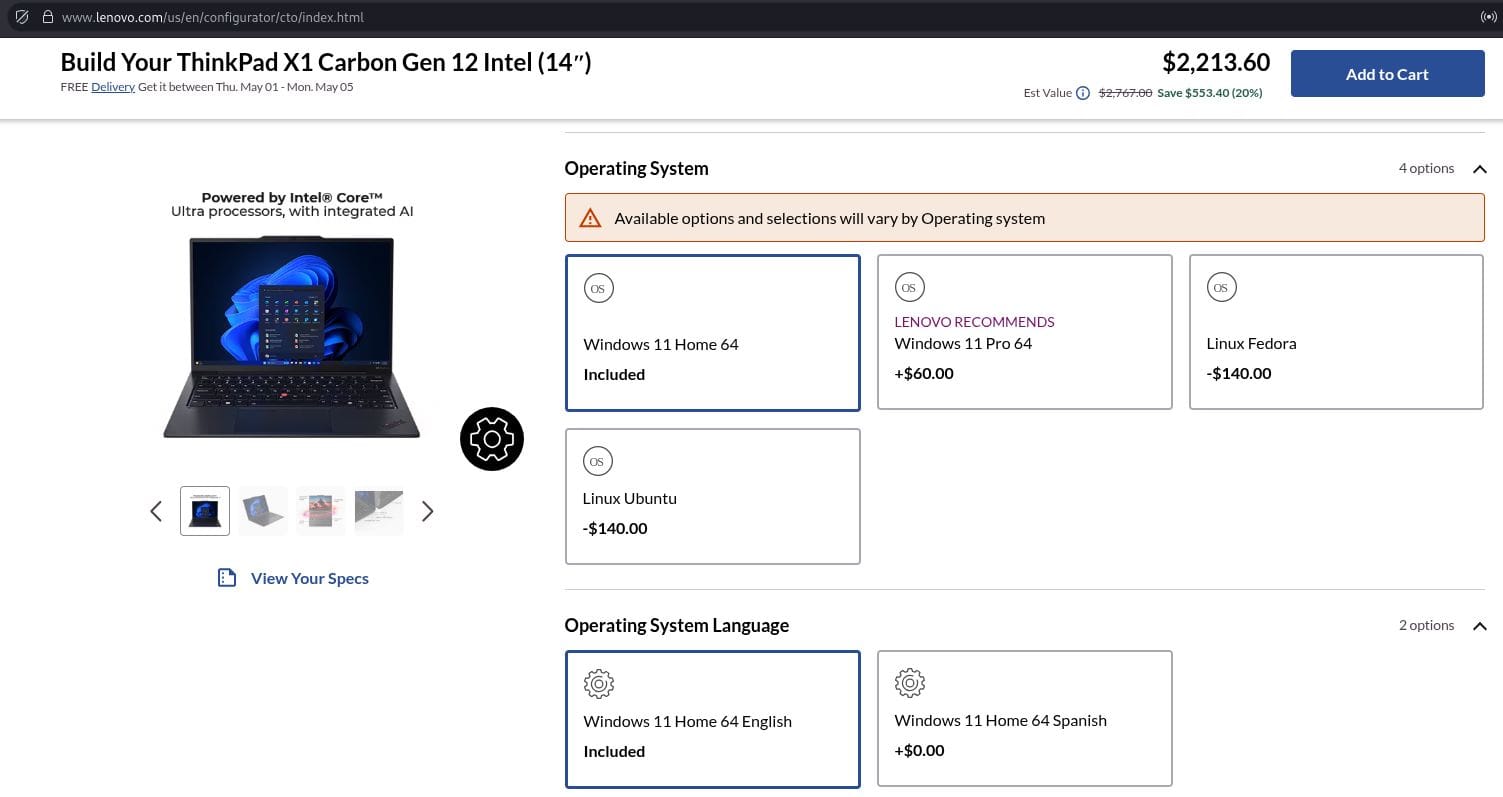
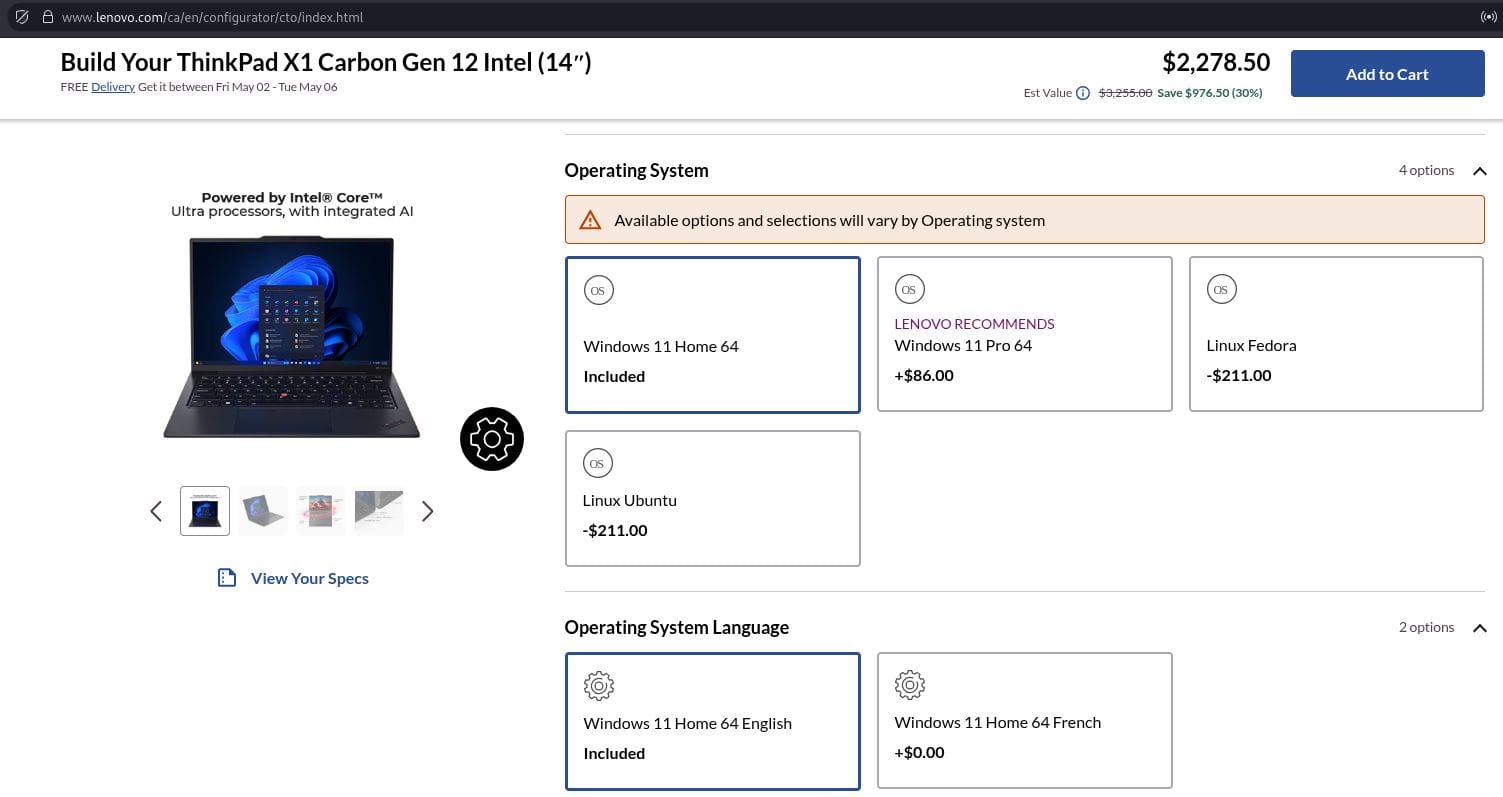
When I dug in further, I found out that the US and Canadian websites for Lenovo offered U.S. $140 and CAD $211 off on the same ThinkPad X1 Carbon model when choosing any one of the Linux-based alternatives.

Lenovo Cuts the Windows Tax and offers Cheaper Laptops with Linux Pre-installedLenovo Cuts the Windows Tax and offers Cheaper Laptops with Linux Pre-installed

US pricing on left, Canadian pricing on right.

Interestingly, while the difference in pricing is noticeable, your mileage may vary if you are looking for such laptops on the official website. Not all models from their laptop lineup, like ThinkPad, Yoga, Legion, LOQ, etc., feature an option to get Linux pre-installed during the checkout process.

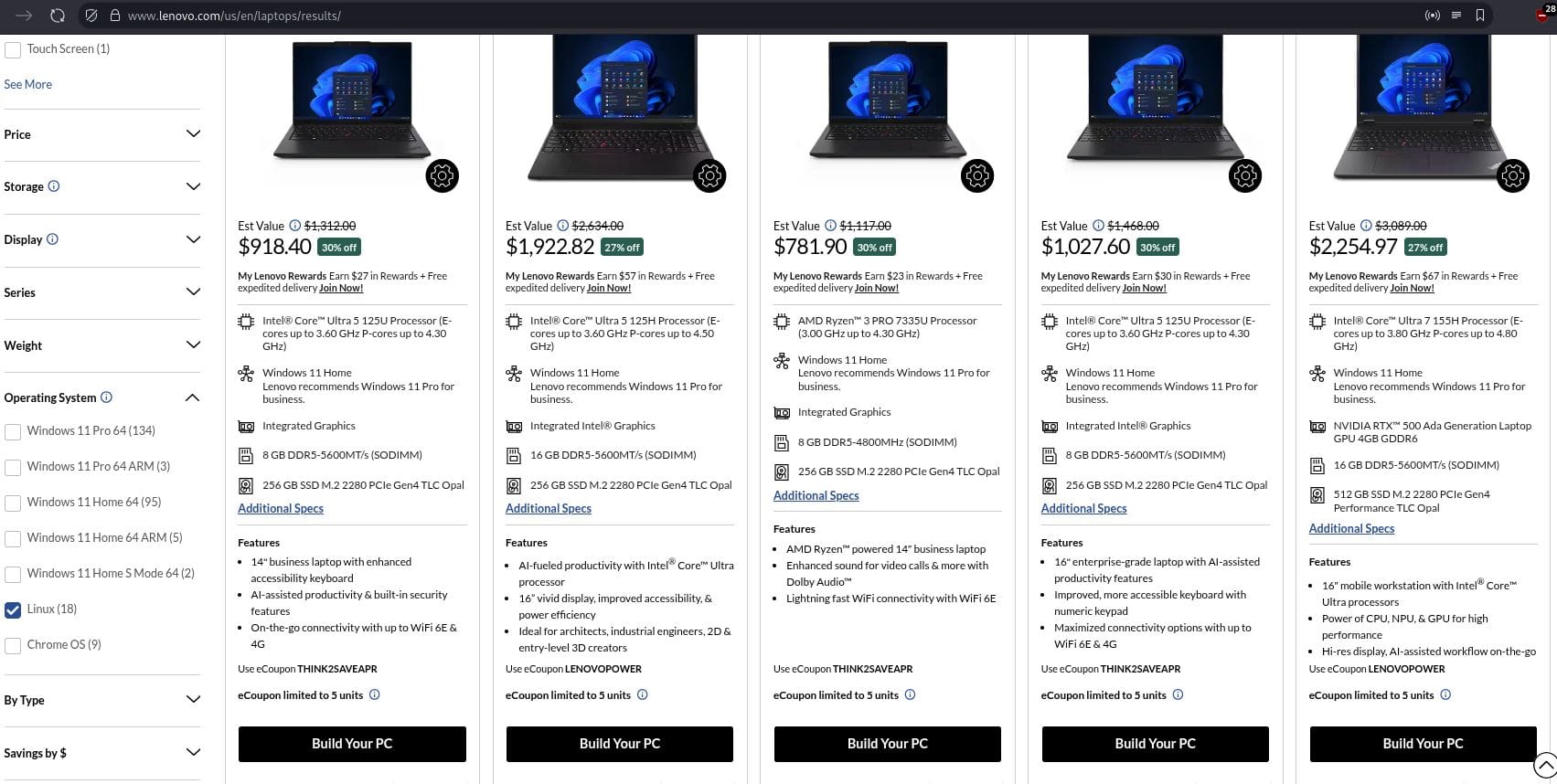
Luckily, there is an easy way to filter through the numerous laptops. Just go to the laptops section (U.S.) on the Lenovo website and turn on the "Operating System" filter under the Filter by specs sidebar menu.

Lenovo Cuts the Windows Tax and offers Cheaper Laptops with Linux Pre-installed

Yes, it's as simple as that. You can do the same for the various official online regional storefronts that Lenovo runs to see whether Linux-based operating systems are being offered on their laptops in your country.

Closing Thoughts

It is good to see that Lenovo is offering Linux in its laptops. In fact, there is another big-name laptop manufacturer, Dell, who also does something similar with its Ubuntu-certified laptops, but both have the same constraint of having limited options for buyers.

Also, as far as I know, Dell doesn't reduce the pricing if you choose Linux instead of Windows. Correct me if I am wrong in the comments.

Nonetheless, I think these manufacturers could do a better job in marketing these Linux-based alternative operating systems to general consumers, showing them how they can save big when opting for these instead of the pricey and bloated Windows.

Otherwise, we might have to start observing Windows Refund Day again.

💬 Your take on this? Would mainstream users benefit from having Linux pre-installed on their laptops?
From It's FOSS News via this RSS feed

all 42 comments
sorted by: hot top controversial new old
[–] hperrin@lemmy.ca 6 points 11 months ago (1 children)

This is awesome and I love it. Maybe they could even take a few more dollars off by not having any OS installed (bypassing the labor costs of imaging an SSD). I’ll be installing my own copy anyway, so I’m fine with a blank SSD.

[–] Successful_Try543@feddit.org 3 points 11 months ago (1 children)

Those manufacturers where you can select either Linux or no OS don't charge extra for Linux.

[–] hperrin@lemmy.ca 1 points 11 months ago (2 children)

I mean it’s like maybe a dollar or two for the labor costs, so that’s understandable. I’d still prefer just a blank SSD anyway.

[–] Ptsf@lemmy.world 3 points 11 months ago (1 children)

It's likely done in an automated way by the same equipment that tests the hardware, so costs are probably more along the lines of a few fractions of a penny, and imo shipping any device without an os at all is a bit silly as they could very likely end up in the hands of someone without the capability or equipment to image them.

[–] Tenderizer78@lemmy.ml 2 points 4 months ago

It would probably cost more to deal with the complaints that arise than they'd save on labor installing Ubuntu or Fedora.

[–] Whirlybird@aussie.zone 0 points 11 months ago (1 children)

For someone that wants to install their own OS, it coming with an OS installed by default is 100% irrelevant because you’d be plugging in a bootable drive on first boot up anyway.

[–] Prime@lemmy.sdf.org 0 points 11 months ago (1 children)

No. If it does not work you can't be sure if it is your fault or the device is broken. This will lead to support costs for the manufacturer

[–] Whirlybird@aussie.zone 0 points 11 months ago (1 children)
[–] Ajen@sh.itjust.works 0 points 11 months ago (1 children)

Because 99.999% of the time the hardware you're buying is different from the hardware you have prior experience with. Even if the model numbers are the same there could be a change in hw or fw revision that breaks compatability with whatever drivers you previously had success with.

[–] Whirlybird@aussie.zone 0 points 11 months ago

You’re installing an operating system though, that’s irrelevant. You’re telling me the people that want their laptop to come with no OS because they want to install their favourite version of Linux because they’re “l33t haxors” can’t tell the difference between broken hardware and incompatible drivers? And they’re installing Linux? Where drivers are one of the biggest issues?

[–] ObstreperousCanadian@lemmy.ca 1 points 11 months ago (1 children)

2025 is the year of the Linux ~~desktop~~ laptop!

[–] henfredemars@infosec.pub 2 points 11 months ago* (last edited 11 months ago) (1 children)

I would really like to see broad support for TPM-backed FDE, which also requires secure boot to work to implement this properly.

For me, this is essential to have for feature parity with Windows on laptop.

[–] powermaker450@discuss.tchncs.de 1 points 11 months ago

other distributions should start having an option for this in the GUI installer, but it might be tricky for the average user

Arch Wiki has a guide on FDE using the TPM and it's transparent in my everyday usage

some minor issues I see are:

  • Secure Boot needing to be disabled then re-enabled during install for it to work as intended
  • needing to write down a long backup passphrase, but this also happens on Windows and MacOS iirc
[–] jagged_circle@feddit.nl 1 points 11 months ago (4 children)

It kinda blows my mind that "no OS" isn't the cheapest option

[–] MagicShel@lemmy.zip 2 points 11 months ago (1 children)

It's the same reason that you have to pay more to stream videos without ads...

[–] muhyb@programming.dev 1 points 11 months ago

Yeah, smart TVs with no OS are way more expensive than the ones riddled with ads as well.

[–] Tenderizer78@lemmy.ml 1 points 4 months ago

It would probably cost more to deal with the complaints that arise from shipping without an OS than they’d save on labor installing Ubuntu or Fedora.

[–] jqubed@lemmy.world 1 points 11 months ago

I seem to recall in the past Microsoft pressured manufacturers to not sell computers without an operating system, arguing that unscrupulous consumers would install pirated copies of Windows on them. A ridiculous argument, but it was the excuse they used.

[–] Whirlybird@aussie.zone 0 points 11 months ago (1 children)

If they could ship a computer with the option upon first boot of Windows, Linux, or no OS without having to pay license costs of Windows that would be fine, but that’s not how it works. 99% of people want Windows. Any laptop shipping with no os would just be sent back a few months later after sitting on the shelves for a few months.

[–] jagged_circle@feddit.nl 0 points 11 months ago (1 children)
[–] Whirlybird@aussie.zone 1 points 11 months ago

Out of windows and linux, it'd be close to 99%. Linux's desktop OS marketshare is 4% according to a quick google, Windows at ~70%, MacOS at ~26%. Since MacOS isn't an option on these, the choice between Windows and Linux would likely be 96% Windows, 4% Linux.

So sure, I'll admit I got that wrong - not 99%, 96% based on 2025 marketshare.

[–] milicent_bystandr@lemm.ee 1 points 11 months ago (1 children)

That's great! - But. But, I hope some people check it out carefully. Some years ago, Lenovo middle-man'd the SSL root certificate on laptops so they could inject ads into Https web pages. (And spy on users? Steal passwords? Manipulate bank accounts? I hope not...)

I wonder what they could hide in an own Linux install?

[–] hessenjunge@discuss.tchncs.de 1 points 11 months ago

Dell did the same thing - in the same year too.

You should always clean install your OS. Let the guys wanting to spy on you put some effort in.

[–] someguy3@lemmy.world 0 points 11 months ago (2 children)

Can anyone tell me why Ubunto? Long term support?

[–] SapphironZA@sh.itjust.works 0 points 11 months ago (1 children)

Yes, Predictable release cadence is also important.

Manufacturers have to validate that it is going to continue working and remain supported. Rolling releases are basically impossible to accommodate in that process.

It's also likely that Canonical is providing free assistance to them, in order to secure enterprise contracts on the other end.

[–] trolololol@lemmy.world 0 points 11 months ago (1 children)

It doesn't hurt that Ubuntu is from South Africa. Other Linux companies that I know of may be European like Suse but they're derived from Red hat who's an American company. Ubuntu comes from Debian which I think is not a company?

[–] Rogue@feddit.uk 0 points 11 months ago (1 children)

Why do you say Ubuntu is South African, Canonical itself is a British company and I can't find why reference to how Ubuntu originated?

[–] trolololol@lemmy.world 0 points 11 months ago

I think you're right. In my mind it was a South African company, I've though like that since before Wikipedia exists or something.

[–] Sunshine@lemmy.ca 0 points 11 months ago (1 children)

It is easy to use and well-known.

[–] someguy3@lemmy.world 0 points 11 months ago* (last edited 11 months ago) (1 children)

I thought Mint was the easy to use one and well known.

[–] Samskara@sh.itjust.works 0 points 11 months ago* (last edited 11 months ago) (1 children)

Mint doesn’t have a proper company behind it.

It’s a community project adding a little fluff on a Ubuntu base.

Ubuntu can actually provide proper support, which Mint doesn’t.

[–] someguy3@lemmy.world 0 points 11 months ago (1 children)

Does Ubuntu have a company behind it? I thought they were all communities.

[–] aim_at_me@lemmy.nz 0 points 11 months ago (1 children)

Canonical, which owns and maintains Ubuntu, makes most of its money through enterprise support. You might have also heard of Red hat, which is a large Linux company, and uses a similar model.

[–] someguy3@lemmy.world 0 points 11 months ago (1 children)

I've heard of Red Hat, but not Canonical. Interesting.

[–] Samskara@sh.itjust.works 0 points 11 months ago* (last edited 11 months ago)

SUSE is another Linux distribution with corporate backing.

PopOS is also corporate backed and based on Ubuntu. Oracle has a commercial distribution based on RedHat. There’s lots of corporate backed Linux.

[–] Agent641@lemmy.world 0 points 11 months ago

Free rainbow socks or no deal!

[–] theotherbelow@lemmynsfw.com 0 points 11 months ago

A step in the right direction. If they don't offer a price difference, they can keep it.

We need better and longer term uefi/bios support as IBM/lenovo used to have systems that specifically prevent uefi Linux installs from booting.

That trust was broken then, they do not have it now.

[–] matelt@feddit.uk 0 points 11 months ago (1 children)

I'm very new to Linux and a very casual user but I'm really loving it. I also can't afford the existing Linux laptops, and I am on the market for a new machine. So yeah I'd buy a cheap laptop that ships with Linux. If it comes with a discount, that's even better!

[–] Ulrich@feddit.org 0 points 11 months ago (1 children)

The new framework 12 starts at $700. Cheaper if you BYO RAM and storage.

[–] matelt@feddit.uk 0 points 11 months ago (1 children)

Oof I'm too much of a casual to install my own RAM on a laptop, I'm too scared to break something! As the other user commented, a good second hand laptop is probably better anyway.

[–] Ulrich@feddit.org 0 points 11 months ago* (last edited 11 months ago)

Cheaper? Yes. Better? No. Recent years have yielded massive advancements in many areas but very specifically, efficiency, meaning less noise, more power and better battery life. That's fine if those things aren't important to you.