I'll cop to not having read the article and I'll say I might, but I can think of some pretty good ones. It's so children and teenagers can tell people when something bad is happening to them. Like being in a child marriage. Or being abused. Or being shot at in school. Or when their community is being preyed upon. Or when they're in a cult. Or when they're kidnapped and they have a phone. Or when they need to advocate for themselves against policy that chiefly affects them. Or when they're afraid something is happening to their friends. Or when they're suicidal. Or when they're lost. I could probably come up with a hundred of these. The thing is that children and teens are half-finished people and we afford people certain rights. So we need to decide if we'd rather treat kids as human or as another group of pawns to control. I loathe this debate.
Technology
A nice place to discuss rumors, happenings, innovations, and challenges in the technology sphere. We also welcome discussions on the intersections of technology and society. If it’s technological news or discussion of technology, it probably belongs here.
Remember the overriding ethos on Beehaw: Be(e) Nice. Each user you encounter here is a person, and should be treated with kindness (even if they’re wrong, or use a Linux distro you don’t like). Personal attacks will not be tolerated.
Subcommunities on Beehaw:
This community's icon was made by Aaron Schneider, under the CC-BY-NC-SA 4.0 license.
So teens who don't fit in well in the IRL spaces that are available to them should have 0 ways to have social interactions?
If teen me hadn't had the internet, I would have 0 joyful memories whatsoever of my teen years. Anyone sympathizing with the ideas in the OP is in my mind purely evil and oppressive, I have no other words to describe this.
Calling people who are trying to protect children pure evil is unhelpful rhetoric. Disagreeing with their opinion is helpful. Sharing an anecdote against their proposals is helpful. Personal attacks are unhelpful and do more harm than good for the conversation. I will admit that they set the stage in bad faith by calling their stance 'inarguable'.
Are you genuinely comparing social media to social interactions? Twitter for example is like a parody of what social interactions are, and I think this article is talking about things like Twitter, TikTok, Instagram, and other algorithmic platforms that give the user an anonymous feed of slop. I can't imagine this is advocating for a ban on platforms like fb messenger, WhatsApp, ect. that aren't nearly as invasive and generally do serve a good social function.
The case isn't clear for platforms like reddit and Lemmy imo, on one side they do have a slop feed effect, but they also feel a lot less aggressive to me for some reason.
Again, how do you define "social media"?
I grew up on IRC as well as web forums and found those social interactions very fun overall, not dissimilar from IRL social interactions.
I would draw the line at having an algorithmic content feed as the primary way of interaction. TikTok, Instagram, Facebook (mostly), YouTube, Twitter, Reddit would be out or would have to drastically change their content discovery system. By algorithmic I mean - one that adapts to the user's personal viewing habits.
I'd classify stuff like IRC and web forums as communicators, in the same basket as WhatsApp, email, sms, and perhaps Discord. I agree that they have, in general, valuable social interactions. They also don't have the same effect as algorithmic platforms where you can be scrolling for 2 hours and not remember a single thing you read, or where you're served content tailored to keep you engaged.
I'm sure there are some valuable platforms that would get hurt by this distinction, but imo it's a good first guideline.
It's a possible distinction to make, the main problem is that the article in the OP didn't make that distinction.
You're right, I guess I just assumed the author had the same view as me.
This is the newest 'think of the children' panic.
Yes, social media is harmful because companies are making it harmful. It's not social media that's the root cause, and wherever kids go next those companies will follow and pollute unless stopped. Social Isolation is not "safety", it's damaging as well, and social media is one of the last, freely-accessible social spaces kids have.
We didn't solve smoking adverts for kids by banning kids from going places where the adverts were, we banned the adverts and penalized the companies doing them.
I disagree, as you said it yourself: companies ARE making it harmful, so it IS harmful. That, and there are various other reasons why its harmful
Its not an empty panic if you actually have real reasons why its harmful.
First you'd need laws in place that determine how the social media algorithms should work, then we can talk.
Haidt ... is campaigning internationally to end the “phone-based childhood”. He says... Videogaming, porn and gambling gave boys such dopamine hits that anything else they did felt boring.
This is pseudo-science.
This is ageism. Social media should be banned for everyone.
Internet anonymity in general is a terrible thing and I would do away with it if I could. I'm impossible to say who's a real person, who's a bot, who's an alternate account. It's allowed every evil and terrible person to find others like them and embolden each other without the oversight of social pressure from the rest of society which I think is an essentially needed social cue of healthy human communities.
Yes I realize the irony of posting this on Lemmy.
Fuuuuck that. The option of anonymity is essential to freedom of expression especially where authoritarianism takes root. Especially important now.
OK, legal name, Id
Give
L take. There's no shortage of people on FB posting under their real names some takes that are no better than those of the average /pol/ user. Anonymity is not the problem here.
I don't believe you read the article nor gave this any thought before you made your flippant comment. Also, you give no reasoning for your dogmatic statements.
I read the piece and have been thinking about this daily for thirty years.
The guy is right and the piece sucks.
It's borderline satanic panic that hasn't thought through the downstream ramifications of even attempting to implement age gates online. And as the previous poster says the negative effects of social media are at the absolute least just as bad in adults. The scaremongering about drug dealers and pedophiles is just that.
There! That's much better! I agree and well done.
Really? You were going for some Socratic roundabout ironic thing? Could have just said what you thought, saved everybody the trouble. That feels a bit patronizing.
@remington is all about healthy discussion. He doesn't mind when people disagree, just as long as they say why.
Patronizingly cryptic AND with disciples coming in behind him to explain his whole deal.
He should watch out for roaming cups of hemlock, just in case.
Videogaming, porn and gambling gave boys such dopamine hits that anything else they did felt boring.
Kids these days don't understand the rush of dumping their entire allowance into 15 minutes of Street Fighter, comitting borderline felonies while riding bicycles around the neighborhood, and then going into the woods to jerk it to that one Playboy before going over Steve's house to worship the devil.
This is exactly the conversation that happened in Parliament over the Australian social media ban and its absurd.
There is a broad recognition that in a regulatory vacuum corporate social media created toxic and addictive "engagement"-maximising algorithms that harm all facets of society exposed to them.
So a solution is proposed: ban it for children.
When exactly, did it become fine for corporations to actively and deliberately harm people as long as they were old enough? How about preventing the harm?
It would be just as easy for a government to ban opaque and engagement maximising feed algorithms. But they went with the option that allows "tech" giants to keep harming the less marketable 80% of the population.
Parliament over the Australian
ban it for children
Banning shit from children in the biggest Nanny State the world has ever known? Really?!?!
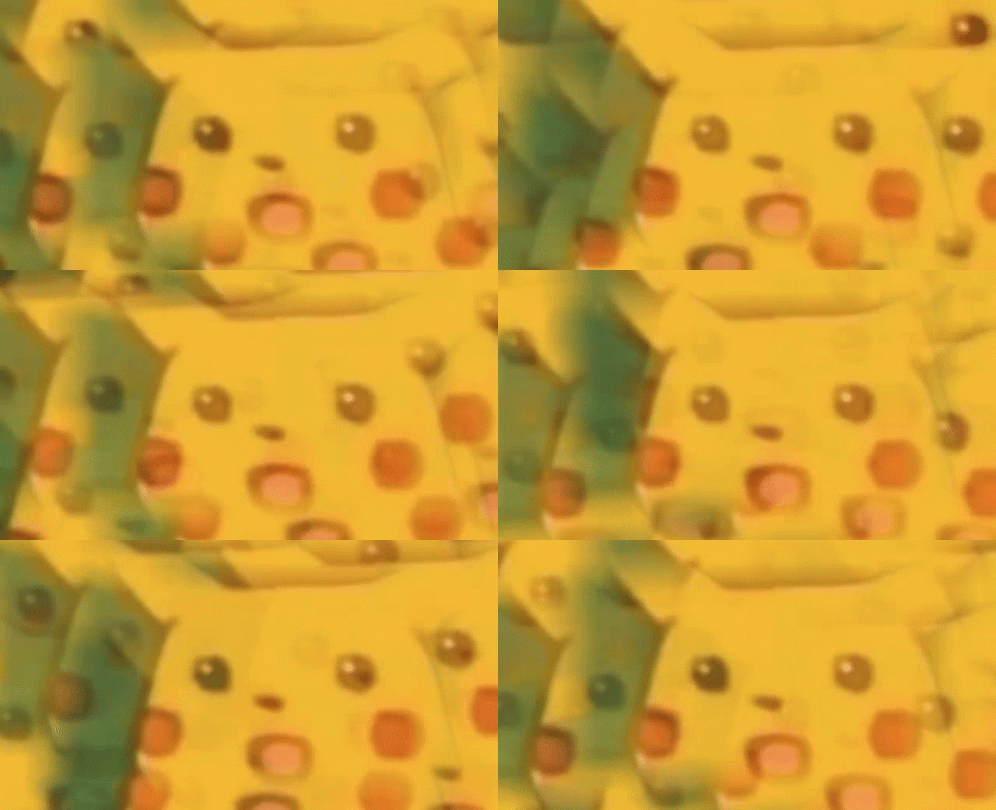
the biggest Nanny State the world has ever known
What's this in reference to?
I was expecting a much stronger argument based on the headline.
Personally I'd prefer regulation on how social media is structured and how algorithms operate. First thing I'd do is ban infinite scroll, which corporations like because it increases 'engagement' whilst harming the quality of the experience for their users.
As a thought experiment, it's somewhat fascinating to ask what "social media" has done. I don't really consider anything past MySpace truly social. The term now means "let's keep you addicted to posts from people you'll never meet" -- essentially, the modern form of checkstand tabloids.
I mean, I don't disagree on the broad strokes, but it does beg the question:
What are you doing here?
This is that. You're on social media. We don't allow smoking and drinking for adults because it's any less harmful for them, it's just that we choose to let grownups choose whether they want to mess themselves up.
So why do you choose to mess yourself up and what should society do about it?
I have full control over my feed here. That's an important distinction. I'd imagine if I end up in someone else's hometown off Beehaw, we'd end up getting a beer or lunch.
Saying Facebook is in the same area code is specious.
So the problem isn't actually "social media" but corporate control?
Well geez I wonder why everybody is attacking social media... \s
It's complicated. The current state of the internet is dominated by corporate interests towards maximal profit, and that's driving the way websites and services are structured towards very toxic and addictive patterns. This is bigger than just "social media."
However, as a queer person, I will say that if I didn't have the ability to access the Internet and talk to other queer people without my parents knowing, I would be dead. There are lots of abused kids who lack any other outlets to seek help, talk to people and realize their problems, or otherwise find relief for the crushing weight of familial abuse.
Navigating this issue will require grace, awareness and a willingness to actually address core problems and not just symptoms. It doesn't help that there is an increasing uptick of purity culture and "for the children" legislation that will curtail people's privacy, ability to use the internet and be used to push queer people and their art or narratives off of the stage.
Requiring age verification reduces anonymity and makes it certain that some people will be unable to use the internet safely. Yes, it's important in some cases, but it's also a cost to that.
There's also the fact that western society has systemically ruined all third spaces and other places for children to exist in that isn't their home or school. It used to be that it was possible for kids and teens to spend time at malls, or just wandering around a neighborhood. There were lots of places where they were implicitly allowed to be- but those are overwhelmingly being closed, commericalized or subject to the rising tide of moral panic and paranoia that drives people to call the cops on any group of unknown children they see on their street.
Police violence and severity of response has also heightened, so things that used to be minor, almost expected misdemeanors for children wandering around now carry the literal risk of death.
So children are increasingly isolated, locked down in a context where they cannot explore the world or their own sense of self outside the hovering presence of authority- so they turn to the internet. Cutting that off will have repercussions. Social media wouldn't be so addictive for kids if they had other venues to engage with other people their age that weren't subject to the constant scrutiny of adults.
Without those spaces, they have to turn to the only remaining outlet. This article is woefully inadequate to answer the fundamental, core problems that produce the symptoms we are seeing; and, it's implementation will not rectify the actual problem. It will only add additional stress to the system and produce a greater need to seek out even less safe locations for the people it ostensibly wishes to protect.
Read this article for free Register for FT Edit now
Once registered, you can: • Read this article and many more, free for 30 days with no card details required • Enjoy 8 thought-provoking articles a day chosen for you by senior editors Register Now
Ah, yes. Truly, I cannot argue against this impeccable logic. I am swayed.
No; it's not inarguable.
I do feel that some minor limitations around social media should exist; such as hours of the day you may not be allowed to read or post; but they should be simple age-gates created to privately verify a person's age via a simple SSO/OAuth style token. If you can't authenticate against some privacy respecting identity proving entity you probably aren't old enough and any account(s) you create would be limited.
Not all social media needs to be age-gated either; but social networks could be forced by law to avoid monetizing your account or habits at all if you don't willingly identify. (and by doing so; also CONSENT TO THIS MONETIZATION) In short; if you are not verified they're required to assume you are a child and handle your data as such...with utmost respect to your privacy.
Man, I still really struggle to understand how we can reliably age-gate anything on the Internet without sacrificing privacy for everyone.
IRL you can just show your govt issued ID, but there's virtually zero privacy risk doing so. Bouncers don't register ID scans, typically, and they're just one person. The govt doesn't know you went to that club or drank at that one bar, unless they're actively surveilling you.
But if I needed to identify myself as an adult online, simply by virtue of how digital systems work, that probably requires checking against a govt database, and that database will keep logs, and now Trump knows I went to Pornhub, and likely also exactly what I watched or searched for.
Maybe I'm dumb, but I really don't know any way around this sort of thing.
I vehemently dislike "inarguably" claims as it's a similar strategy as "protect the children, you would want to leave a child unprotected, now would you?" and this is a double whammy as it is about protect children so, yeah.
Having said that.
I think there are definitely issues to be resolved.
The way social media keeps kids reeled in is one thing. In the past I saw teenagers doing stuff together, laughing, getting themselves into trouble (as a part of growing up), endless endless chattering together... Now I continuously see groups of teenagers quietly on their phones in a group, only interrupted by every now and then one teen showing something to others.
Just in general, I think little kids should have a bit less media to begin with. Again, I walk over the street and see mother's with tiny kids and they're already glued to the screen instead of looking around. I feel like that generation misses the beauty of the world outside in lieu of constant screen time. I getting, it's nice and quiet for the parents who also want a life, but it seems a lot. It sort of feels like these kids are losing humanity and instead get this new world of only tech, and soon, only AI.
I think there are loads of other issues to be resolved as well. I'm a staunch advocate for banning mobile phones on schools (exceptions where needed) for example.
Having said all that, I don't think that outright banning social media for kids is a good idea either, it doesn't have to be a nothing or everything decision.
One thing could be that social media companies could be forced to publish their selection algorithms, and requiring said algorithms to adhere to a set of laws that ensure kids can interact healthily with their products.
There are loads of other solutions out there. I don't think a full ban is right but leaving it at how it currently is also is not a solution