The Smol Web

367 readers
1 users here now

Community for the appreciation and sharing of links, resources, and culture of: the smol web / small web / ~(w)~ / the indie web / or even the non-www internet (gemini, gopher, etc).

Back of a napkin definition, subject to change: if it's internet accessible and is maintained by a person, especially for non-commercial aims, then I would consider it smol. There are, however, much stricter definitions.

Definitions

Resources

founded 1 year ago
MODERATORS
1


Hi folks, I'm so dang tired of the internet as it currently is. The idea of a small web, personal websites, returning to what the internet was intended to be sounds incredibly exciting to me and I'd like to invest in that... but I don't really know where to start? So much of what I read seems to have a ton of coding jargon. I clicked on Small Web 101 and it was a masterlist of somewhat confusing links.

The most coding I've done was on Khan Academy as a teenager or setting up an automatic macro to run the coliseum for me in Flight Rising. I pirate basically everything I watch but I've only torrented one or two things and don't really grasp how that works. I don't really know anything about my laptop but I have a vague idea that I should switch to Linux and I replaced the screen once.

What's step one for a wannabe Small Web enthusiast?

2


The web is a mess, bloated with data-gathering trackers, predatory UX, massive resource loads, and it is absorbing everything it touches. The Small Internet is a counter-cultural movement to wrangle things back under control via minimalism, hands-on participation, and good old fashioned conversation. At its heart are technologies like the venerable Gopher protocol or the new Gemini protocol offering a refuge and a place to dream of a better future.

Join me and be reintroduced to Gopher in 2021 and learn what this old friend has to offer us in a world full of web services and advertising bombardment. We will also explore the new Gemini protocol and how it differs from Gopher and HTTP.

We will explore the protocols themselves, their history, and what the modern ecosystems are like. I will briefly review the technical details of implementing servers or clients of your own, and how to author content as a user. Discussion will cover limitations, grey-areas, and trade-offs in exchange for speed and simplicity.

Through these alternative protocols we'll see the small internet in action.

3


Welcome to volume twenty-four of Scrolls, a newsletter for sharing cool stuff from the IndieWeb, Fediverse & Cybersecurity realms. This week we discuss the point of blogging, what social media is (and isn’t), and drop a lot of awesome infosec tools/resources.

Scrolls isn’t dead yet. Let’s go!

4


I've been testing Gemini in Lagrange browser for a couple of days now. I like the concept and philosophy behind it. Simple, small sites, mostly text based.

But, I'm wondering why most of the browsers for Android are unmaintained and outdated. This protocol is perfect for mobile. No overloaded pages, small file sizes etc.

It seems that development of a lot of Gemini software discontinued a couple of years ago. What happened?

5


A a collection of articles that to some degree answer the question “Why have a personal website?” with “Because it’s fun, and the internet used to be fun.”

6


Unfortunately after learning more about Kagi I prefer not to support their practices. But I really liked their search especially the small web search. What's a similar site I could use for this?

7


tldr: What would a smallweb-style "code viewer" look like? What kind of theme and UI elements should it have? Here's my attempt: https://repos.tuckerm.us/ui-experiments/branches/main/demo/

While self-hostable git forges like Forgejo are really cool, I also think they're overkill for most use cases. When I just want to put some side projects up on the web, I don't need an issue tracker or a discussion forum. I know you can disable those features in Forgejo, but what if I just didn't have those features at all? And therefore didn't need much of a backend server?

I recently realized that most of what I want in a git repo viewer can be done with just static HTML files. I started working on that as an 11ty static site generator plugin.

It's very very hacky right now, but it works as a proof of concept. I'm improving it now. If people end up using it, I'm hoping that they customize it to fit the style of their existing personal site. But I want it to come with a default theme so that it can be used right out of the box.

I was playing around with an idea for a look and feel here: https://repos.tuckerm.us/ui-experiments/branches/main/demo/

At first I was using the stock Bootstrap UI components, which are practical and professional. But then I decided that this smallweb repo viewer should have a look and feel that matches the ethos of the project itself: personal, not corporate, and open to being expressive. And not just trying look like Github with no backend.

The current, Bootstrap-styled pages are here, and that is also the repository for the project itself. But I'd love to make it more unique that that.

Does anyone have any input for a look and feel for this project? I'm open to anything. A color palette you like, a basic layout, or general ideas.

8
9
1
submitted 7 months ago* (last edited 7 months ago) by grrgyle@slrpnk.net to c/smolweb@slrpnk.net


Punchy little article that touches binds together a few frustrations into a clear set of well articulated complaints.

EDIT: meant to post this elsewhere since it's not really about the smol web, so much as what wrong with much of the rest of the web, but if you invert the complaints in the article you basically find everything that is lovable about our lovely indie spaces. :)

10


cross-posted from: https://lemmy.ml/post/34624204

11
12
1
submitted 9 months ago* (last edited 9 months ago) by thegreenman@slrpnk.net to c/smolweb@slrpnk.net


So I wrote a blog post on how I feel we can encourage more people to fedi, and it starts with DON'T TELL PEOPLE ABOUT THE FEDIVERSE, because I'm very clever, or something. Would be happy to get your thoughts on that!

13


Not actually ads as we, the modern netizens of the internet of 2005+20 know them, but fun little sort of buttons or blinkies used to cross-promote other places on the smol web.

I've seen a few of these around. But most recently I stumbled onto navlink ads and it reminded me of the phenomenon. I know there are others out there, I just can't remember where to find them.

Anyway, I like them. It's like using the tools of advertisers to add a little irreverent fun to our indie spaces.

14
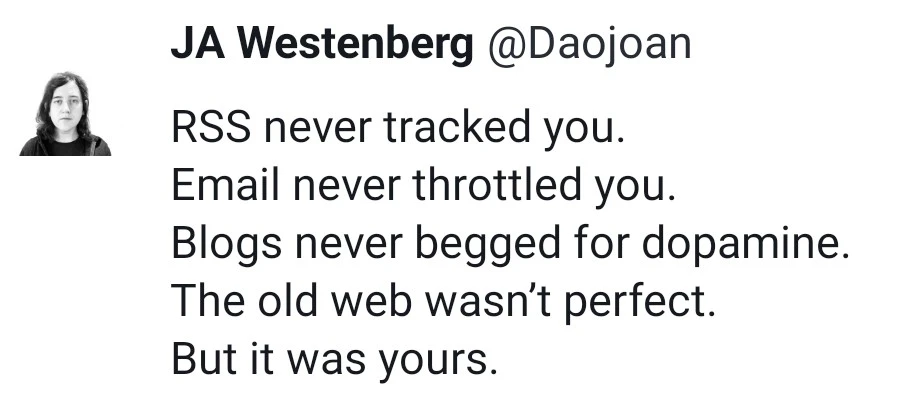
15
16
1
submitted 11 months ago* (last edited 11 months ago) by grrgyle@slrpnk.net to c/smolweb@slrpnk.net


Hardly needs an introduction, but someone is always experiencing something new on the internet, so if this is you today - congratulations!

You can click many of the images to pop up an archived version of an old Geocities page. Or just scroll and enjoy the soothing theme song (recommend turning sound on (speaker icon in top-right)).

Here's a splainer from the footer of Cameron's World itself:

GeoCities was a web-hosting service that made it possible for people to build their own home pages. During the 90s, users from all over the world created personalized corners of the Internet.

By the time the U.S. service shut down in October 2009, there were over 38 million GeoCities pages. Cameron’s World brings together archived material from thousands and thousands of these sites.

In an age where we interact primarily with branded and marketed web content, Cameron’s World is a tribute to the lost days of unrefined self-expression on the Internet. This project recalls the visual aesthetics from an era when it was expected that personal spaces would always be under construction.

Actually, a little bit of trivia: if you go back to the aughts with the WayBack Machine, you'll find the domain was considerably riskier then. Click around at your own risk, because it gets NSFW pretty quickly. :)

17


As the title asks, has anyone here had experience with it? I saw it mentioned once on lemmy and I was intrigued, but I don't quite understand what do you actually do on a specific tilde, how do you choose which tilde to sign up to and what makes them a "-verse", because they all seem to be rather disconnected from each other?

18
1
submitted 11 months ago* (last edited 11 months ago) by grrgyle@slrpnk.net to c/smolweb@slrpnk.net


Or how yesterweb begat web revival begat ~smol~ begat {{INSERT_YOUR_GLORIOUS_AND_FREAKY_HOMEPAGE_HERE}}.

I'm still currently reading this piece, but it's already got enough soy on the bean* to be worth sharing. I think it might lean a bit too much into the nostalgia club area of things (which I'll admit is a personal draw), but like I said I'm not done reading it yet. :P

* alt to "meat on the bone" I'm still workshopping lol


EDIT: Okay, I kept reading and my initial reticence was unfounded. It's a great taxonomy of the disparate and overlapping personas that describe many of the netizens who feel like a better internet is possible.

Tag urself, I'm nostalgic corpo hater who wants everyone to get along.

030/100 [███░░░░░░░] : The "90s Web"
060/100 [██████░░░░] : The Anti-Capitalists
040/100 [████░░░░░░] : The Socialites
020/100 [██░░░░░░░░] : The Artists
020/100 [██░░░░░░░░] : The Minimalists
19


Blurb from the web page:

The Smallweb Subway is an experimental project that seeks to connect communities online using webrings.

[...]

The subway system theme is my attempt at making the internet feel more like a place where you can have neighbors. If a webring looks like a subway line, then it's easier to imagine a friend only a few stops away!

I really like this visual, and being able to see different topics on their own "lines." This feels like such an intuitive design, I hope it gets copied or riffed on elsewhere.

20


Example of a button: Flashing text "12 MEN" next to old Windows My Computer icon incidentally another fun place on da small web (the button is also a link).

The TL;DR is that it just sort of became the standard because of being an early standard, and then because they are kind of a nice size. Something I don't think the article mentions (I'll admit I started skimming around the end) is that when displayed for fun, web folk often like to stack or grid these together, so it makes sense that if you're making a new button that you'd make it the same size, so that it would fit in with all the rest.

21
1
Every site needs a Links Page (thoughts.melonking.net)
submitted 1 year ago* (last edited 1 year ago) by grrgyle@slrpnk.net to c/smolweb@slrpnk.net


Don't let your website be a dead-end. Add a links page to other independent web weavers, and let people continue surfing the tubular series of pipes that make up the small web.

22


Might be a useful philosophy for those who still find some utility in posting to larger social medias (like Mastodon, etc), but still want to maintain an indie presence that is totally under their control.

23
1
Lessons from Yesterweb (yesterweb.org)
submitted 1 year ago* (last edited 10 months ago) by grrgyle@slrpnk.net to c/smolweb@slrpnk.net


EDIT since the forum has shut down, here is a wayback machine link.

If you spend any amount of time perusing the small internets (for there are many), you will come across a link to yesterweb.org. However, you'll quickly discover that it is no longer active (see forum post explaining). It's a bittersweet feeling for anyone coming in late to the game.

But if you continue reading the available corpus, especially the "Summary" you'll find some interesting resources. I particularly enjoyed reading the sections under Significant Errors. To select a couple (just read the bolded parts for the gist):

On community size

It makes no sense to have over a thousand people in one chatroom and simultaneously have high standards for the quality of social connection and discussion.

On picking good moderators

Since moderation is (typically unpaid) work, many moderators rationalize this sacrifice through non-monetary compensation. [...] Others will realize this value in their self-aggrandizement ...

On compromising on technology

From our time with the Discord refusers it became clear that the vast majority were more concerned about the technology (and, ultimately, themselves) and less concerned about its social implications. [...] without [Discord] it would have been impossible for us to accomplish in any significant manner what we had set out to do.

I don't agree with this take, obviously, since I'm on here and not a Discord server. But I appreciate the authors sticking their neck out, and putting their rationale in writing, where it can be picked apart by armchair copy-pasters like me. :P

Misunderstanding terms/aims of project

Our understanding of culture had evolved over time and we realized at the very end that there was a widespread confusion with members mistaking a counterculture for a subculture.

See their definition of subculture v. counterculture here


There are a tonne of other notes, forum posts, blog entries, etc etc etc to dig into, but ultimately the project "failed" in some interesting and v well documented ways. I found this snippet from the forums of particular interest as someone who struggles even to raise their personal consciousness:

... the old culture returned and we could not progress from a tech-nostalgia-fandom server with a petty-bourgeois sense of rebellion that emulates what one would commonly find on Tumblr, Mastodon, or homes in a wealthy first world suburb.

Something to think about, right?

PS. If you poke around, you might find certain offshoots and capsules still pinging the void.

24


The part that I found heartening to hear was this one:

I am more optimistic than I've been in a long time about the massive potential of the human internet to come roaring back in a way that we haven't seen in a generation