Degrowth

2430 readers
1 users here now

Discussions about degrowth and all sorts of related topics. This includes UBI, economic democracy, the economics of green technologies, enviromental legislation and many more intressting economic topics.

founded 2 years ago
MODERATORS
1
2


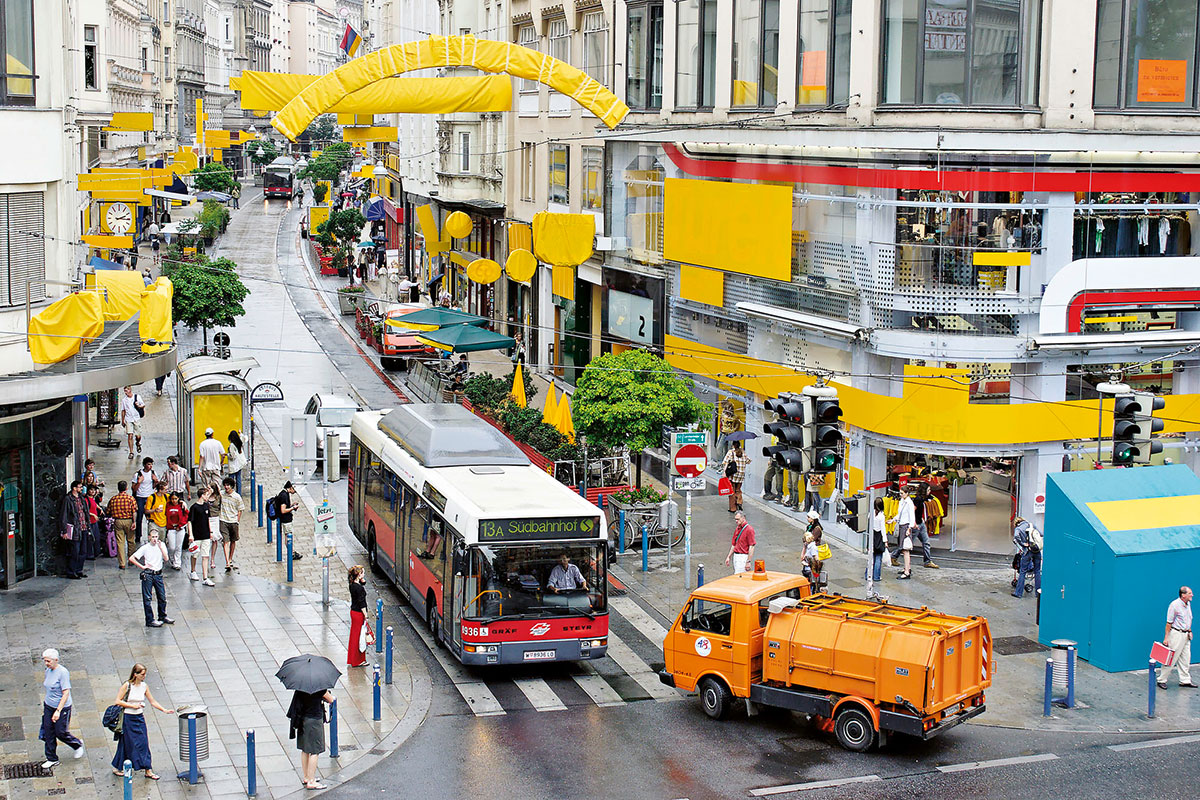
This is from an art project in Vienna called Delete!, where they covered everything, which could be seen as ads in the Neubaugasse.

https://www.steinbrener-dempf.com/en/portfolio-item/delete/

3


The Happy Planet Index is not really about happiness, but tries to measure how well a country is able to transform its natural resources into well being. For that it takes life expectancy and levels of happiness from the World Happiness Report and divides it by the ecological footprint, which is trying to measure the resource impact.

The top three countries are: Costa Rica, Guatemala and Tajikistan

As for others Brazil is 10th, Germany 16th, UK 19th, Italy 23, Japan 33, France 39, China 51, India 65, Australia 103, USA 105

The full report is here:

https://happyplanetindex.org/wp-content/uploads/2026/07/HPI_2026_final0607_compressed.pdf

4
5
6
7
8
9


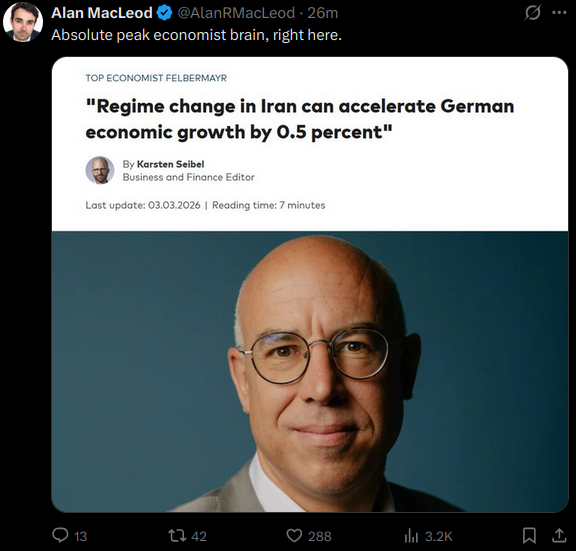
what bothers me most is that the concept of degrowth isn't even possible to contemplate to these numpties. This economic model is failing, yes, but the article does not actually propose to consider the deeper reasons. "Economic growth" must be pursued at all costs according to these fucking twats... oh? Really? Why? When we have energy constraints, how the fuck can this even be possible, yanno? They don't even consider the reality of energy descent being inevitable, and that we are now staring it in the face.

I'm so tired of not being allowed to talk about this to 99% of people, too.

10
 
 
11
12


We have an urgent responsibility. Our existing economic system is incapable of addressing the social and ecological crises we face in the 21st century. When we look around we see an extraordinary paradox. On the one hand, we have access to remarkable new technologies and a collective capacity to produce more food, more stuff than we need or that the planet can afford. Yet at the same time, millions of people suffer in conditions of severe deprivation.

What explains this paradox? Capitalism. By capitalism we do not mean markets, trade and entrepreneurship, which have been around for thousands of years before the rise of capitalism. By capitalism we mean something very odd and very specific: an economic system that boils down to a dictatorship run by the tiny minority who control capital – the big banks, the major corporations and the 1% who own the majority of investible assets. Even if we live in a democracy and have a choice in our political system, our choices never seem to change the economic system. Capitalists are the ones who determine what to produce, how to use our labour and who gets to benefit. The rest of us – the people who are actually doing the production – do not get a say.

So we end up with irrational forms of production as a result: we get massive production of things such as SUVs, mansions and fast fashion, because these things are highly profitable to capital, but chronic underproduction of obviously necessary things like affordable housing and public transit, because these are much less profitable to capital, or not profitable at all.

The solution is staring us in the face. We urgently need to overcome the capitalist law of value and democratise our economy, so that we can organise production around urgent social and ecological priorities. After all, we are the producers of the goods, the services, the technologies. It is our labour and our planet’s resources that are at stake. And so we must claim the right to decide what is produced, how, and for what purpose.

13


Silicon Valley billionaires, such as Elon Musk, Jeff Bezos, and Sam Altman, promise salvation through space colonization, immortality, superintelligent AI, and endless growth. Adam Becker, astrophysicist and author of More Everything Forever: AI Overlords, Space Empires, and Silicon Valley's Crusade to Control the Fate of Humanity, debunks these profoundly immoral and biophysically impossible delusions, and explains why resisting them through collective action is essential. Highlights include:

  • How tech billionaires confuse science fiction for reality and why their fantasies of space colonization are biophysically impossible;
  • Why Artificial General Intelligence (AGI) remains an ill-defined concept that is based in the false assumption that humans' evolved brains work like computing machines;
  • Why large language models (LLMs), the dominant form of AI, are neither creative nor accurate enough to achieve the dreamed-for leap in machine intelligence;
  • What the end of Moore's Law tells us about diminishing returns to technological complexity and the expectation of endless technological growth;
  • Why longtermism is a dangerous ideology of technological salvation and endless growth, prioritizing hypothetical future populations while excusing present-day social injustice and ecological destruction;
  • How the fear of death underlies techno-utopian off-planet and transhumanist fantasies;
  • Why resisting their oligarchic visions requires calling out the ridiculousness of their ideas and organizing collectively to push back both politically and economically.

0:00 Introduction

4:44 Motivations to write the book

9:23 Confusing science fiction for reality

12:37 Musk and Bezos reasons for off-planet plans

15:55 Musk Mars plans are delusional

20:33 Bezos space station plans are delusional

23:34 Kurzweil's AGI dream

29:27 End of Moore's Law

34:38 Limits of large language models

36:37 Longtermism perversion of ethics

44:58 Effective accelerationists

48:42 Malcolm and Simone Collins

50:32 Fear of death and technological salvation

53:57 Meaningful democratic resistance

14


cross-posted from: https://slrpnk.net/post/33984443

That pattern seems to be holding. In 2024, global GDP per capita reached a new high as did annual carbon emissions. But as climate targets slip and warnings mount that tipping points may already have been crossed, faith in growth for growth’s sake is starting to fracture.

15


During Cop30 negotiations in Brazil last year, delegates heard a familiar argument: rising emissions are unavoidable for countries pursuing growth.

This week, the UN secretary general, António Guterres, called for economies to “move beyond GDP” as a measure of progress, warning that the world’s “existing accounting systems” were driving the planet towards disaster.

His remarks echo an increasingly influential school of economics, known broadly as “post-growth”, that asks what was once unthinkable: will solving the climate crisis mean learning to live without constant expansion?

Post-growth economists often reject GDP in favour of new frameworks that account for environmental damage – such as the “doughnut economics” adopted recently by Amsterdam, or New Zealand’s attempt at a “wellbeing budget”.

The field has its disagreements, particularly over the extent to which countries should actively pursue de-growth measures to scale down their economies. But proponents agree that with the planet pushed to the limit, a radical rethink is needed.

“Economic growth has a near mythical status in the affections of economists and politicians. But wishful thinking won’t solve the climate crisis,” said Tim Jackson, professor of sustainable development at the University of Surrey and a leading post-growth economist. “Post-growth economics offers us more choice, more realism and more insight into the possibilities for human prosperity. It’s not about returning to the cave but about breaking free from our intellectual prisons.”

16
17
18


cross-posted from: https://slrpnk.net/post/32632129

"[R]epresentative democracy is a failure and elections are a circus. If we want to reform democracy, elections have to be abolished." | A political strategy for degrowth

19


Channel: Vlad Bunea

Article with sources: https://vladbunea.substack.com/p/sufficiency-as-an-anti-capitalist

20
21
22


Second, some reflections on the word “degrowth”, which was the main focus of this study. Our results show that much of the opposition to (or neutrality toward) degrowth is due to misunderstanding of the word rather than rejection of the underlying principles and policies.

Degrowth is a crucial analytical and scientific term and we need it for these purposes. Advocates also note that it is a “missile word” useful for provoking people to rethink long-held assumptions. This can be powerful. But the word may be less useful as a public-facing political slogan, as — depending on the context — it is often misunderstood and can inspire negative reactions. Unless, that is, you have the capacity to educate people about what the term means and what such a transformation would entail.

23


cross-posted from: https://slrpnk.net/post/31120082

A very long essay, but I think worth a read - for solarpunks especially - even if you end up disagreeing with the anti-growth and anti-renewables conclusion.

Tldr: the first blind spot is that land disturbance (such as, for example, turning forests into agricultural land) is the "other leg" of climate change: it disrupts the water cycle, making some areas drier and some areas wetter, leading to, eg, crop failures and natural disasters.

Why don't we hear more about land disturbance as the other leg of climate change? Because capitalism demands growth. Capitalism can "solve" emissions with "green growth" - replacing old fossil fuel power plants with shiny new solar panels, and making a bunch of companies and developers richer in the process. But capitalism can't make more land. It can't solve the land disturbance problem by growing - it can only solve it by not growing. And that capitalism cannot do.

And the second blind spot is the tremendous ecological, environmental, and human harm done by the capitalist growth of "renewable" energy - from the slave children digging rare earths in the Congo to the pristine deserts paved over for giant solar projects. But because we are so single-mindedly focused on cutting emissions, we think "at least renewable energy doesn't produce carbon dioxide, so that's better, right?" And we put a nice green coat of paint on the world-destroying von Neumann machines of capitalism.

So what's the solution?

That being said, personally I propose: Let’s start with the goal of no new energy infrastructure whatsoever from any source, make do with what we have now, and shut down infrastructure from there as we eliminate frivolous use. This is an attainable goal. What are examples of frivolous use? Here’s a few candidates: AI, next day shipping, cheap plastic shit from China, cut flowers imported from South America on airplanes, perishable food shipped halfway around the world, commercial air travel, weed-free mown lawns, streaming movies and music, fast fashion, video game consoles, big screen TVs, f’ing single-use coffee pods, and the list goes on and on and on.

24
25


A recent paper by Keysser, Steinberger, and Schmelzer summarized different theories about what motivates economic growth.

Video version: https://www.youtube.com/watch?v=o4zjEGI7DSo

This obsession with economic growth comes, as the paper shows, from various sources. They counted 21 such plausible sources.

1 Accumulation of money.

2 Income and wealth inequality.

3 Economic class and private property.

4 Market competition.

5 Monetary economy.

6 Advantages of firm size.

7 Cheap resources and energy.

8 For-profit firms and profit maximisation.

9 Sales effort.

10 Working time / Labour-saving technological change.

11 Financial market depreciation.

12 Private interest-bearing debt and money creation.

13 Consumerist culture.

14 Growthist ideology.

15 Neoliberal ideology and policy.

16 Power and domination.

17 The state, elites and geopolitics.

18 Welfare state financing.

19 Miscellaneous, such as when human needs grow faster than productivity.

20 Population structure.

21 Technology and infrastructure

These 21 general themes have 112 mechanisms that lead to economic growth dependencies and imperatives. For example, theme 3 economic class and private property has 12 such mechanisms related to how private property forces the economy to grow just to maintain its existence. If we apply a critical view to this summary, which comes from 248 publications, we may be tempted to say that the causal chain stops right here, with this list of 112 mechanisms under 21 themes.

view more: next ›