dumnezero

joined 1 year ago
[–] dumnezero@piefed.social 7 points 1 day ago (1 children)

I was just watching this and it seems related to your situation:

Why Are Americans So Bloody Stupid? https://www.youtube.com/watch?v=j9MubNsh3rs

[–] dumnezero@piefed.social 8 points 2 days ago

The best use case of AI generators, just like for "crypto", is for scams, frauds, hacks, and other shady stuff.

There is no reason to keep it.

[–] dumnezero@piefed.social 11 points 2 days ago

Slopware manufacturing

[–] dumnezero@piefed.social 23 points 3 days ago

Maybe they just wanted to deny the positive feedback to him.

[–] dumnezero@piefed.social 3 points 3 days ago

this, but with less zoning

[–] dumnezero@piefed.social 0 points 4 days ago

they give you

doubt

[–] dumnezero@piefed.social 1 points 4 days ago (2 children)

but the original is not available for download on the publisher's site.

[–] dumnezero@piefed.social 1 points 4 days ago

center red button or the orange button at the bottom.

[–] dumnezero@piefed.social 0 points 4 days ago

We probably need some of the original cultivar of algae to grow (clone). I'm not sure if they can be exported (sold) dry.

The application is often called algaculture or algaeculture, but it's micro in this case, so look for micro-algae.

115
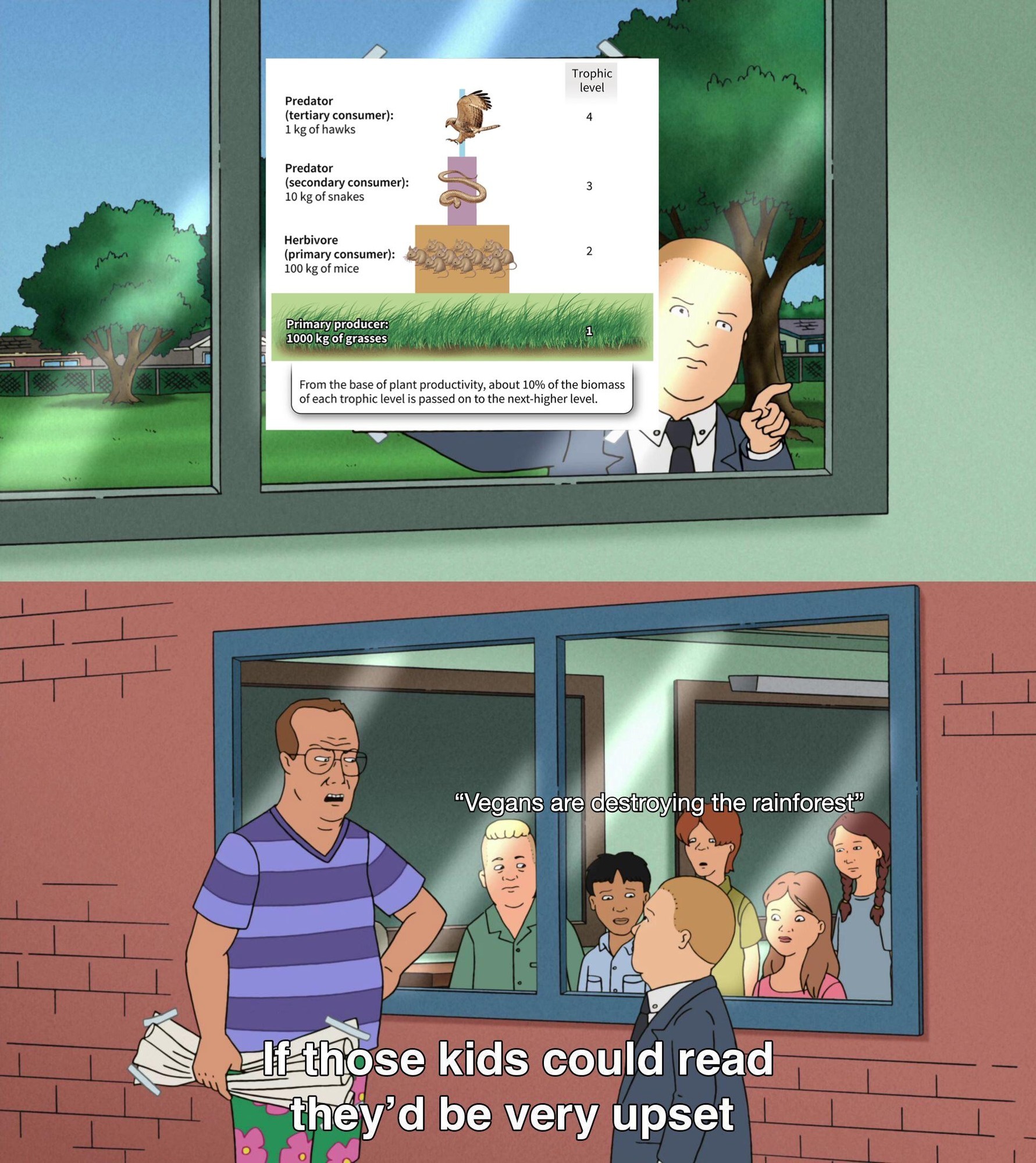
Every.time. (media.piefed.social)
submitted 6 days ago* (last edited 6 days ago) by dumnezero@piefed.social to c/science_memes@mander.xyz


The artificial intelligence industry's data center boom is the latest chapter in a long history of environmental racism and resource exploitation in vulnerable Native communities, says Oglala Lakota and Northern Cheyenne activist Krystal Two Bulls, the executive director of Honor the Earth, an Indigenous-led environmental justice organization that is tracking over 100 proposed data center projects on tribal and rural lands. We speak to Two Bulls about the myriad impacts of what she calls a "modern-day iteration" of "settler colonialism," including noise pollution, cancers and respiratory illnesses, water depletion, energy grid overload and even "ecological collapse." As tech companies set their sights on Indigenous lands, Two Bulls says, "We're always the one that ends up having to sacrifice our relationship to land, air, water, our communities and our nonhuman relatives."


Invasive fungal infections are increasingly leading to life-threatening diseases worldwide. And in agriculture, fungi pose a massive threat to harvests...


This video discussion is SFW.

Recent reports from a TTP invesigation have revealed that, while Apple and Google have rules against “nudify” apps, their app store search and advertising systems actually point users to them. The result? 483 million downloads, more than $122 million in lifetime revenue, and a growing number of sexual deepfake scandals in schools.

Kat Tenbarge of Spitfire News is joined by Katie Paul, Director of the TTP, or Tech Transparency Project. Together they discuss the results of the investigation, how these apps are being weaponized against women and minors, and how tech giants like Elon Musk (and his notoriously explicit AI chatbot Grok) are contributing to the growing crisis.


This video is about how fake honey pot influencer posing as a service member opened my eyes to how AI tech is being utilized by the worst people on the planet to make all our lives worse!

00:00 - 0 - JESSICA FOSTER

00:56 - 1 - SHE'S AI

01:25 - 2 - ARTIFICIALLY GENERATED

02:25 - 3 - WEIRD TWEETS BY OLD MEN

02:57 - 4 - TRUTH IS STRANGER THAN FICTION

03:44 - 5 - SPOTTING THE STRANGENESS

06:12 - 6 - AI IS TOO HARD TO SPOT

08:45 - 7 - AI: WE ARE NOT READY

10:10 - 8 - COMPANIES DON'T PROTECT US

12:52 - 9 - SHIFTING ATTENTION: EDUCATION

15:25 - 10 - EASIER TO CONTROL UNEDUCATED POPULACE

16:53 - 11 - I THINK WE SHOULD USE AI...not for this

17:22 - 12 - HOPE FOR THE FUTURE

18:56 - 13 - THE BAD GUYS

21:16 - 14 - WE'RE NOT ALONE IN OUR FIGHT


Description from the video:

Hi there hello. I checked back in on Snapchat in 2026 to see if the Snapchat Discover page had improved since my last video about it. I should not have done that.

So I dedicated an entire week's worth of bathroom breaks to scrolling through the Snapchat Spotlight page again and doing the research. What I found instead were several distinct buckets of AI slop; generic AI generated videos, incel motivation content, aggressive AI Barbie, AI toddlers and parrots saying scripted things, and an entire talking food and object cinematic universe that I was not prepared for and that I'm fairly certain has ruined all of our lives.

I'm so sorry to show you any of this. See you in the woods.

Chapters:

00:00 Remembering Snapchat Exists

00:12 Checking In On The Spotlight Page

00:41 The Half Beard Engagement Bait Couple

01:29 It Got So Much Worse

01:57 Bucket One: Generic AI Slop

03:03 The Lemon Grandma Cinematic Universe

03:34 Bucket Two: Incel Motivation Content

05:19 AI Slop But Make It Misogynistic

05:46 Bucket Three: Aggressively Vulgar AI Barbie

06:28 Bucket Four: AI Toddlers Saying Scripted Things

07:53 Bucket Five: AI Parrots Saying Scripted Things

08:28 Bucket Six: The Talking Food And Objects Cinematic Universe

09:55 Everything Introduces Itself Including The Discharge

10:51 The Strawberry Fruit Soap Opera Lore

13:15 We're All Going To Live In The Woods Now


John Oliver discusses the elections on the horizon for Viktor Orbán, the prime minister of Hungary and the longest serving current head of government in the EU, why conservatives in the US are so invested in him maintaining power, and what it all has to do with Rob Schneider.


(pasted)

The climate crisis didn’t begin with factories, smokestacks, or fossil fuels. It began with slave ships.
In this sharp and provocative lecture, Jason W. Moore delivers a devastating answer: the problem isn’t “anthropogenic” — made by humans. The problem is capitalogenic — made by capital.

Moore critiques the most dangerous idea of the modern world — the "Man" versus "Nature" binary — and shows how it was born in the Columbian invasions after 1492. He replaces the comforting myth of Spaceship Earth with the far more accurate metaphor: Slaveship Earth. Signifying a world-ecology of power, profit and life built on the capitalist expulsion of most humans from “humanity,” Cheap Nature, and five centuries of violence, appropriation, and frontier-making, Moore traces the long history of climate change before and during the capitalist era.

This is not another story of hopelessness or population panic. It is an ecology of hope. Moore reveals how every major climate shift in the Holocene has been a moment of civilizational crisis and political possibility — from the fall of Rome and the peasant revolts that ended feudalism, to today’s climate crisis. He shows why the Capitalocene today is propelling a crisis of life-making and profit-making at once, and why only collective democratic action can seize the opportunities hidden inside the capitalogenic threat.

In this wide-ranging talk, Moore explains:

• Why “anthropogenic global warming” is neither innocent nor accurate — Britain and the US alone are responsible for more than a third of historical greenhouse gas emissions.

• How sugar plantations, silver mines, and the slaveship — not the steam engine or the Industrial Revolution — created the organizational template for capitalism as a world-ecology and its Cheap Nature projects.

• Why the Anthropocene is an elitist anti-politics machine that hides five centuries of capitalogenic crisis behind the fiction of “humans did it.”

• How climate shifts have repeatedly destabilized ruling classes and opened paths to greater equality for the vast majority.

• Why today’s state shift demands we move beyond Green Arithmetic to an ethic of care, connection, and democracy in the web of life.

This is not a call for green tech or climate austerity. It is a call to end the cheapening of life and labor once and for all — and to build a different world inside the one that is dying.

From a public lecture by Jason W. Moore, "Climate, Capitalism, and Geohistorical Crises, School of Architecture, ETH-Zurich (Eidgenössische Technische Hochschule Zürich), 25 February, 2019.

Jason W. Moore teaches world history at Binghamton University and coordinates the World-Ecology Research Collective. He is the author of Capitalism in the Web of Life and, with Raj Patel, A History of the World in Seven Cheap Things. Key ideas for this lecture are drawn from Moore’s books and essays, most freely available on his website jasonwmoore.com, including “The Capitalocene” essays, “Opiates of the Environmentalists," and "Our Capitalogenic World."

view more: next ›