0
Introducing oniux: Kernel-level Tor isolation for any Linux app
(pzhdfe7jraknpj2qgu5cz2u3i4deuyfwmonvzu5i3nyw4t4bmg7o5pad.onion)
I think they will be the first to have both digital ID and CBDC.
Or possibly Israel will be? Or China. Paying/Having cash may become illegal eventually.
Ah, AI-generated "cheap" text. That'd explain a lot!
In addition to what you've pointed out (which perhaps many Monero users agree with) such as the paper Monero issue, I'd say that fundamentally CEXes have this conflict of interest: they're supposed to help investors or whatever, help them become rich (as if that's the point). But reality is, often customers' losses are their profits - that's their (casino-like) business. In short, they essentially want you to lose your money. And in the first place, this investment aspect is not even the point of cryptocurrencies.
EU bans in 2027? - that's old news. Already in 2022: there were anonymous accounts ban in Lithuania for example (and the remarks by US Deputy Secretary of the Treasury about "unhosted wallets" too). Basically central entities have always wanted to regulate things centrally, but that's not how cryptos are supposed to work. I think XMR is one of the only few coins, still having this fundamental (admittedly, a bit idealistic) philosophy. Either way XMR is only a few "true" cryptos, actually being used (as opposed to just being traded as investment aka gambling). Because of that, some people, including myself, may tend to feel that Monero is essentially valuable and that the recent price movements are something that could have always happened (though, this unconscious assumption could be misleading too). So maybe... even though what's happening now might have been triggered by some criminals, that may have been just catalysts; the cause of these price actions may be intrinsic - because Monero is valuable, it's being valued. Perhpas a bit too optimistic view, but perhaps not entirely untrue either?
Cryptographically it'd be absurd to share your sec key with CEX ("hosted" wallet). Like 30-year-old PGP/GPG key-escrow debates yet again; or worse, not even escrow, CEX users don't even have their keys. Which feels so absurd. I've never once used CEXes, except I tried no-KYC web swaps a few times (but they too are CEXes, having the same fundamental problems). Obviously pure P2P DEX solutions feel much better and safer, where Alice and Bob are mathematically / trustlessly safe as in atomic swaps or via multisigs. DEXes (e.g. Bisq, Haveno) may be for-profict business too (no free lunch), but that's beside the point. Nevertheless, it's important to realize that everything, including "no-KYC" or "DEX" solutions, may become "sneaky" if not scammy.
Yeah, most probably. It's crazy, though: they're now saying that: privacy-by-default = bad, no-privacy = good. That's the EU for you?
That's possible. I happened to see these weird/questionable theories elsewhere, not really convincing:
"There are also rumors that major exchanges are thinking about relisting XMR, which, when combined with Monero's lower liquidity and more concentrated holdings, can lead to major price movements"
"Researchers say part of that growth is due to a shift in the U.S. regulatory tone. The FIT21 crypto bill is picking up steam, and the SEC is taking a step back from labeling privacy coins as securities. This seems to be helping the market out a bit. It looks like the easing of pressure has led to more money flowing back into assets like Monero"
"There is also a lot of excitement about Monero's upcoming FCMP++ upgrade, which is expected later this year."
https://u.today/xmr-explodes-past-350-is-monero-finally-back
"Perhaps ironically, the surge is being fueled by this regulatory purge."
[This may be right.]
"Monero's rise is reactive rather than entirely organic. Fearing censorship, there is a rush toward decentralization."
https://u.today/monero-xmr-surges-with-3900-volume-skyrocketing
Try not to take things too personally. Tails devs explicitly said they were making it for regular people (activists, journalists, domestic violence victims, etc.) and mainly not for advanced users. So by design it's a normie-friendly OS (a user is not even expected to know how to use pgp); as such, one might generally assume its users may not be "geeks". Nothing personal there.
While asking questions and exchanging ideas are wonderful, one can also enjoy the freedom to study (one of the four essential freedoms), guessing, narrowing down a problem by trial and error. An attempt at solving the problem on one's own is often of great value, a great way to learn, even if it's unsuccessful; after that, one might be able to ask an even better question, which could be helpful for more people too. Either way, I think that most Monero users can happily agree with each other that we want a better version of bisq :) (Sorry if this comment is uncalled for.)
Maybe this is why no one ever posts here.
Imho (quite) a few users ditched monero.town when they had started blocking Tor.
On the front page of monero.town, sm.ms and catbox.moe are recommended as image hosting services. Unfortunately both are not Tor-friendly, esp. Catbox blocks Tor.
The Cock.li guy comes up with a solution.
Example https://monero.town/post/1025717 where
https://files.catbox.moe/6z3p3z.jpg is not viewable via Tor
https://files.fatbox.moe/6z3p3z.jpg would be viewable via Tor
The syntax is
so…
Result:
Text link would be
[Text](URL)you can replaceTextwith an inline image,URLwith the image URL, i.e.
[](URL)so…
[](https://files.fatbox.moe/6z3p3z.jpg)
Result
Note: Optionally you can put Alt text in ![] as in

Another hosting service imagebam.com is iffy but Tor friendly, easy to upload images there from Tor Browser & you can direct-link to the uploaded full image.
Using 3rd party image hosting services has privacy implications, but it will save the server resource of monero.town.
Apparently, the Nintendo Switch gets 230 hashes per second mining #Monero
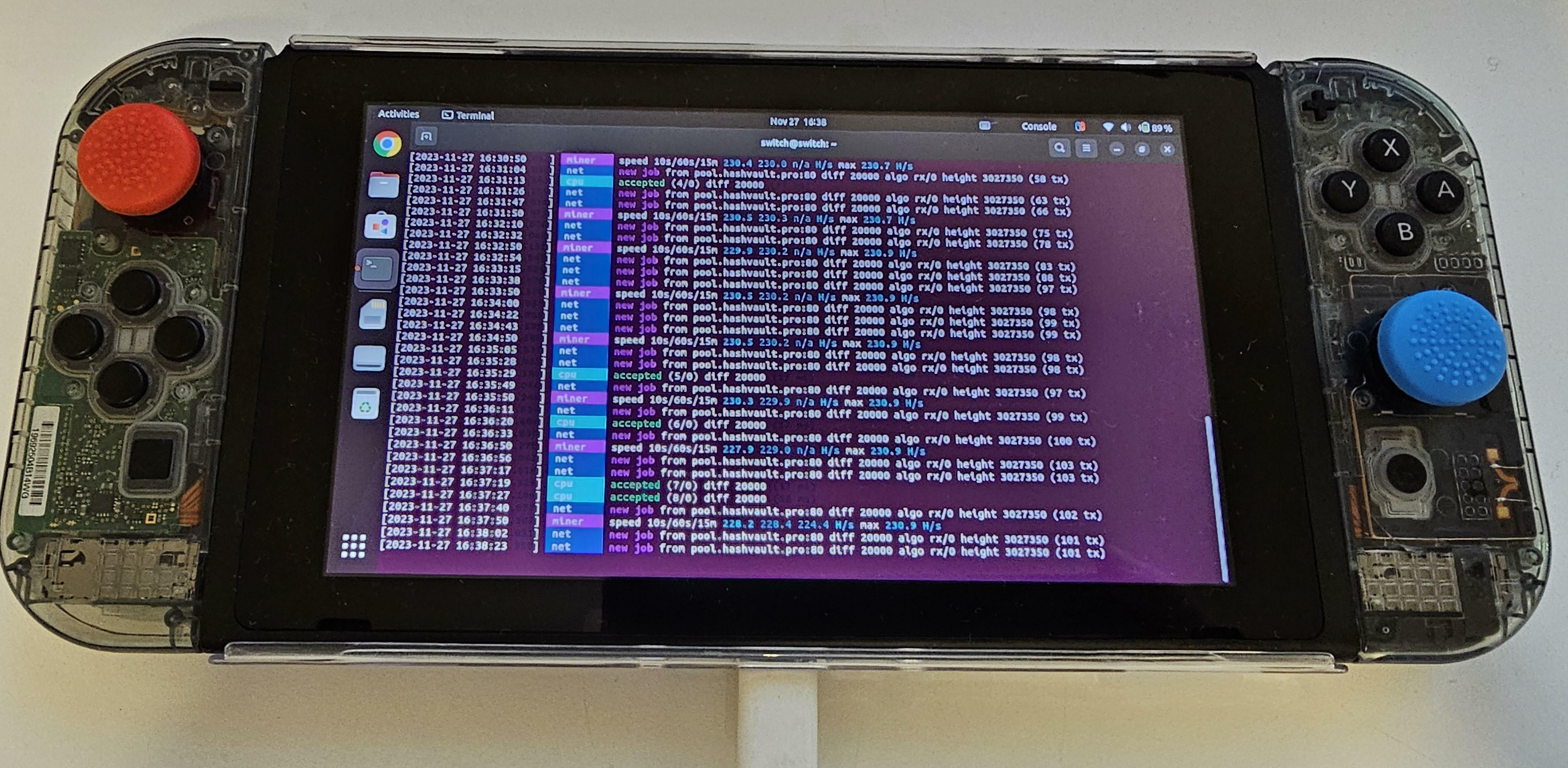
Can you mine crypto with a Nintendo Switch? https://cryptonews.net/news/mining/27918548/
Interestingly, RandomX, the Monero mining algorithm, allows for alternative experiments like this due to being ASIC-resistant. Miners can use simple CPUs or gaming devices to run the algorithm and try their luck at block discovery while supporting network security.
The linked article (and so AutoTL;DR) is not very accurate. If you’re interested in this incident, read the original post, which is short and compact. General media articles are only quoting or re-quoting this thread, typically with some misunderstanding.
Specifically (about this post): Among other things, multisig is only suggested; nothing has been decided yet.
Generally (in many similar articles): Probably a specific local machine was hacked, though no one really knows yet what happened. It’s unlikely that the Monero network itself was hacked.
Since I’m a Monero supporter, obviously I tend to say good things about it, but frankly, the ironical fact here is, Monero is so privacy-focused that when something like this happens, it’s difficult to identify the attacker—i.e. by design Monero also protects the identity of the attacker. Some Monero users are having this weird, paradoxical feeling: it would be nice if we could catch this evil attacker, but being able to catch the attacker would be in a way very bad news for Monero (if you know what I mean) 😕
For example "3 (1 New)" is understandable: there are 3 comments, of which 1 is new. But I sometimes also see things like "6 (-3 New)", "5 (-1 New)", where the number of new comments is negative. Is this some kind of known bug, or is it by design actually meaning something? It's totally harmless, but weird...
Don't forget about the proposed Client-Side-Scanning in EU too!


They have ignored this request for almost 10 years. https://protonmail.uservoice.com/forums/935538-accounts-payments/suggestions/33188971-accept-monero-for-payment
Like 3 or 4 years ago, Seth said they might soon accept Monero, but they didn't either. Proton is not too bad, to be sure, but it's been really questionable in various ways too... Better late than never, though.
Cf. elsewhere https://l.opnxng.com/r/Monero/comments/1lmuhfi/proton_to_add_monero_support_with_1000_signatures/