Historical_General

joined 2 years ago
MODERATOR OF
 

"I have the map and the key to the mountain that was used in the film in a frame," he notes. "And I have Thorin's sword and his oaken shield. It's on my bookshelf!"

Eleven years ago, Tolkienites rejoiced as The Hobbit: An Unexpected Journey landed in UK cinemas. With Lord of the Rings director, Peter Jackson, at the helm, a legion of actors including Martin Freeman, Ian McKellen, Cate Blanchett, and Orlando Bloom signed on to star.

Joining them, British actor Richard Armitage won the role of Thorin Oakenshield – the legendary King of Durin's folk. Determined to reclaim the Lonely Mountain from Smaug, and secure the coveted Arkenstone, Thorin's redemptive story of greed made him one of the most interesting characters in the trilogy.

Reflecting on The Hobbit's enduring legacy and the profound effect that the franchise had on him, Richard, 52, spoke exclusively to HELLO! about his time on set.

On why the role of Thorin was so special to him, Richard explained: "It had an impact on me because I think The Hobbit was one of the first books I ever read where I really allowed my imagination to engage.

"I was completely absorbed by Tolkien. Then I found Lord of the Rings and I think it was where my early feelers were going towards being an actor, but I didn't realise it at the time," he continued.

"So, when I came to playing Thorin Oakenshield as a 40-year-old, I was retracing my steps right back to being an eight-year-old in school and finding that book for the first time. So, it was just such a massive thing for me."

As for his time on set, Richard revealed a particularly poignant memory from day one of production.

"One of the fondest memories I had was on the very first day of shooting when Peter Jackson blessed his new sound stage with a Māori Haka. I had to speak Māori to the crew because they saw my character as the King of the Dwarves," he tells HELLO!.

"And so they asked me to make this speech in Māori and the door was lifted and the sun was rising across the floor and it was incredibly moving. It was a really special moment."

After wrapping the trilogy with The Hobbit: The Battle of the Five Armies (2014), Richard was able to take home a number of his most treasured possessions from the set, which he continues to cherish.

"I have the map and the key to the mountain that was used in the film in a frame," he notes. "And I have Thorin's sword and his oaken shield. It's on my bookshelf!"

After the success of the Lord of the Rings and The Hobbit, Tolkeinites have since entered the Rings of Power era, following the release of Amazon Prime's high fantasy series in 2022.

With the show renewed for a second season, naturally, we had to ask if Richard would be interested in a role of some sort. "I mean, I would love to, but I think it's very hard to do that. I'd have to be a different character because you couldn't bring Peter Jackson's version of Thorin Oakenshield into somebody else's. But I love the story," he said.


I was binge-watching the DVDs with my wife, Sarah, when it hit me: Middle-earth does exist, and I don’t need a portal. I can fly there in 23 hours. I turned to Sarah and said, “Shall we move to New Zealand?” One of the many things I love about my wife is that she listens to my madder ideas with a careful seriousness. Six months later we were in Auckland.

This has strong Bilbo Baggins vibes lol.


What The Hobbit Animated Movie Did Better Than the Peter Jackson Trilogy

The animated adaptations of The Hobbit and The Lord of the Rings from the 1970s and 1980s have a bit of a bad reputation these days, but these are not entirely deserved. In particular, Arthur Rankin Jr. and Jules Bass’ 1977 TV movie of The Hobbit, with a screenplay by Romeo Miller, gets a lot of things right that Peter Jackson’s three-part live-action film adaptation did not.

The most obvious advantage that the animated version has over the live-action films is its length. The fact that the live-action movies are too long is pretty well-established, but by way of a reminder, the book of The Hobbit is about 300 pages long, with slight variations in each edition. Other books of similar length that have been adapted into films include Jane Austen’s Pride and Prejudice, Emma Donoghue’s Room, John Green’s The Fault in Our Stars, and Harper Lee’s To Kill a Mockingbird. One thing all of these have in common, is that they were adapted into one single film, two to three hours long. Pride and Prejudice has also been adapted into a six-hour miniseries by the BBC, but none of them have been stretched out to just under eight hours, which is the combined length of the theatrical cuts of the three live-action Hobbit movies. (They’re just under nine hours if you are watching the extended editions though.)

The Rankin/Bass version of The Hobbit, on the other hand, is a mere one hour and 17 minutes, which you could almost argue is actually too short. The introductions of Elrond—who has an inexplicable crown of stars around his head for no apparent reason—and Beorn, for example, could have done with a little more room to breathe. But for a fairly slight story, a runtime that is a little too short feels like an improvement on a runtime that is far too long.

One thing both versions “get right,” that is, they do it really well, is the music, but the Rankin/Bass film uses music in a different way to the live-action movies. In Jackson’s 2012 film The Hobbit: An Unexpected Journey, Howard Shore’s “Far Over the Misty Mountains Cold,” performed by Richard Armitage and the other dwarves in an incredibly evocative basso profundo voice, is a thing of beauty. The Rankin/Bass The Hobbit also features a musical setting for the same song from the book, and although it lacks the power of that incredible bass voice, it’s a good piece of music in its own right.

But the Rankin/Bass movie doesn’t stop there; it’s actually a musical with relatively short songs being peppered throughout the story. This is a completely valid choice too. Author J.R.R. Tolkien’s books are full of songs, and nearly all of the songs that appear in the film are samplings of Tolkien’s own songs from the book using his lyrics. The only exception is the theme song, “The Greatest Adventure,” which is a complete original.

Making the film as a musical also fits with the overall tone viewers would have expected from Rankin/Bass. The studio was known for its holiday specials—made-for-television, animated or stop-motion films that usually aired around Christmas time. Rudolph the Red-Nosed Reindeer (1964) and Frosty the Snowman (1969) had already become holiday staples by the time of The Hobbit. Both heavily featured music and songs, and Rudolph was a musical feature with several different songs included throughout the story. A musical with short songs appearing frequently is something audiences would expect from the Rankin and Bass studio. And they also expected the studio to produce animations aimed at a “family” audience, primarily children. This is the biggest thing Rankin and Bass got right and that the Jackson movies get wrong: The Hobbit is a story for children.

When Tolkien originally imagined The Hobbit in the 1930s, it was as a story for his own children, and was not originally connected to the wider mythology of Middle-earth. It was only as time went on that the story got drawn into his bigger mythmaking project. And while The Lord of the Rings is clearly a novel aimed at an adult readership, The Hobbit is equally clearly intended for a younger audience. Bookshops these days generally shelve it with Middle Grade fiction aimed at children aged roughly eight to 12, not far from Tolkien’s friend C.S. Lewis and his Narnia books (which Tolkien did not like, and probably would not appreciate seeing next to his own work!).

In fairness to Peter Jackson, Tolkien did come to regret the tone and style of The Hobbit. This was partly because it made it stick out like a sore thumb next to his other writing about Middle-earth, but also because Tolkien came to believe passionately that children should not be talked (or written) down to, and that children’s literature did not require some kind of special, slightly silly tone. In a letter to W. H. Auden in 1955, Tolkien said of The Hobbit: “It was unhappily really meant, as far as I was conscious, as a ‘children’s story’, and as I had not learned sense then… it has some of the sillinesses of manner caught unthinkingly from the kind of stuff I had had served to me… I deeply regret them. So do intelligent children.”

There’s an argument to be made, therefore, that The Hobbit should be transformed into something with a darker, more adult tone in an adaptation. Jackson probably felt he had little choice in the matter anyway since his live-action Hobbit movies were prequels to his live-action The Lord of the Rings movies—and those, as is appropriate to The Lord of the Rings, have a tone of high epic fantasy with an intended audience of adults and older teenagers.

But Tolkien regretted the tone and style of The Hobbit, not because he regretted writing it for children, but because he felt that writing for children should not engage in “sillinesses of manner.” It is still a story intended primarily for children, and while of course film adaptations have to make changes, the Rankin and Bass film feels more like it captures the spirit of The Hobbit because it is aimed primarily at children. There are no lewd jokes, the scary sequences are kept at an appropriate level, and of course, the runtime will not test the patience of elementary school aged children too much.

One of the main ways Rankin and Bass make it clear that this is a film intended for children and their families is by deliberately echoing aspects of Disney’s animated films. The decision to make the film a musical is one obvious similarity with Disney’s animated fairy tales, but there are others as well. The similarity in the character design of the dwarves in The Hobbit to the dwarfs from Disney’s 1937 classic Snow White and the Seven Dwarfs is not a coincidence. (By the way, if anyone is wondering, Tolkien was quite particular about the fact that his imaginary creatures were dwarves, as opposed to dwarfs. In his Author’s Note at the beginning of The Hobbit, Tolkien explained that “in English the only correct plural of dwarf is dwarfs, and the adjective is dwarfish. In this story dwarves and dwarvish are used, but only when speaking of the ancient people to whom Thorin Oakenshield and his companions belonged.”)

Join our mailing list

Get the best of Den of Geek delivered right to your inbox!

To cement the Disney-like feel, the film opens on an image of a big, hard-bound and illustrated book, just like Disney’s Snow White, Pinocchio (1940), Cinderella (1950), Sleeping Beauty (1959), The Sword in the Stone (1963), The Jungle Book (1967), and Robin Hood (1973). Interestingly, Rankin/Bass’ The Hobbit opens on an image of the book, by J.R.R. Tolkien, with the author and the famous first line (“In a hole in the ground there lived a hobbit”) clearly visible. The end of the movie, on the other hand, shows Bilbo’s in-universe Red Book, titled There and Back Again: A Hobbit’s Holiday, before finishing on an image of the One Ring, glinting in a glass case on Bilbo’s mantelpiece. Both clearly parallel the Disney trope, especially the opening, which places the story firmly in a fictional, “fairtytale” universe.

There are of course some things the Jackson movies got right that the Rankin/Bass version did not. One of the more inexplicable decisions made for the animated movie was to increase the body count of named characters in the climactic Battle of the Five Armies. In Tolkien’s novel, and in Jackson’s film, the only three members of the Company to die are Thorin, Kili, and Fili. Rankin and Bass, however, kill off seven of the Dwarves, only even naming Thorin and Bombur, both of whom die on screen. We can assume that Kili and Fili were among the seven killed and that Balin survived (since he has to go and die in Moria sometime between The Hobbit and The Lord of the Rings), but it is a mystifying decision, especially since films aimed at children do not usually increase the body count.

The Jackson movies also include some fantastic sequences that, taken on their own, are perfect screen adaptations of scenes from the book. Bilbo’s riddle-game in the dark with Gollum under the Misty Mountains in An Unexpected Journey and his verbal sparring with Smaug in The Desolation of Smaug are near perfect, helped by fantastic performances from Martin Freeman as Bilbo, Andy Serkis as Gollum, and Benedict Cumberbatch as Smaug. The casting is all around pretty perfect, especially Freeman, and while Legolas’ added storyline was controversial, the character really is supposed to be the son of Thranduil, the King of Mirkwood, and it’s rather nice to see him slotted in there, even if the role he is given is not to everyone’s taste.

Overall though, the Rankin/Bass animated adaptation of The Hobbit, whatever its flaws, feels like it captures a bit more of the feel of the book, even if it leans quite heavily toward a more Disney-like tone. And if you have young children, you are almost certainly better off trying to show them this version instead of the live-action films. That is if you are too impatient to wait until they are old enough to read the book!

[–] Historical_General@lemm.ee 0 points 2 years ago* (last edited 2 years ago) (2 children)

Seems unlikely they'd do that, perhaps the angle you took might have triggered them. They tend to know their history and cite well, and get lied about a lot, so they're suspicious of people who might get details wrong and probably take them for trolls.

their savior Karl M

Obviously I can't fairly judge what you wrote but you are at the very least not left wing right?


“Eucatastrophe”: Tolkien on the secret to a good fairy tale

  • For J.R.R. Tolkien, the single most important element of a fairy tale was the dramatic reversal of misfortune in the story's ending. *

Key Takeaways

  • In Greek mythology, the story of Pandora's box comes in (at least) two versions. In one, hope is released as the final evil in the world. In another, hope is the only consolation and weapon we have.
  • J.R.R. Tolkien coined the word “eucatastrophe” to describe a hallmark of good fairy tales: Good people win out despite the odds. Hope, in other words, is a vital story component.
  • For Tolkien and the Christian existentialist Gabriel Marcel, hope is the most important disposition we can possess. Without it, the darkness of the world will win out.

There are at least two versions of the story of Pandora’s box. In the classic version from the Greek poet Hesiod, when Pandora’s curiosity got the better of her, she unleashed into the world all sorts of evils: sickness, famine, death, and people who ask questions at the end of a meeting. When Pandora finally closed the jar, she left only one “evil” inside: hope. For Hesiod, there’s nothing so cruel as hope. Hope is what forces us to carry on building, fixing, and loving when the world offers only destruction, chaos, and heartbreak. It’s what gets us off the ground only to be punched back down. Hope is the naivety of a fool. As Friedrich Nietzsche put it, “Hope, in reality, is the worst of all evils because it prolongs the torments of man.”

Another variation of the Pandora’s box story is a Greek fable called “Zeus and the Jar of Good Things.” In this account, everything is inverted. The jar does not contain misery but good things. When “mankind” (there’s no Pandora in this version) opened the jar, they let out and lost all these good things: the things that would have made life a paradise. When the lid was closed, there was only one divine blessing left: “Hope alone is still found among the people.”

The author J.R.R. Tolkien and the Christian existentialist Gabriel Marcel would likely prefer the second version. After all, they considered hope to be perhaps the most important part of being human.

The eucatastrophe

Kurt Vonnegut is famous for writing novels like Slaughterhouse-Five and Cat’s Cradle. In storytelling circles, he’s famous for his “shapes of stories.” These were eight diagrams that define the traditional arcs of common stories, like “Boy Meets Girl” or “From Bad to Worse.” His arc about fairy tales goes like this: Things start badly and then get a bit better. But then there’s a catastrophe that brings everything to ruin. The story ends with a drastic upheaval in fortunes — a transformation and magical finale — and everyone lives happily ever after.

Tolkien, were he alive, would agree. For him, the single most important element of a fairy tale is this final dramatic reversal of misfortune. He coined the word “eucatastrophe” to describe it. “The consolation of fairy-stories [is] the joy of the happy ending: or more correctly of the good catastrophe, the sudden joyous ‘turn,'” Tolkien wrote. The Lord of the Rings does not end with the hobbits dead and Sauron cackling over his orcish, industrial empire. It ends with light beating dark — with simple kindness, love, and companionship winning out over evil.

Lifting the heart

Tolkien is very careful to make the point that this is not some form of escapism. It’s not quixotic wish fulfillment. It does not pretend the world is an endlessly happy idyll of singing dwarves and affable wizards. The world has great suffering and misery, and there are plenty of nightmares to be found. The eucatastrophe, though, is “the joy of deliverance; it denies (in the face of much evidence, if you will) universal final defeat.”

The purpose of a good fairy story is not to hide the shadows of the world. The original Grimms’ Fairy Tales (not the sanitized Disney versions) were full of infanticide, cannibalism, and horror. The mark of a good fairy story, Tolkien wrote, “…[is that] however fantastic or terrible the adventures, it can give to child or man that hears it, when the “turn” comes, a catch of the breath, a beat and lifting of the heart, near to (or indeed accompanied by) tears.”

Hope is all we have

The religious undertones here are not accidental. Tolkien was a Catholic who was fond of the redemption and grace found in the narratives of the Bible. Marcel did not, as far as we know, read Tolkien, but his own philosophy of hope bears striking similarities.

What Tolkien describes as the eucatastrophe, or final deliverance, Marcel called hope. For Marcel, “Hope consists in asserting that there is at the heart of being, beyond all data, beyond all inventories, and all calculations, a mysterious principle which is in connivance with me.”

Hope is the belief in an order to the Universe — an order where everything will turn out well enough. It is a kind of faith that simply refuses to accept that things are broken, or that misery, suffering, and death are all that exist. Marcel was a Christian, but his account of hope can apply to anyone. The hopeful of the world are those who see the Universe as being on their side. Set against “all experience, all probability, all statistics,” they see that a “given order shall be re-established.” Hope is not a wish. It is not optimism or naivety. It is an assertion. It is telling the world, “No, this is not the way things will be; things will be better.” For both Marcel and Tolkien, it is only with hope that we banish despair.

You do not haggle with or beg the darkness. Like a blazing torch, you must shine hope brightly and fiercely.


But some people don't have the privilege of having hope. Some sit in the dark waiting for bombs and white phosphorus to fall on them, burn them and die as the world watches a genocide occur on live television. I pray for the people of Gaza, none of whom are human animals, for their existence.


A new report claims the apology posted for Lord of the Rings: Gollum was written using ChatGPT without the dev team's consent.

  • The Lord of the Rings: Gollum game received a negative response due to technical problems, derivative gameplay, uninteresting narrative, and poor graphics.
  • The apology posted by Nacon was generated by an AI-powered text generator, ChatGPT, without the knowledge of the developer, Daedalic Entertainment.
  • The game's troubled development was attributed to a lack of funds and time, leading to downscaled features and a rushed release.

According to a recent report, Daedalic Entertainment, the developer behind the infamous The Lord of the Rings: Gollum game, has claimed that the apology was generated by the AI-powered text generator, ChatGPT. This report also states the developers had no knowledge of this apology being written and that it was a decision from its publisher, Nacon. Alongside that, Daedelic Entertainment employees also went into detail about what had gone wrong with Lord of the Rings: Gollum during development.

Earlier this year, the licensed game had launched to a rather overwhelming negative response, evident with how Lord of the Rings: Gollum became one of the lowest-rated games of 2023. Several critics and fans have cited the game's technical problems being the biggest factors to this negative reception, compounded by the gameplay that many found to be derivative and uninteresting. The graphics weren't a big selling point either, nor was its narrative compelling to many. As such, the game failed to deliver on all fronts to many people, with gamers walking away unimpressed with the big licensed game. The developers have recently spoken up about its troubled development and the source of the struggles the team faced.

Anonymous employees from Daedalic Entertainment were interviewed by German gaming outlet GameTwo, with some discussing the relationship between the developers and its publisher, Nacon. One thing that was brought up was the apology regarding Gollum's troubled launch that was posted to the game's official Twitter account. According to Daedalic, this apology was written using the ChatGPT software, to which the developer had no knowledge of it being written or its content prior to its publication, claiming it was all handled by Nacon.

My favorit part. This nonpology from Nacon was written with ChatGPT. pic.twitter.com/N0ZtX2I6WZ — Knoebel (@Knoebelbroet) October 7, 2023

Regarding the apology made for The Lord of the Rings: Gollum, many gamers stated that the revelation of Nacon having used ChatGPT to generate it was the reason why it had seemed noncommittal and disingenuous. The biggest indicator in hindsight of how this apology was written without any oversight was the misspelling of the game's title, addressing it as "The Lord of the Ring: Gollum" in the post.

The average development budget of a AAA game in 2023 is usually around $50-$300 million dollars, with Gollum's budget being a more modest 15 million Euros. This lack of funds and time was a big contributing factor to why the game was released in the state it was, according to a former senior designer. The developers went into how a lot of features had to be downscaled due to this, such as one scene having to be restricted to only seeing Gollum eavesdrop on two major characters since they had no time to animate the characters. With this report, it's possible that more blame could fall on the game's publisher, Nacon, rather than the developers.

The Lord of the Rings: Gollum is available now for PC, PS4, PS5, Xbox One, and Xbox Series X/S, with a Switch version to come at a later date.

Links:

https://www.videogameschronicle.com/news/chatgpt-was-used-to-write-gollum-game-apology-its-claimed/

https://www.dexerto.com/gaming/lord-of-the-rings-gollum-apology-reportedly-written-by-chat-gpt-2327768/


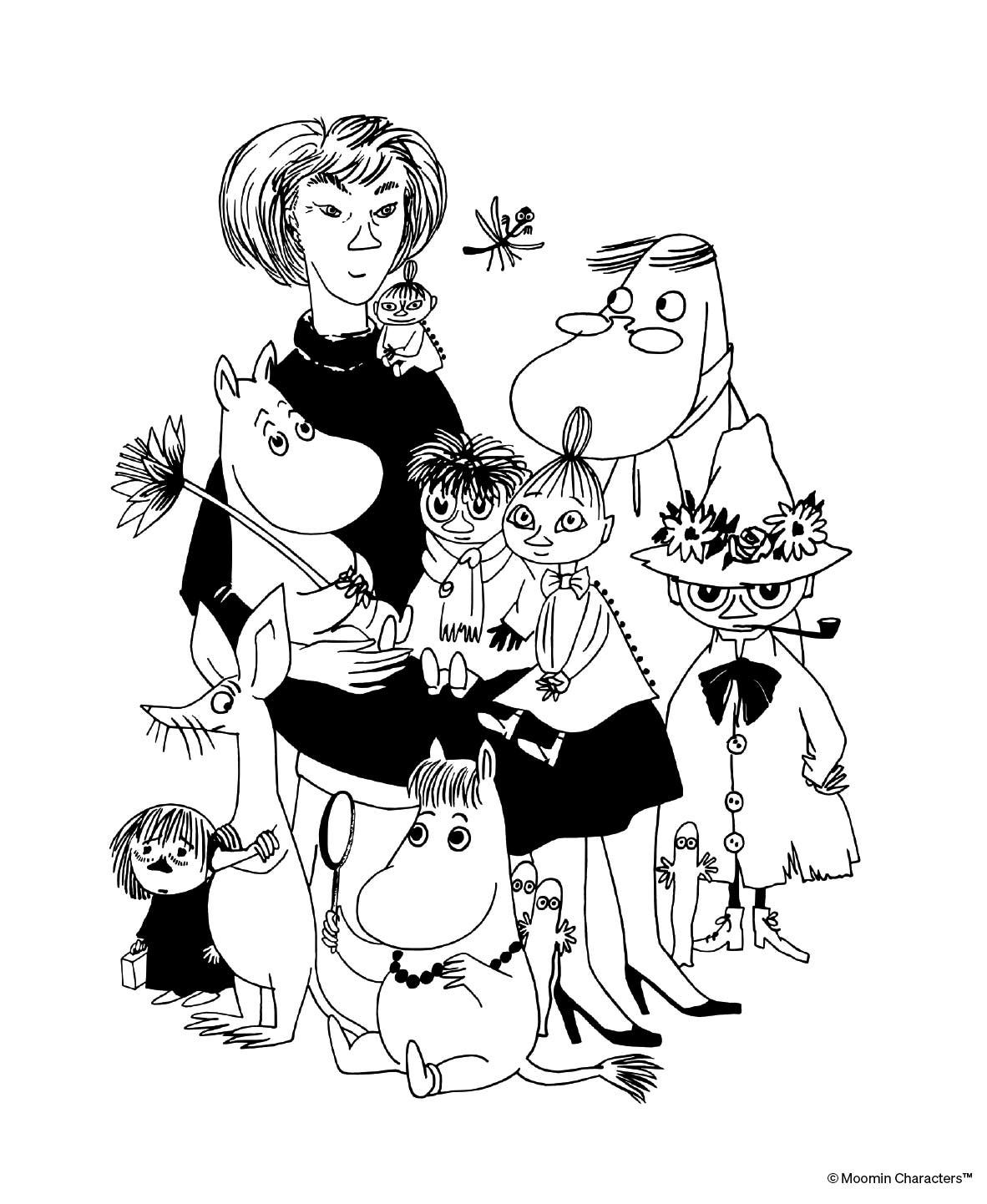
How Moomin creator Tove Jansson found her dark side illustrating Tolkien and Carroll

She thought Lewis Carroll was ‘pathological’. Her Gollum was so monstrous that JRR Tolkien amended his book’s text – but copies of Tove Jansson’s illustrated edition of ‘The Hobbit’ fly off shelves even though they remain in the original Finnish. Susie Mesure visits a new exhibition that shows how the brain behind the Moomins turned her vividly macabre eye to transform other classic books

In November 1960, Astrid Lindgren got in touch with Tove Jansson, the creator of the Moomins. Lindgren, who wrote the Swedish children’s classic Pippi Longstocking, was also a publisher – and she begged Jansson to turn her imagination to the works of JRR Tolkien. “Who will comfort Astrid if you don’t agree to the proposal I’m now going to make to you?” Lindgren wrote in a letter, riffing on the title of another of Jansson’s recent picture books, Who Will Comfort Toffle?

In the UK, as in her native Finland, Tove Jansson is, of course, best known for the Moomins, an adventurous family of fantastical creatures who live in a magical valley on the edge of a Finnish archipelago. A Moomin comic strip ran in London’s Evening News from 1954 until 1975, reaching millions of readers across the Commonwealth, and, more recently, the first new animation series about the Moomins for nearly three decades – Moominvalley – brought the white trolls to life for a new, younger generation. Fans range from devotees who grew up on books such as Finn Family Moomintroll or Comet in Moominland, to those with a penchant for collecting Moomin mugs, which Moomin Characters, the family-owned company that looks after Jansson’s legacy, still churns out year after year.

Less is known, however, about the success Jansson, a Finnish icon who died in 2001 aged 86, had illustrating the work of other writers, something a new exhibition in Paris is putting under the spotlight. Houses of Tove explores how Jansson was so much more than a comic strip creator, a job she came to loathe because it kept her from her true passions: painting and writing. The show includes a first edition of The Hobbit, or Bilbo – en hobbits äventyr, as it is known in Swedish, which Jansson jumped at the chance to illustrate for Lindgren. It also features a number of preparatory sketches she made for the commission, which were used in a 1973 Finnish translation: the first edition, featuring a wonderful red dragon hovering above a tiny army scaling jagged peaks, is on display.

Images

spoilerimage iamge imgae imaeg


cross-posted from: https://lemm.ee/post/10323811

Frickles talks Harry Potter fanfiction, writing it, and more!

(Author of A Malignant Ruse Harry/Daphne, A Discordant Pattern, etc)


edited for tone and in regard to topic at hand.

The author who wrote about hobbits, elves and orcs also translated the Book of Jonah for the Jerusalem Bible. J.R.R. Tolkien, best known for The Lord of the Rings and The Hobbit, was asked in 1957 to contribute to a new translation of the Bible coming out of England.

The task was led by Fr. Alexander Jones, an English priest who started a project to translate the Bible based on the original Hebrew and Greek texts. This was in response to Pope Pius XII’s encyclical Divino Afflante Spiritu that encouraged scripture scholars to translate anew the Bible based on the original languages, instead of the Latin Vulgate.

Fr. Jones was inspired by a new French translation and, when in doubt, the translators of the English edition consulted the French. The project was innovative and the goal was to create a modern literary translation.

Tolkien was a well-known philologist and author at the time and Jones decided to contact him in hopes that he could contribute. Tolkien accepted the task and was given the Book of Jonah. After his initial draft Jones wrote back, saying, “In truth I should be content to send you all that remains of the Bible, with great confidence, but there is a limit to generosity and opportunity!”

Unfortunately, what now appears in the Jerusalem Bible has been highly edited after Tolkien submitted his final draft. This was for various reasons, but now for the first time it is possible to read Tolkien’s original translation.

While there was a recent attempt to publish this material in book form, the only place to find it is in The Journal of Inklings Studies. It is available online, through a digital subscription, and allows Tolkien enthusiasts to see how Tolkien translated the book of the Old Testament. What ended up in the Jerusalem Bible can also be viewed here.

When comparing the two there do exist several lines that were left unedited in the final edition. For example, Tolkien translated Jonah 2:1 as, “And Yahweh appointed a great fish to swallow Jonah; and Jonah remained in the belly of the fish three days and three nights.”

This was phrasing was important to Tolkien as he wrote in a letter, “Incidentally, if you look at Jonah you’ll find that the ‘whale’ – it is not really said to be a whale, but a big fish – is quite unimportant. The real point is that God is much more merciful than ‘prophets,’ is easily moved by penitence, and won’t be dictated to even by high ecclesiastics whom he has himself appointed.”

The most “Tolkien-esque” line in the whole book is Jonah 2:6-7, which reads in both his draft and the final translation as, “The seaweed was wrapped about my head at the roots of the mountains.”

This last phrase might sound familiar and is found in The Lord of the Rings, when Gollum sees the Misty Mountains for the first time, “It would be cool and shady under those mountains. The Sun could not watch me there. The roots of those mountains must be roots indeed; there must be great secrets buried there which have not been discovered since the beginning.”

Note

Tolkien was a devout Catholic and while we don't have an entire Bible translated, this is fascinating nevertheless.

1
submitted 2 years ago* (last edited 2 years ago) by Historical_General@lemm.ee to c/tolkien@lemmy.world
 

extract

Where on earth was Middle-earth? Based on a few hints by Tolkien himself, we’ve always sort-of assumed that his stories of “The Hobbit” and “The Lord of the Rings” were centered on Europe, but so long ago that the shape of the coasts and the land has changed.

But perhaps that’s too easy and too Eurocentric an assumption; perhaps, like so many other things these days, Tolkien’s fantasy realm too is in dire need of mental decolonisation.

And here’s an excellent occasion: an Iranian Tolkienologist has found intriguing hints that the writer based some of Middle-earth’s topography on mountains, rivers, and islands located in and near present-day Pakistan.

... (read all on the site)

In an article published on Arda.ir, the web page for the Persian Tolkien Society, Mohammad Reza Kamali writes that during several years of cartographic study, “I found that maybe there are real lands [that] could have inspired Professor Tolkien, and some of them are not in Europe.”

Around 2012, Kamali’s eye stopped when it came across a Google Map of Central Asia that showed the mountain chain of the Himalayas, the peaks of the Pamirs bunched together in an almost circular area, and the huge, flat oval of the Takla Makan desert, bounded to the north by the Tian-Shan mountains.

...

But are these similarities really more than coincidences? Why would Tolkien, who was based in Oxford and steeped in English lore and Germanic mythology, turn to the Indian subcontinent for topographical inspiration? Perhaps because cartographic knowledge of that part of the world was far more general in Britain then than it is now. Until the late 1940s, the countries we know today as India and Pakistan were part of the British Empire. Detailed maps of the region would have been standard fare for British atlases.

Kamali is convinced that the topographical features on Tolkien’s map of Middle-earth are not mere fantasy, but derive from actual places in our world, and were ‘riddled’ onto the map. In that case, we may look forward to more discoveries of Tolkien’s real-world inspiration.

Here’s one example of Tolkienography—if that’s what we can call the effect of actual geography on this particular writer’s imagination—which I gleaned myself, some years ago in East Yorkshire. A local historian told me that Tolkien had been stationed in the area during the First World War, and had apparently stored away some local place names for later use. The name Frodo, he said, derived from a town where he had attended a few dances – Frodingham, a village across the Humber in northern Lincolnshire, not far from Scunthorpe (Scunto? We dodged a bullet there).

Whether that story is entirely true or not is beside the point. As fantasy fans know, any grail quest is ultimately about the quest, not the grail. In fact, to quote Mr Kamali, the treasure is important only because it’s well hidden, “by a clever professor who enjoys riddles.”


Tolkien couldn't stand cars, and his philosophy of embracing walking and biking might just be the key to a hobbit's happy and cheerful life.

Most of us who love the Lord of the Ringsbooks have felt the appeal of a hobbit’s life. These merry little folk live generally uncomplicated and joyful lives full of good cheer, song, good food and jolly (if sometimes nosey) community.

One of the most self-evident ways to live like a hobbit is also pretty counter cultural. It’s to ditch your car in favor of walking or biking to your destination instead.

Hobbits, and most of the good creatures in Lord of the Rings, consistently opt for a simpler and slower pace of life. Industrialization and polluting machinery in the series are consistently symbols of evil, embodied by Sauron and his orcs.

The series’ none-too-subtle rejection of industrialization reflects author J.R.R. Tolkien’s own personal views. After owning a car for a time when his four children were little (an experience that provided the inspiration for his little-known storybook Mr. Bliss), Tolkien sold the car and switched to a bicycle as a matter of principle.

A cautionary message from his writings is that “we must recognize the machine for what it is — a mere tool with the potential to enslave, against which we must be ever on guard.”

Tolkien’s loathing of motor-cars

It’s a little-known fact that Tolkien abhorred cars to an intense degree. As Tom Neas points out in a Geek Insider piece:

Tolkien did own a car for a short period of time. He purchased a Morris Cowley in 1932, which he named “Jo.” A few years later he replaced Jo with a new car, creatively named “Jo 2.”

Tolkien was not a good driver; on an early visit to his sister he knocked down part of a stone wall. However, he was brazen, speeding down Oxford streets with little concern for other drivers or pedestrians, crying “Charge ’em and they scatter!”

By the start of the second World War, Tolkien gave up driving, as rationing had begun. Around the same time, he noticed the damage that cars did to the landscape and never drove again, which gave rise to his more well-known negative views on cars.

Cars destroyed peace and beauty, he felt, and made life less pleasant all around. He referred to a car’s motor as the “infernal combustion engine,” as in a letter to his son in 1944,

It is full Maytime by the trees and grass now. But the heavens are full of roar and riot. You cannot even hold a shouting conversation in the garden now, save about 1 a.m. and 7 p.m. – unless the day is too foul to be out. How I wish the “infernal combustion” engine had never been invented. Or (more difficult still since humanity and engineers in special are both nitwitted and malicious as a rule) that it could have been put to rational uses—if any.

Cars symbolize “spirit of Isengard”

I don’t think it’s a coincidence that he named the villain in The Hobbit Smaug, like the smog of factories and machines.

He referred to “destroying Oxford in order to accommodate motor-cars” as an example of “the spirit of ‘Isengard,’ if not of Mordor.”

Harsh words, but does Tolkien perhaps have a point? Besides the congestion, traffic, and commotion cars cause, they can distance us from our neighbors, removing opportunities for casual daily interactions that bring so much happiness.

Loads of research support the mental and physical health benefits of walking and biking (check out the Netflix documentary Live to 100: Secrets of the Blue Zones for more!).

If you’ve ever wanted to live like a hobbit, maybe you can find an opportunity to ditch the car for an outing this week. Any chance that destination is close enough to walk or bike instead? And who knows, perhaps this outing will lead you to a memorable adventure you never would have found otherwise.

view more: next ›