Fred

joined 2 years ago
[–] Fred@programming.dev 11 points 10 months ago (5 children)

Don't forget the tech giants are all IPv6 enabled. Google Netflix Apple xhamster Facebook Microsoft are all reachable over v6.

[–] Fred@programming.dev 5 points 10 months ago

Well the "one address" bit sure :) but given the scale supported by CGNAT systems today, I don't think being able to support an entire country behind a single cluster is that far off. At which point the difficulty becomes "is the 100.64.0.0/10 block big enough"? Or maybe they're using DS-lite for the hauling from private network to the NAT.

[–] Fred@programming.dev 4 points 10 months ago

While exploring solutions, I use f or ffto mean “follow-up/to-squash” and a to mean logically separate. Sometimes other (additional) short abbreviations to know where to move, squash, and edit the changes to.

I recently discovered git commit --fixup=abcd1234: it will make a new commit with a message of fixup! <message from abcd1234>. (It's the only special thing that flag does: a specially formatted commit message, which you can craft yourself if you remember the spelling of the fixup! marker.)

When you later rebase, git rebase --interactive --autosquash will automatically mark that commit to be a fixup of abcd1234.

magit for emacs has shortcut for creating a fixup commit selecting the previous commit, I'm sure other interfaces do too.

I guess my commit descriptions get better with project lifetime

I've found that too, which I think is because as the project matures, you're more likely to make fixes or contained features, as opposed to regular "change everything" as you explore the design in a young project.

[–] Fred@programming.dev 20 points 10 months ago (2 children)

As @shane@feddit.nl says, you can use the same public port for many different destination address, vendors may call it something like "port overloading".

More importantly, you can install a large pool of public address on your CGNAT. For instance if you install a /20 pool, work with a 100 users / public address multiplexing, you can have 400,000 users on that CGNAT. 100 users / address is a comfortable ratio that will not affect most users. 1000 users / address would be pushing it, but I'm sure some ISP will try it.

If you search for "CGNAT datasheet" for products you can deploy today, the first couple of results:

[–] Fred@programming.dev 18 points 11 months ago* (last edited 11 months ago)

This is the behaviour of inet_aton, which ping uses to translate ASCII representations of IPv4 addresses to a 32 bit number. Its manpage: https://man7.org/linux/man-pages/man3/inet_aton.3.html

It recognizes the usual quad decimal notation of course, but also addresses of the form a.b.c or a.b, or in this instance, a, with is taken to be a 32bit number.

Each part can also be written in hex or octal, with the right prefix, such that 10.012.0x800a is as valid form for 10.10.128.10.

Not all software use inet _aton to translate ASCII addresses. inet_pton for instance (which understands both v4 and v6) doesn't

[–] Fred@programming.dev 9 points 11 months ago* (last edited 11 months ago) (2 children)

Inside the lambda expression you can have a comprehension to unpack the keys list to get the same sort of uplet as your "manual" example, like this:

>>> items = [{"core_name": "a", "label": "b"},{"core_name": "c", "label": "d"}, ]
>>> keys = ["core_name", "label"]

>>> tuple(items[0][k] for k in keys)
('a', 'b')

>>> sorted(items, key=lambda d: tuple(d[k] for k in keys))
[{'core_name': 'a', 'label': 'b'}, {'core_name': 'c', 'label': 'd'}]
[–] Fred@programming.dev 0 points 11 months ago* (last edited 11 months ago) (1 children)

Would some battons (like that: https://www.wickes.co.uk/Wickes-Redwood-PSE-Timber---44-x-44-x-2400mm/p/9000281515, or possible smaller depending of the profile of your table), fixed to the underside of the gaming top so that they're leaving a negative image of the fixed table top? That way, once installed, the gaming top can't slide around. That would only work well in my mind if the gaming top is a single piece.

Edit: with that idea, minimal length of the gaming is that of the table plus two thicknesses of the baton you'd use, ie. more than the 20mm you seem to have in mind. Maybe, maybe not an issue.

For the cover, I'd consider a felt with a waterproof backing, although I don't have a specific material in mind. If you don't add felt, I'd soften the angles of the MDF.


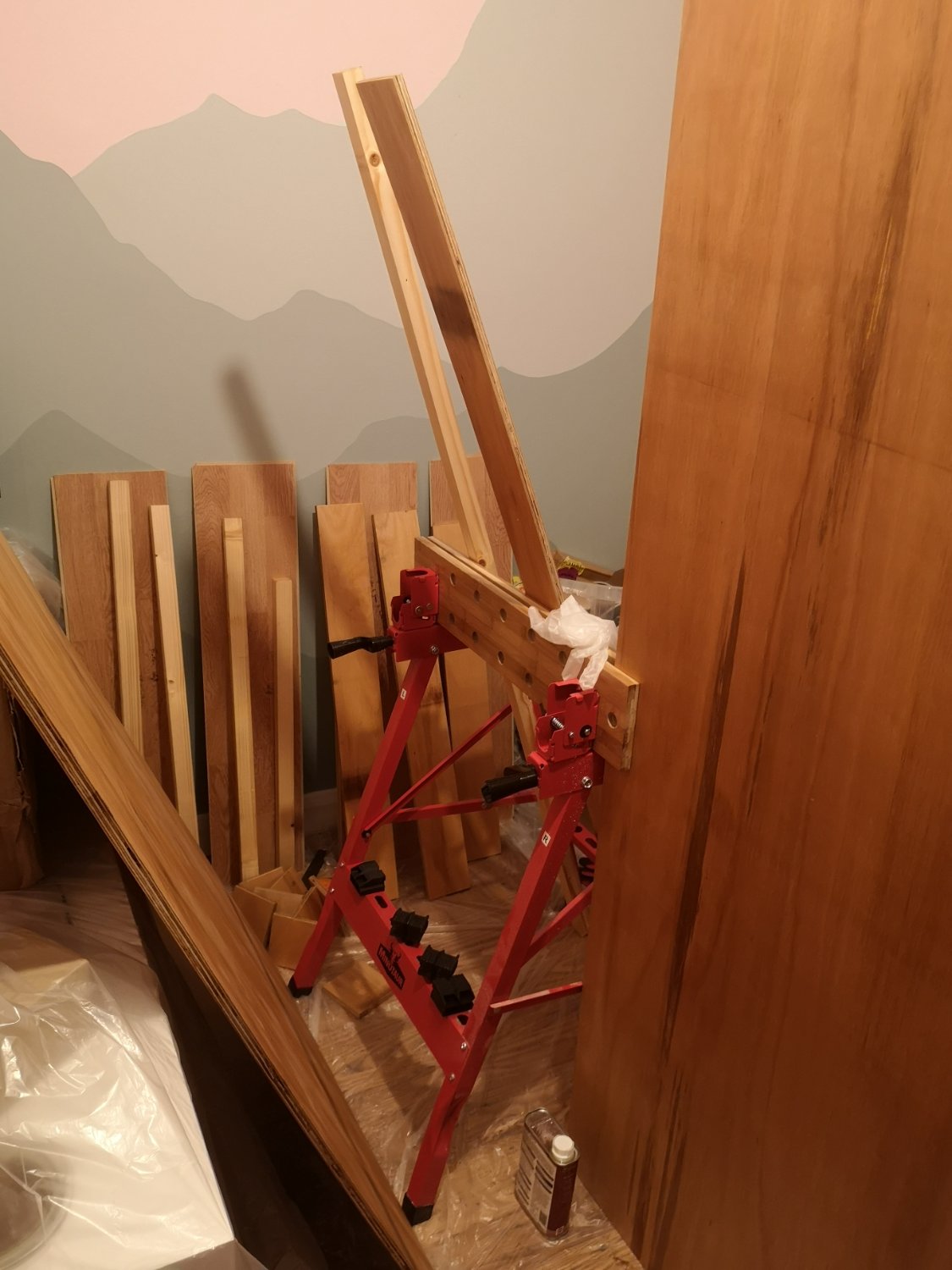
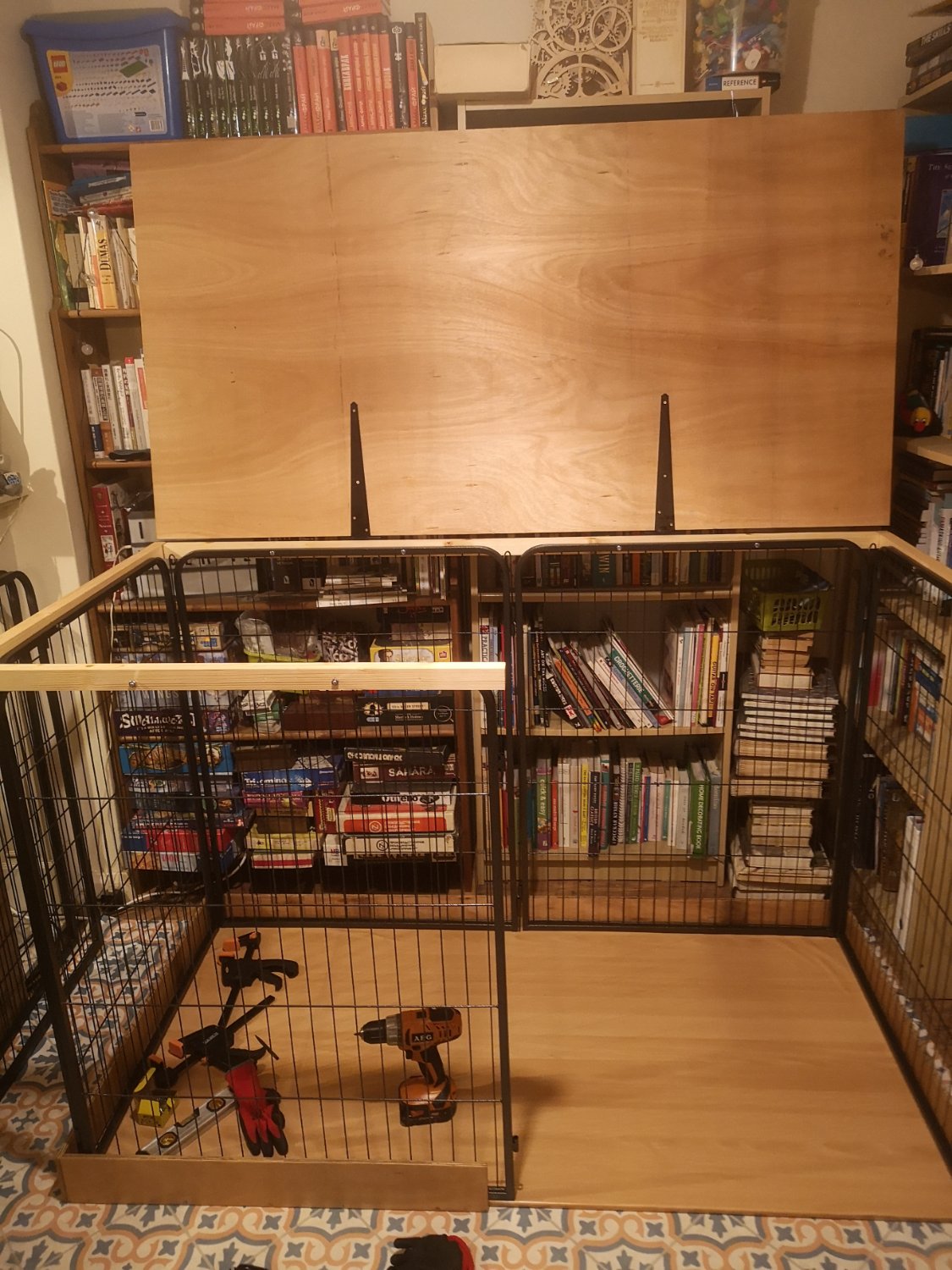
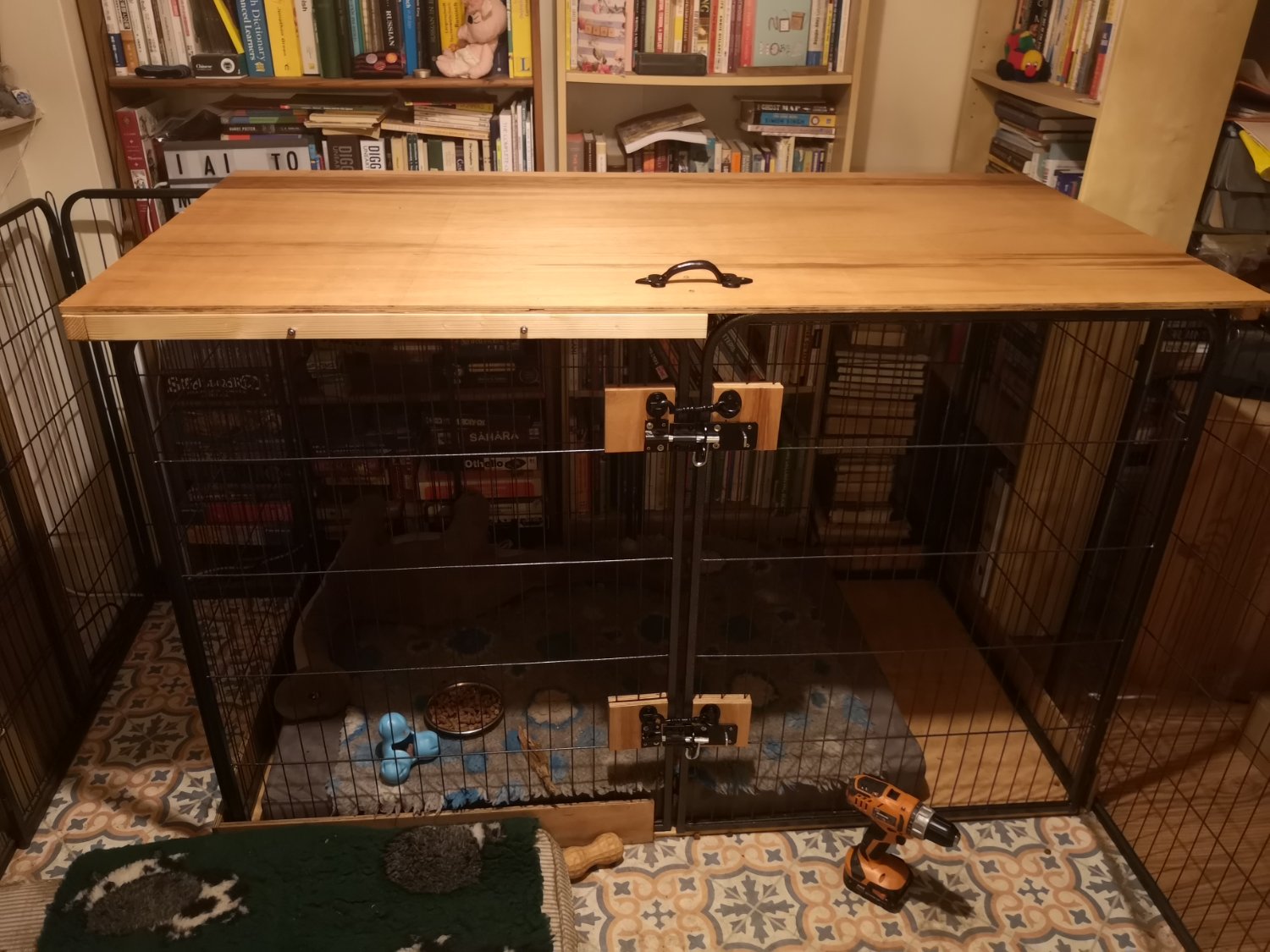
I made a crate for puppy! He keeps outgrowing the ones we bought, so I made a large one out of his playpen panels that should be big enough until he's fully grown.

The floor is a sheet of plywood. I put vinyl wrap on it for waterproofing (turns out it's too fragile, by the time I made the rest I made a couple of tears).

For the top, I made a lip out of PSE wood (I think 25mm), to give more rigidity and allow fitting a hinged top.

Cabin hooks for the door, but they turned out to be too loose, so I added a Brenton bolt.

Puppy likes it, so overall a success!

Progress pictures :
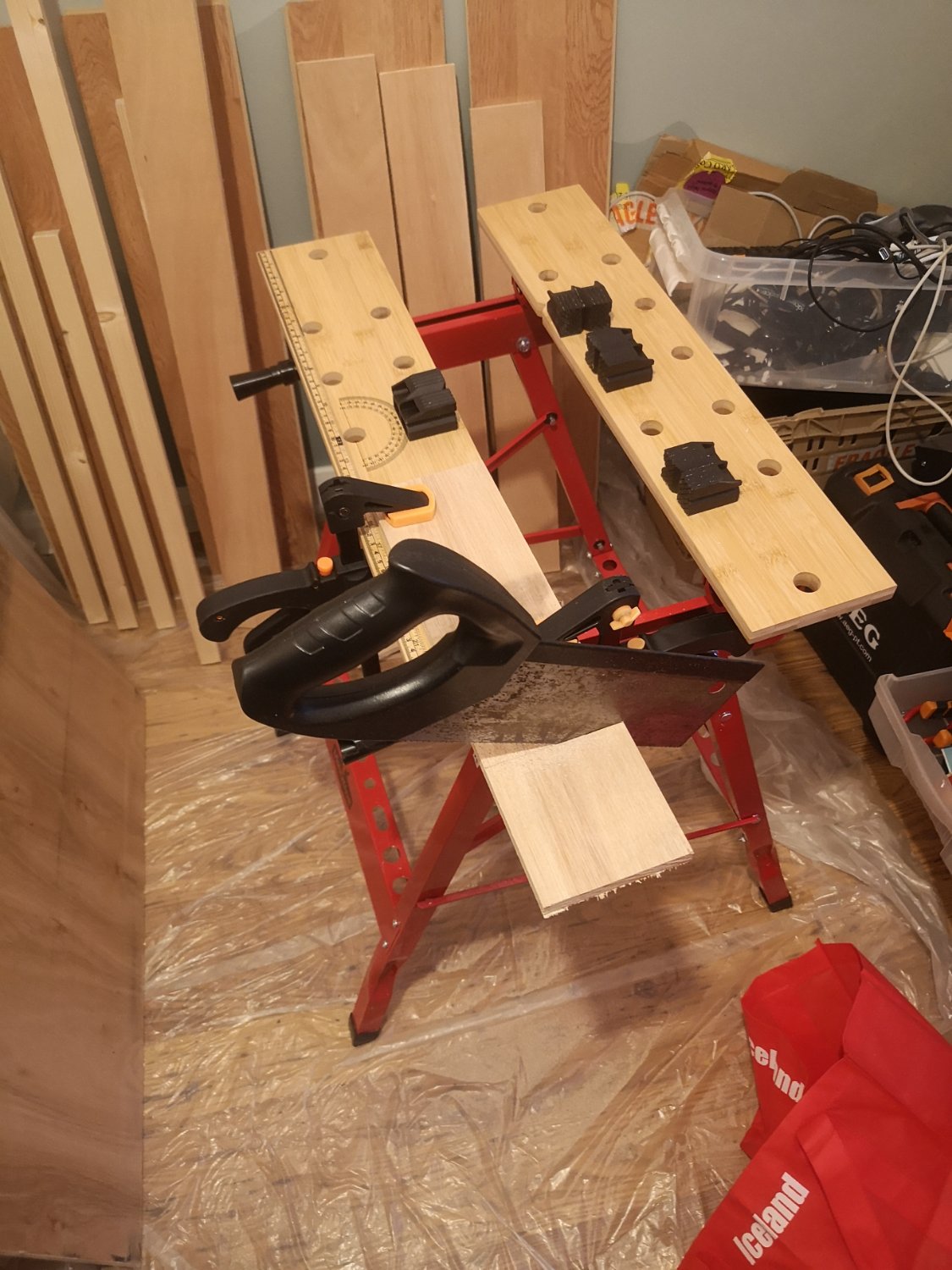
The host of the crate:

 

Hi,

Weekend before last (ie Sunday 24th) I applied tung oil to plywood (simply described as "12mm hardwood plywood" by the DIY shop). One week and a bit later, it looks dry to the eye, there is no shiny spot, the wood has a warmer colour, but if I run my fingers on the surface I get a tiny amount of oil.

I applied the oil by pouring a small amount on the surface of the wood then rubbing with an old rag, leaving no pool of oil.

Sunday (the day before yesterday ) I used kitchen towels to try to dry it off. The towels picked up a tiny bit of oil, but evidently not everything.

Is tung oil that slow to dry? Should I wait another week? Can I do something to help the process along? (Sanding or steel wool? Too aggressive for the thin veneer of plywood? Rub with a small amount of white spirit? )

I'm making a crate for Puppy who has outgrown two crates already, I picked the oil that was advertised as food & toy safe without realising how difficult it'd be to apply. In fact that's my most ambitious project to date, I'm really a beginner.

Puppy tax: Proud puppy on a trunk

[–] Fred@programming.dev 4 points 2 years ago

And Fabrice Bellard, the original author of ffmpeg, went on to create qemu which pretty much made open-source virtualization possible. Also TCC (even if I don't think that one is widely used), he established a world record for computing decimals of Pi using a single machine that had ~2000× less FLOPS than the previous record, and so much more...