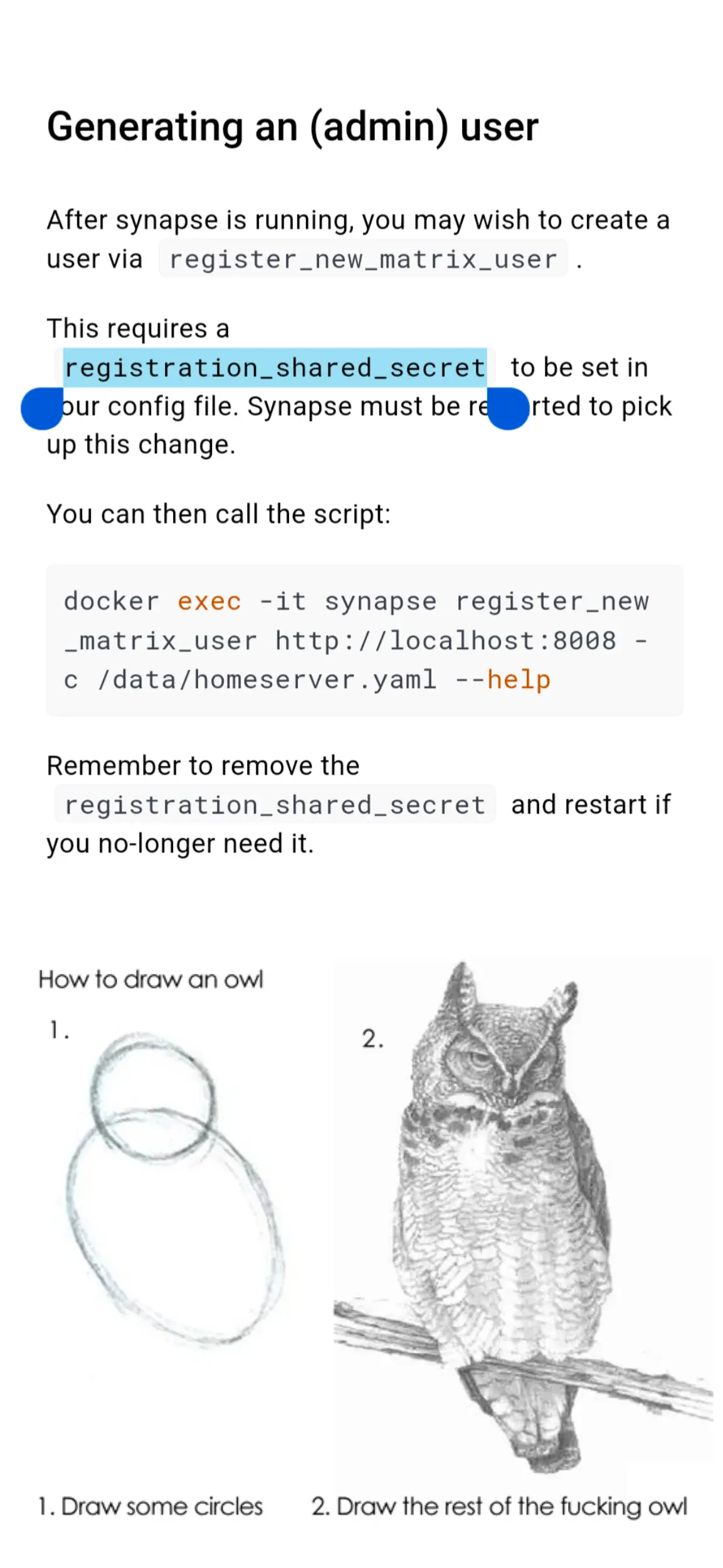
Yeah the documentation (if it even exists) of most projects is usually clearly written by people intimately familiar with the project and then never reviewed to make sure it makes sense for people unfamiliar with it. But writing good detailed documentation is also really hard, especially for a specialist because many nontrivial things are trivial to them and they believe what they're writing is thorough and well explained even though it actually isn't.
Selfhosted
A place to share alternatives to popular online services that can be self-hosted without giving up privacy or locking you into a service you don't control.
Rules:
-
Be civil.
-
No spam.
-
Posts are to be related to self-hosting.
-
Don't duplicate the full text of your blog or readme if you're providing a link.
-
Submission headline should match the article title.
-
No trolling.
-
Promotion posts require active participation, with an account that is at least 30 days old. F/LOSS without a paywall has exceptions, with requirements. See the rules link for details.
Resources:
- selfh.st Newsletter and index of selfhosted software and apps
- awesome-selfhosted software
- awesome-sysadmin resources
- Self-Hosted Podcast from Jupiter Broadcasting
Any issues on the community? Report it using the report flag.
Questions? DM the mods!
I write technical documentation and training materials as part of my job, and the state of most open source documentation makes me want to stab people with an ice pick.
Do you have some reading recommendations on how to write good documentation, e.g. readmes for end users?
as a chronic documentation reader, the best advice i can give is to document everything Anything that the user can and will potentially interact with, should be extensively documented, including syntax and behavior. Write it like you're coming back to the project in 5 years after having done nothing and you want to be able to skip right to using it. When we build something ourselves, we often hold a bit of internal knowledge from the design process that never quite goes away, so it's almost always a lot easier for us to reverse engineer something we've made, than it is for someone else with zero fore-knowledge to do it themselves.
Generally this can be a bit of a nightmare, but if you minimize the user facing segment it's not all that bad, because it's usually pretty minimal, and what would otherwise be a handful of pages, turns into 10 or maybe 15.
as for existing documentation, the i3wm user guide is really good, it's pretty minimalist but it leaves you enough to be able to manage.
You're doing God's work!
Over my career, it's sad to see how the technical communications groups are the first to get cut because "developers should document their own code". No, most can't. Also, the lack of good documentation leads to churn in other areas. It's difficult to measure it, but for those in the know, it's painfully obvious.
Jesus, technical people are some of the worst communicators I've ever worked with.
It's not necessarily their fault though. Y'know who goes into technical jobs? People who often prefer to work with machines, physical stuff, laws of nature, that's who. And often because it's MUCH easier than working with people, at least for them.
On top of that, soft skills are HARD. Communication is HARD. It comes easier for some, but it's a skill like any other. It's the technical socialites, the diplomatic devs who become the best managers and leaders, due to the rarity of their hybrid skillsets.
I'm in the middle. Just technical enough to mostly understand the devs and understand the implications of plans, and just enough soft skills to turn that into decent documentation, emails, and working with clients.
SUCKS that I've gotten a taste of project management and hated the absolute fuck out of it. I probably would've been decent at it otherwise.
"Well--well look. I already told you: I deal with the god damn customers so the engineers don't have to. I have people skills; I am good at dealing with people. Can't you understand that? What the hell is wrong with you people?"
This reminds me of when I sent someone a program in a zip folder. Windows now opens zip folders by default, and it looks just like any other folder.
So of course they opened the zip and double clicked the exe, but everyone knows you can't open an exe inside a zip folder (at least, if the exe depends on the folders and files around it). If you try to, windows will extract the exe into a temp space, but leave all the dependencies behind. So the exe promptly crashes.
I didn't think I needed to specify "you need to extract the contents of the zip folder first, then run the exe." It feels like saying "you need to take the blender out of the box before you can use it. And not just the _base _ of the blender, you have to take out all the parts."
Some things just feel so much like second nature that we forget.
I totally and completely blame Microsoft for this. They do so many other ridiculous things in the name of not confusing the average tech illiterate user.
Clicking a Zip file and having it transparently open and treating it like a regular folder when it is not. This. THIS is borderline criminal.
Propose a better way to browse the contents of a zip folder in a native 1st party way