this post was submitted on 29 Jun 2026
1350 points (98.6% liked)
Work Reform
16761 readers
115 users here now
A place to discuss positive changes that can make work more equitable, and to vent about current practices. We are NOT against work; we just want the fruits of our labor to be recognized better.
Our Philosophies:
- All workers must be paid a living wage for their labor.
- Income inequality is the main cause of lower living standards.
- Workers must join together and fight back for what is rightfully theirs.
- We must not be divided and conquered. Workers gain the most when they focus on unifying issues.
Our Goals
- Higher wages for underpaid workers.
- Better worker representation, including but not limited to unions.
- Better and fewer working hours.
- Stimulating a massive wave of worker organizing in the United States and beyond.
- Organizing and supporting political causes and campaigns that put workers first.
founded 3 years ago
MODERATORS
you are viewing a single comment's thread
view the rest of the comments
view the rest of the comments
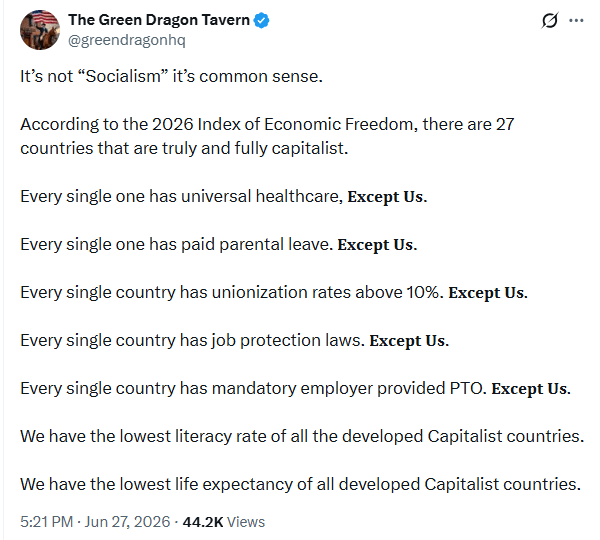
Bro, it's socialism.
Some of it is national socialism, so maybe don't get too enthusiastic about how the Brits segregate out their health care services or the Germans treat unemployed immigrants or the French handle non-native speakers trying to form a union.
But all of this has socialist economic organizing at its foundation.
Socialism refers to collective ownership of the means of production. Social democracy refers to a capitalist market economy supplemented by welfare programs, labor protections, and public services. The two terms are not interchangeable despite frequent misuse on the internet. You are describing and advocating for social democracy not socialism.
https://youtube.com/shorts/zMmjKRettxA
The systems exist on a spectrum and implementations vary heavily by region, culture, and material capacity.
I'm describing nationalized health care, which is socialist in character. I'm not advocating for any system in these posts, merely warning that nationalist tenancy can lead to segregated provision of service in an economy model.
The last person I engaged with in this sub tried to convince me that slavery is perfectly legal and universally practiced throughout the United States by every state and every institution. Feel free to look through my comment history if you're curious. The man was clearly not arguing from a rational position.
As a quick summary, he was claiming that the exception clause in the 13th amendment is effectively a blanket authorization for chattel slavery. It isn't. The Constitution contains numerous other amendments that establish and protect the rights of incarcerated people, even while they are serving sentences.
That said, this can go one of two ways. I can simply tell you that you're mistaken and leave it at that, or I can go point by point explaining why, with sources and supporting evidence. I'd rather not do the latter because it's a substantial amount of work, and I don't know whether you're interested in an actual discussion or just an argument.
Socialism is not a spectrum. It is, fundamentally, the public ownership of the means of production. Nothing more and nothing less.
Universal or nationalized healthcare, by itself, is not socialism. In most countries with universal healthcare, the means of production remain privately owned. Healthcare is financed or subsidized through taxation, while private hospitals, pharmaceutical companies, and medical practices continue to operate alongside the public system.
I also don't understand why people advocate for socialism specifically. It has never demonstrated a consistently successful long-term track record. Countries that have attempted to organize their economies around it have generally struggled with inefficiency, poor management, and authoritarian tendencies.
If what you actually mean is social democracy or democratic socialism, that's a different discussion. Those systems are broadly compatible with market economies while supporting robust social programs, and those are approaches I generally support.
So my question is simple: why do you support socialism specifically?
It's not actually though. you're confusing nordic welfare states for socialism, there are even variants of socialism like market socialism with none of these.
Socialism is strictly about worker owned means of production.
I find myself correcting this misconception constantly. It is alarming how many people either don't know or don't understand what socialism actually means.
People routinely label any government subsidy, welfare program, or public service that benefits the population as "socialism." That is not what the term means. In political and economic theory, socialism is fundamentally about social or public ownership of the means of production, not simply the existence of government programs.
I suspect the persistence of this misconception is a combination of confirmation bias, the Dunning–Kruger effect, and simple stubbornness.
Nordic states reorganized themselves from feudal agrarian military economies into industrial social welfare economies over the course of the late 19th and 20th centuries. Their party politics and bureaucratic reorganization was explicitly informed by socialist theories and economic models devised during that time.
Strong unions, state owned industries, and Democratic governance gives working Scandenavians direct say over and profit from their local economies
It being inspired by socialism doesn't change the fact that the workers don't own the means of production there and it is therefore not socialism. Them having more say because they have unions is not the same.
Workers control the means of production through the democratic state
they don't though, they regulate it and apply some pressure, but these are still privately held, socialism is always in contrast to private ownership.
The Nordic Model is public ownership of high value industry (most notably, the O&G industry). They also have universal healthcare and free education, which come as a byproduct of state owned and operated medical centers and schools. And strong union membership puts a public leash on private enterprises at the level of direct worker action.
"The government controls around 35% of the total value of publicly listed companies on the Oslo stock exchange, with five of its largest seven listed firms partially owned by the state.[34]" good, but not socialism. Free healthcare and schools are not related to socialism.
Literally public ownership of means of production
35% does not make worker ownership the principal aspect of the economy, thus it is not socialist.