this post was submitted on 20 Aug 2025
53 points (98.2% liked)
Selfhosted
60054 readers
1027 users here now
A place to share alternatives to popular online services that can be self-hosted without giving up privacy or locking you into a service you don't control.
Rules:
-
Be civil: we're here to support and learn from one another. Insults won't be tolerated. Flame wars are frowned upon.
-
No spam.
-
Posts here are to be centered around self-hosting. Please ensure it is clear in your post how it relates to self-hosting.
-
Don't duplicate the full text of your blog or git here. Just post the link for folks to click.
-
Submission headline should match the article title.
-
No trolling.
Resources:
Any issues on the community? Report it using the report flag.
Questions? DM the mods!
founded 3 years ago
MODERATORS
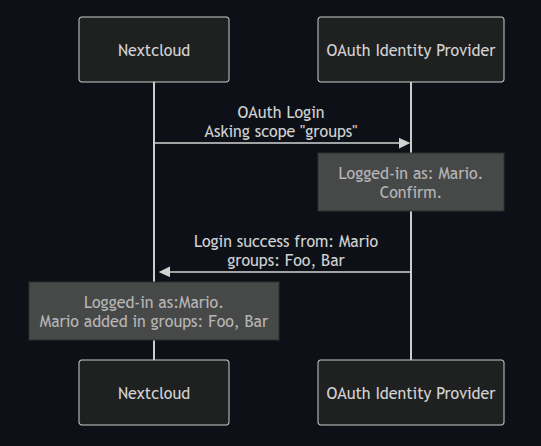
Thanks, this helped me better understand what is going on. Tried to formulate a response: https://github.com/nextcloud/server/issues/26233#issuecomment-3217564155
I’d probably add that for something like nextcloud granted scopes can be an „orthogonal”–for the lack of a better word–subset of requested scopes.
The set of requestable scopes has to be defined by the system itself, not its specific configuration. E.g. „files:manage”, „talk:manage”, „mail:read” are all general capabilities the system offers.
However, as a user I can have a local configuration that adds granularity to the grants I issue. E.g.: „files:manage in specific folders” or „mail:read for specific domains or groups only” are user trust statements that fit into the capability matrix but add an additional and preferably invisible layer of access control.
It’s a fairly rare feature in the wild and is a potential UX pitfall, but it can be useful as an advanced option on the grant page, or as a separate access control for issued grants.