Art
1180 readers
1 users here now
THE Lemmy community for visual arts. Paintings, sculptures, photography, architecture are all welcome amongst others.
Rules:
- Follow instance rules.
- When possible, mention artist and title.
- AI posts must be tagged as such.
- Original works are absolutely welcome. Oc tag would be appreciated.
- Conversations about the arts are just as welcome.
- Posts must be fine arts and not furry drawings and fan art.
founded 6 months ago
MODERATORS
1
Carefully signed by the artist with the place and date of execution, this drawing was likely made as an entry in an album amicorum, or friendship album—a collection of drawn and written tributes to an individual patron or associate. The nude woman holding the brushes, palette, mahlstick, and coat of arms of the Guild of Saint Luke is an unmistakable personification of the art of painting. The meaning of the devil breathing fire on her leg is less obvious, but it may allude to the idea that art itself can be a dangerous temptation.
Welcome to Visual Arts!
I have been posting in various art communities across Lemmy recently and I've wanted to have one on an instance that I love. From now on this is where I'll be making most of my posts and would love to see more people join in!
I'll be trying to add more and more links with my posts from now to show rbe source of information and offer you resources on where to find art. May even create a post dedicated to sources later.
Similarly the most common style of posts you'll see will include:
- Single image posts with a passage to explain them.
- Multi image posts to show themes within an artists oeuvre.
- Single image posts without explanatory text if I can't add much of value.
I'll also be cross posting a fair bit to make sure more and more people are exposed to art as that is my primary desire.
Hope you all enjoy.
Sincerely, SnokenKeekaGuard.


3
4
This photograph forms part of Neshat's Women of Allah series created between 1993 and 1997 upon returning from a trip to Iran after many years in exile during and following the 1979 Islamic Revolution. In this series, the veiled, gun-bearing women and the black-and-white photograph format suggest newspaper clippings showing Iranian women's involvement in the Iran-Iraq War and Islamic Revolution. Handwritten verses over the body often act as an analogue to the spoken word and quote feminist poets and writers such as Furugh Farrukhzad and Tahira Saffarzada. Here, the woman's hand gesture suggests prayer, and the popular prayer inscribed on the edge of her white veil reads: "Give a hand so I can hold a hand."
The Met

5
Bahman Mohassess played a central role in Iran’s pre-revolutionary avant-garde artistic and literary circles of the 1950s–70s, joining the renowned Fighting Rooster Art Society (also called Fighting Rooster Surrealists), who married an interest in European avant-garde movements with the left-wing political activism of Iran’s Tudeh Party. Mohassess fostered close relationships with Iran’s leading poets and intellectuals of the time, while also distancing himself from the artists of Iran’s so-called Saqqakhaneh school, who integrated historical artistic and religious motifs within the modernist painting frame. Having studied in Italy at the Accademia di Belle Arti di Roma in 1954, he returned to live briefly in Iran in 1964 before relocating permanently to Rome in 1968.
The vulnerability, sense of alienation, and distorted physicality embodied by Mohassess’ "minotaurs" have been understood as avatars for the artist that speak to his experiences as a gay man. The artist embraced his own queer sexuality at a time when it was illegal in many countries, including Iran and Italy, to identify outside of strict gender mores and sexual norms. Although the minotaur was feared as monstrous in ancient Greek mythology, this painting undercuts the threat suggested by the chimera’s partially animalistic nature and alien physicality by rendering him unable to stand on his own two feet. Indeed, the painting literalizes a Persian-language idiom for a state of clumsiness, helplessness, or ineptitude that translates as "without hands and feet." Here, the minotaur’s pose recalls the ancient Greco-Roman sculptural typology of the Dying Gaul, in which a seated warrior with bent legs leans into his half-bent right arm as if to steady himself. The Dying Gaul’s physiognomy and articles of clothing or props help identify him as both threateningly Other or "barbarian" as well as enfeebled. Likewise, Mohassess’ minotaur communicates a startling dual state of alterity and fragility.
Another interpretation of the theme of death and decay in the painting relates to a widely known argument popularized by one of Iran’s leading intellectuals, Jalal al-e Ahmad (1923–1969), who used illness and contagion as metaphors for the Westernization (what he referred to as gharbzadeghi, or Westoxification) in the early to mid-1960s.
The Met

6
Iranian-American artist Ardeshir Mohassess was a celebrated satirist of contemporary life and politics in Iran. Introduced to the Iranian intelligentsia at a young age by his mother, a poet and educator with a prominent literary salon in Isfahan and Tehran, Mohassess began publishing drawings in Towfiq, Iran’s leading satirical and literary journal in 1951, at the age of thirteen. His work reflected an ongoing fascination with media culture, photographs, newspaper clippings, Hollywood films, as well as Qajar-era lithographs and coffeehouse paintings. Mohassess also collaborated with many of Iran’s leading twentieth-century writers and intellectuals such as Ahmad Shamlu (1925–1999) and Sadeq Hedayat, and was well-known with Iranian artistic circles of the 1960s and 70s.
After moving to New York 1976, his style changed to focus increasingly on compositions influenced by the collapsed perspective and mid-ground composition of Persian miniature painting. At the same time, he rendered figures in a loose and vividly animated line. Scenes depicting literary, courtly and religious themes became common. In this work, a woman in a sleeveless shift dress and bobbed hair holds a bouquet of enormous roses. Above, a watering can rains water onto her head, while at her feet another head resembling that of the woman’s grows. The ink drawing was published originally in Ardešir o havā-ye ṭufāni (Ardeshir and Stormy Winds) (Tehran: Tus Publication, 1973). In his introduction to the book Ali-Aṣḡar Ḥāj Sayyed-Javādi noted that Ardeshir "senses a stormy wind and observes the creatures who tumble about in this wind: the one who flees and the one who stands; the one who lights a lamp for the victims of the storm, and the one who steals the light and leaves the rest to the darkness."
The Met

7
In this period, Arabshahi was interested in combining elements of Iran’s ancient, pre-Islamic arts with the technological advances being pushed through under the banner of nation-building. Rather than focus on a specific era or civilization, the artist drew loosely from Babylonian, Achaemenid and Assyrian sources. His works are often divided into rows in the style of ancient frieze reliefs. Cuneiform markings are evoked by the pseudo-script that is just visible behind the figures. Ancient motifs such as the rosette—a circle with spokes—or the disk symbolizing the solar deity Shamash appear frequently in Arabshahi’s paintings. Moreover, the artist’s use of prints, multiple paint layers, loose brushstrokes, and the selective application of metallic paints combine to lend the work the surface texture and air of an artifact. At the same time, many of the archaizing elements of the work double as references to a futuristic, technologically driven future. The metallic paints evoke metal surfaces. The stiff, featureless figures in the paintings look more like robots than people, and the composition’s stacked layers seem to embed them in factory assembly lines or large, cog-driven machines. Untitled, Massoud Arabshahi (Iranian, born Tehran 1935–2019 Tehran), Oil paint and metallic paints on wove paper, Iran This image cannot be enlarged, viewed at full screen, or downloaded.
-The Met


9
14
Brain Food, from the Jokes series (N87) for Duke brand cigarettes. Publisher Issued by W. Duke, Sons & Co. Lithography by George S. Harris & Sons 1890
(lemmy.dbzer0.com)
Trade cards from the "Jokes" series (N81), issued in a set of 50 cards in 1890 to promote W. Duke Sons & Co. brand cigarettes. Brain Food, from the Jokes series (N87) for Duke brand cigarettes, Issued by W. Duke, Sons & Co. (New York and Durham, N.C.), Commercial color lithograph

10
22
We crossed the River at McKonkey's Ferry 9 miles above Trenton ... the night was excessively severe ... which the men bore without the least murmur...
(lemmy.dbzer0.com)
-Tench Tilghman, 27 December 1776/Struggle Series - No. 10: Washington Crossing the Delaware by Jacob Lawrence 1954
For this unconventional retelling of the iconic story of George Washington crossing the Delaware River, Lawrence relied on the firsthand recorded observations of General Washington’s military aide, Tench Tilghman, to depict the precarious experience of the men who made the crossing on the night of December 25, 1776. Their surprise attack on Hessian forces in Trenton, New Jersey led to a turning point in the American Revolution. Lawrence reinvented the canonic scene as three densely packed small boats, tossed by choppy winter waters. Fused in interlocking planes, the heavily cloaked, almost indecipherable figures appear frozen in an agitated state. By privileging unknown men, Lawrence creates a stark contrast to the popular narrative celebrating the hero-genius Washington, immortalized in Emanuel Leutze’s 1851 epic canvas in The Met collection—a painting that Lawrence likely knew well and held in the back of his mind as a foil as he rendered his own interpretation.
We Crossed the River... belongs to a series the artist produced from 1954 to 1956 called Struggle: From the History of the American People. Lawrence originally conceived this series as sixty 12-by-16-inch tempera paintings, spanning subjects from European colonization to World War I. It was intended to depict, in the artist's words, "the struggles of a people to create a nation and their attempt to build a democracy." In the end, he completed thirty panels representing historical moments from 1775 through 1817—from Patrick Henry's legendary "Give Me Liberty or Give Me Death" speech to the early years of westward expansion.
Lawrence painted the series at the height of the Cold War and Joseph McCarthy's Red Scare, which also coincided with landmark Civil Rights events, such as the 1954 Brown v. Board of Education Supreme Court ruling that called for the desegregation of public schools. These contemporary struggles deeply informed the artist's approach to and selection of his historical subjects. In his ambitious portrayal of these episodes as inherently contested and diverse, Lawrence foregrounds the experiences of women and people of color. Most panels are, like The Met’s, accompanied by quotations from historical texts. Lawrence's prescient visual reckoning with American history remains profoundly resonant with ongoing issues of racial justice and national identity.
Against the wishes of Lawrence and his dealer, Charles Alan, the Struggle panels were not kept together by the first owner of the series and began changing hands after 1959. As a result, five paintings went unlocated, possibly lost, or even unrecognized by their present owners as belonging to a larger body of work. In the summer-fall of 2020, The Met featured Jacob Lawrence: The American Struggle, an exhibition that reunited the twenty-five extant panels for the first time in sixty years. During the exhibition’s run, two of Lawrence’s "missing" panels remarkably came to light, both located in homes on Manhattan’s Upper West Side.
The Met.

11
Lawrence is renowned for his visual interpretations of Black life and history, which he often explored in series. This painting evokes a scene along Lenox Avenue, a central street in Harlem known at the time for its many pool parlors. The composition reveals a dimly lit room filled with dark-green pool tables punctuated with brightly colored billiard balls. Men focus intently on their competitive and communal recreation, while a few spectators look on. Zigzags of cigarette smoke and pool cues further animate the image.
Pool Parlor is the first work by Lawrence that entered The Met collection. The Museum purchased the painting as a prizewinner in its "Artists for Victory" competition in 1942, a celebratory exhibition of contemporary American art during World War II. This acquisition was a rare recognition of the talent of an artist of color by the Museum at the time. Lawrence’s artistic star had risen the previous year, when the painter, then only twenty-three years old, debuted his ambitious sixty-panel Migration Series (1940–41; Museum of Modern Art, New York and Phillips Collection, Washington, D.C.), which dramatized the mass internal migrations of African Americans moving out of the segregated and rural South to Northern and Midwestern cities to find jobs, better housing, and freedom from oppression.
The Met.

12
Pruitt’s charcoal drawings depict African American subjects adorned with a mix of accessories sourced from the worlds of science fiction, cartoons, hip-hop, and African art. Here, a Dogon figure from Mali—a Dyongou Serou—is connected by wires to a hat that, in the artist’s conception, captures brain waves. This futuristic headdress thus allows a direct, mental connection with the past for its wearer. The composition is also thus a microcosm of the issues that occupy this talented young artist—the "back to Africa" movement, Sun Ra and Afrofuturism, the cultural history of the African diaspora, and astronomy and space exploration.
The particular Dyongou Serou that Pruitt depicts in this drawing was at one time in the collection of Lester Wunderman and was illustrated in The Met’s 1988 exhibition catalogue "Art of the Dogon: Selections from the Lester Wunderman Collection," which is the artist’s likely source for this drawing. While the figure’s face-covering gesture is quite common in Dogon works, the interpretation of its significance is still debated and could range from introspection or shame to despair or mourning.
-The Met

13
14


16

17


A few months ago, I read an extraordinary article by Imran Mulla. On a hill above the Ellora Caves, he revealed, stands the abandoned Tomb of the Last Ottoman Caliph.
Its a fascinating symbol of Ellora' global past, and in my opinion the Turkish Embassy should try and restore it. It's a fascinating symbol of Turkish-Indian ties.
To understand why it's here, we have to go back to the early 20th century, when Ellora's suburb of Khuldabad was the spiritual centre of the Nizamate of Hyderabad.
In 1931, the Nizam of Hyderabad married his sons to the daughters of the deposed Ottoman caliph Abdulmecid II. Then, a week later, he purportedly secured a deed from the last Caliph, nominating their joint grandchildren as the next Caliphs of Islam.
To signify the revival of the caliphate in Hyderabad, he then began constructing a grand Ottoman tomb for Abdulmecid II at Ellora.
Just as the Nizam and Caliph hoped, Hyderabad soon came to be regarded as “the most prominent Muslim city outside of the Holy Land,” and uttered in the same breath as Mecca and Jerusalem.
But the Caliph would never be buried here. War would soon sweep across Europe, and by 1948 Hyderabad state had itself been extinguished.
The tomb built for the Caliph was all but forgotten, and now lies abandoned on a hill, the last great monument ever built at Ellora.
-Sam Dalrymple. (Full article in his paid substack, would recommend if youre interested in the topics he covers)

18
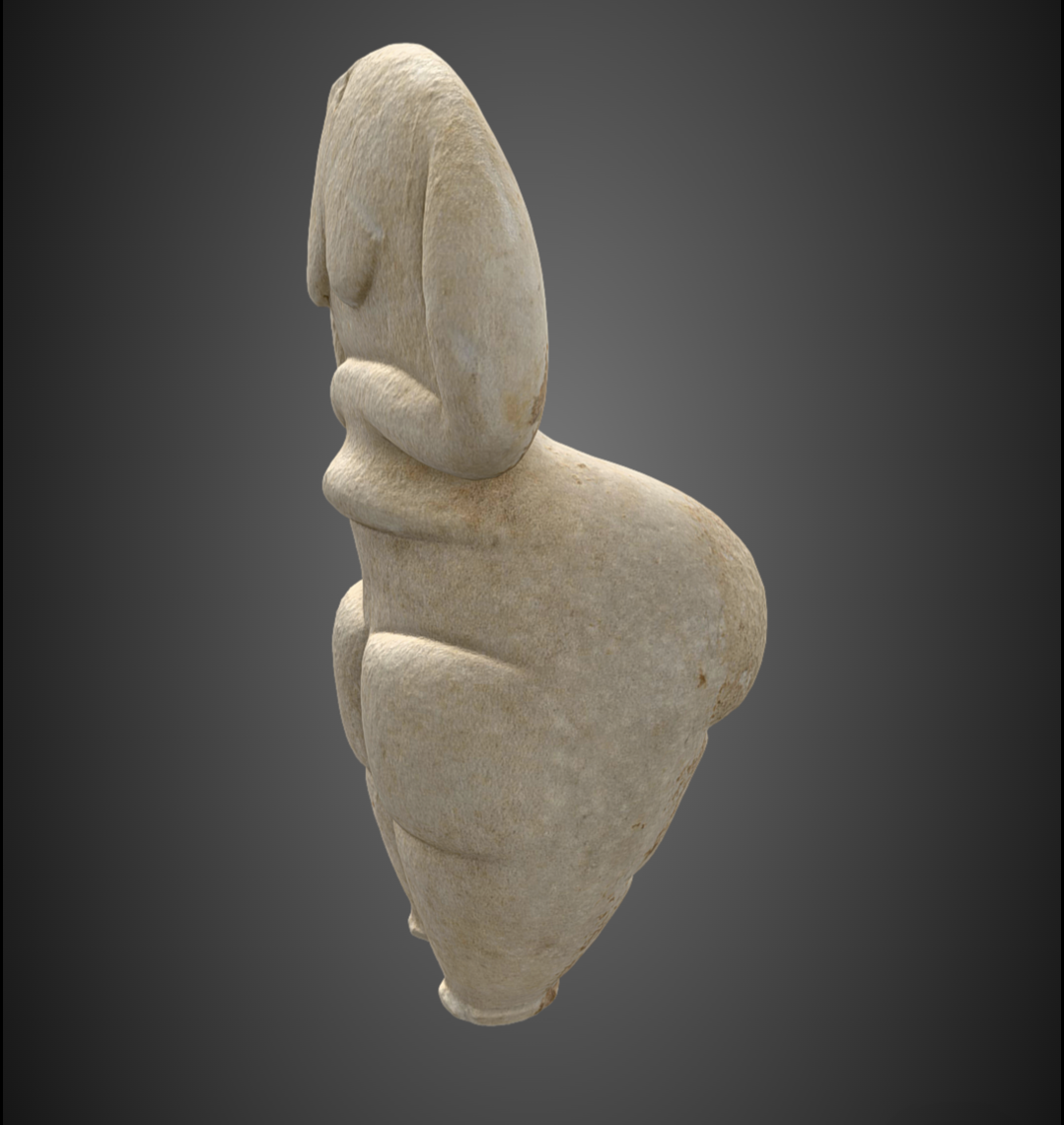
From https://www.metmuseum.org/art/collection/search/255417
You need to see it in 3d to see how big they liked their junk in the trunk
19
39
Ernst Stöhr - Vampire (1899, originally published in the art magazine "Ver Sacrum")
(lemmy.dbzer0.com)

20
33
In the year 1414, the Ming court stood stunned as a Bengali delegation presented a giraffe to the Yongle Emperor of China.
(lemmy.dbzer0.com)
The question of course was… how the hell did a giraffe get to Bengal in the first place?
https://open.substack.com/pub/travelsofsamwise/p/the-sultan-of-bengals-giraffe?r=1wlet9
Paid article.

21
224
Victor Hugo is best known as a novelist, but he was also a master illustrator. 70 years before the surrealists, he painted these with ink, soot, coffee, and blood
(lemmy.dbzer0.com)


22


24
25
15
"The Finding of Moses" by German artist Ferdinand Keller - 1879
(christianpicturesblog.blogspot.ca)
view more: next ›