Solarpunk

9371 readers
8 users here now

The space to discuss Solarpunk itself and Solarpunk related stuff that doesn't fit elsewhere.

What is Solarpunk?

Join our chat: Movim or XMPP client.

founded 4 years ago
MODERATORS
1


I'm always looking for things to add to my RSS reader! I loved the Hundred Rabbits site that was posted here recently and thought others might have some nice submissions.

I recently found Sunshine and Seedlings which is substack, alas, but has some great content.

I'm also a fan of Low-tech Magazine.

2


Solarpunk is a movement in speculative fiction, art, fashion, and activism that seeks to answer and embody the question “what does a sustainable civilization look like, and how can we get there?”

The aesthetics of solarpunk merge the practical with the beautiful, the well-designed with the green and lush, the bright and colorful with the earthy and solid.

Solarpunk can be utopian, just optimistic, or concerned with the struggles en route to a better world ,  but never dystopian. As our world roils with calamity, we need solutions, not only warnings.

Solutions to thrive without fossil fuels, to equitably manage real scarcity and share in abundance instead of supporting false scarcity and false abundance, to be kinder to each other and to the planet we share.

Solarpunk is at once a vision of the future, a thoughtful provocation, a way of living and a set of achievable proposals to get there.

  • We are solarpunks because optimism has been taken away from us and we are trying to take it back.
  • We are solarpunks because the only other options are denial or despair.
  • At its core, Solarpunk is a vision of a future that embodies the best of what humanity can achieve: a post-scarcity, post-hierarchy, post-capitalistic world where humanity sees itself as part of nature and clean energy replaces fossil fuels.
  • The “punk” in Solarpunk is about rebellion, counterculture, post-capitalism, decolonialism and enthusiasm. It is about going in a different direction than the mainstream, which is increasingly going in a scary direction.
  • Solarpunk is a movement as much as it is a genre: it is not just about the stories, it is also about how we can get there.
  • Solarpunk embraces a diversity of tactics: there is no single right way to do solarpunk. Instead, diverse communities from around the world adopt the name and the ideas, and build little nests of self-sustaining revolution.
  • Solarpunk provides a valuable new perspective, a paradigm and a vocabulary through which to describe one possible future. Instead of embracing retrofuturism, solarpunk looks completely to the future. Not an alternative future, but a possible future.
  • Our futurism is not nihilistic like cyberpunk and it avoids steampunk’s potentially quasi-reactionary tendencies: it is about ingenuity, generativity, independence, and community.
  • Solarpunk emphasizes environmental sustainability and social justice.
  • Solarpunk is about finding ways to make life more wonderful for us right now, and also for the generations that follow us.
  • Our future must involve repurposing and creating new things from what we already have. Imagine “smart cities” being junked in favor of smart citizenry.
  • Solarpunk recognizes the historical influence politics and science fiction have had on each other.
  • Solarpunk recognizes science fiction as not just entertainment but as a form of activism.
  • Solarpunk wants to counter the scenarios of a dying earth, an insuperable gap between rich and poor, and a society controlled by corporations. Not in hundreds of years, but within reach.
  • Solarpunk is about youth maker culture, local solutions, local energy grids, ways of creating autonomous functioning systems. It is about loving the world.
  • Solarpunk culture includes all cultures, religions, abilities, sexes, genders and sexual identities.
  • Solarpunk is the idea of humanity achieving a social evolution that embraces not just mere tolerance, but a more expansive compassion and acceptance.
  • The visual aesthetics of Solarpunk are open and evolving. As it stands, it is a mash-up of the following:
    • 1800s age-of-sail/frontier living (but with more bicycles)
    • Creative reuse of existing infrastructure (sometimes post-apocalyptic, sometimes present-weird)
    • Appropriate technology
    • Art Nouveau
    • Hayao Miyazaki
    • Jugaad-style innovation from the non-Western world
    • High-tech backends with simple, elegant outputs
  • Solarpunk is set in a future built according to principles of New Urbanism or New Pedestrianism and environmental sustainability.
  • Solarpunk envisions a built environment creatively adapted for solar gain, amongst other things, using different technologies. The objective is to promote self sufficiency and living within natural limits.
  • In Solarpunk we’ve pulled back just in time to stop the slow destruction of our planet. We’ve learned to use science wisely, for the betterment of our life conditions as part of our planet. We’re no longer overlords. We’re caretakers. We’re gardeners.
  • Solarpunk:
    • is diverse
    • has room for spirituality and science to coexist
    • is beautiful
    • can happen. Now!
3


#Proof that protecting nature works

Bhutan, a Himalayan kingdom of just 800,000 people with almost 70% forest cover, has written nature protection into its constitution.

Its forests absorb more carbon than the country emits, supports rich biodiversity, and helps protect the Himalayan water systems that sustain around 1.6 billion people downstream in Asia. It is proof that one country’s choices can impact an entire region. Their latest project, Restore Bhutan, is restoring 50,000 hectares of forests, farmlands and urban landscapes by 2030.

Bhutan is a 2026 Earthshot Prize Finalist to Protect and Restore Nature.

4
5
6


Modern forms of intensive grazing can be damaging to environmental health due to overstocking and overuse of static plots of land, but a growing body of research suggests the loss of practices like transhumance could have a similarly detrimental effect. Moving herds through seasonal ranges helps clear up dry vegetation without pushing pastures into an overgrazed state. The pathways carved by transhumant herds over create a system of natural firebreaks that make isolated spot fires less likely to explode into a full-blown inferno.

7


I came across this on former Mythbusters Adam Savage's Youtube channel. 20 MPH top speed, 35+ mile range, can get another 18 miles per day on solar charging alone. As Adam describes "It looks like a kid's drawing of a future vehicle, but not the way that you think".

8


Highly adaptable to changing landscapes, leopard cats often live close to farms and villages. In northeastern Thailand, females are frequently found raising their litters in sugarcane fields. The tall leaves offer shelter from the sun, but proximity to humans exposes the cats to threats ranging from capture for the illegal trade to fires caused by agricultural burning — a traditional method used by farmers to clear fields and control pests.

Since 2023, the center says it has admitted between 40 and 65 leopard cats each year, up from an annual average of around 10 before that. Staff attribute the increase to a combination of worsening habitat fragmentation, rising fire activity and greater public use of the government’s wildlife hotline.

It is not unusual for farmers to find sick or lost leopard cat cubs in and around their fields, particularly during the burning season, which spans from January to April. Following recent government regulations on agricultural burning, fire rates on agricultural land in the northeast appeared to decline slightly this year. Yet overall fire activity increased this burning season, driven largely by forest fires. Between January and August 2026, the center admitted more than 60 leopard cat cubs from all over the region. According to the team, over half were found in charred fields, often with burn injuries.

Cats have nine lives, but sometimes they need a little help with it.

9


Every society needs to have its fringe, transgressive counterculture. I would live at the abandoned strip mine, entreating the slumbering devil of ages past. Presuming the steel is not reclaimed for use in homes or ecological projects.

I would pray to it for resilience and to supplicate its spirit to never return. Its thirst for industry must be quelled with songs and the aromas of cooked food, lest it seep back out into the land and inspire folk to consume the earth again.

The creaks and groans of the metal in the wind would lull me to sleep, and its bulk would shelter me from rain.

10
11


In light of the planetary polycrisis, it is time to challenge the dominant strand of Western thought that asserts only humans possess rights and that other species exist solely for human benefit. [...] This form of democratic self-organization is based on the idea that all species and nature as a whole have rights.

12
13


Harbour is Scrappy Capy Distro's anarchist zine, published digitally for free since 2023. They accept a huge variety of submissions, from short stories to photos, from poems to art, in both English and German.

Consider sending some of your works!

14
15
16


With thousands of buildings torn down every year, nonprofits and city agencies are racing to record the stories attached to historic structures before they're dismantled and sold for parts.

17


Agriculture is an ecologically embedded enterprise, and we should not tolerate actions that degrade our natural capital, the diversity and function of our ecosystems, or the health of the atmosphere, soils and waters that surround and support us. At the same time, we must recognise that agriculture is embedded in society – a farm practice that runs counter to society’s goals is hard to maintain. I agree that a farm can and should be valued by its owners as a place to live, and as a source of pleasure in good farming, good eating and engagement with both domestic and wild neighbours. Society continues to measure farms, and judge farmers, on their production of grain, meat, biomass and other commodities. Farmers are caught up in a highly competitive market system that typically allows only a slim margin between money coming in and money going out. Meanwhile, the goal of public policy for agriculture continues to be guided by the desire for cheap food.

While the predicament of modern agriculture may appear so dire that we will inevitably adapt and organise a more sustainable system, ecologists at Murdoch University in Australia came to a different conclusion after analysing the problems facing farmers in the semi-arid southwestern part of that continent. Farmers and policy-makers continue to invest in production systems that don’t fit the land because they are now tightly bound up in patterns of modern agribusiness and food production. Financial capital goes to conventional farmers more easily than to alternative farmers, and social capital – in the forms of agronomic research, technical assistance (for addressing issues with animal health, soil fertility, soil erosion and water pollution), and especially processing, distribution and retail – supports the energy- and natural-capital intensive system. The authors describe this as a ‘lock-in trap’, ‘an industry that has so much “sunk-costs” that it may continue to degrade the resource it relies upon until the capital is totally removed.’ Shifting the system to a more desirable state – one that is ecologically as well as socially resilient – requires us to forge new social connections in the quest to establish more sustainable patterns of land use.

18


I thought the original headline was misleading but that the story is still extremely cool.

19


Came across two guys who had rebuilt an old tractor and made it run on electrical power and solar panels while acting autonomus. Article on Swedish

20


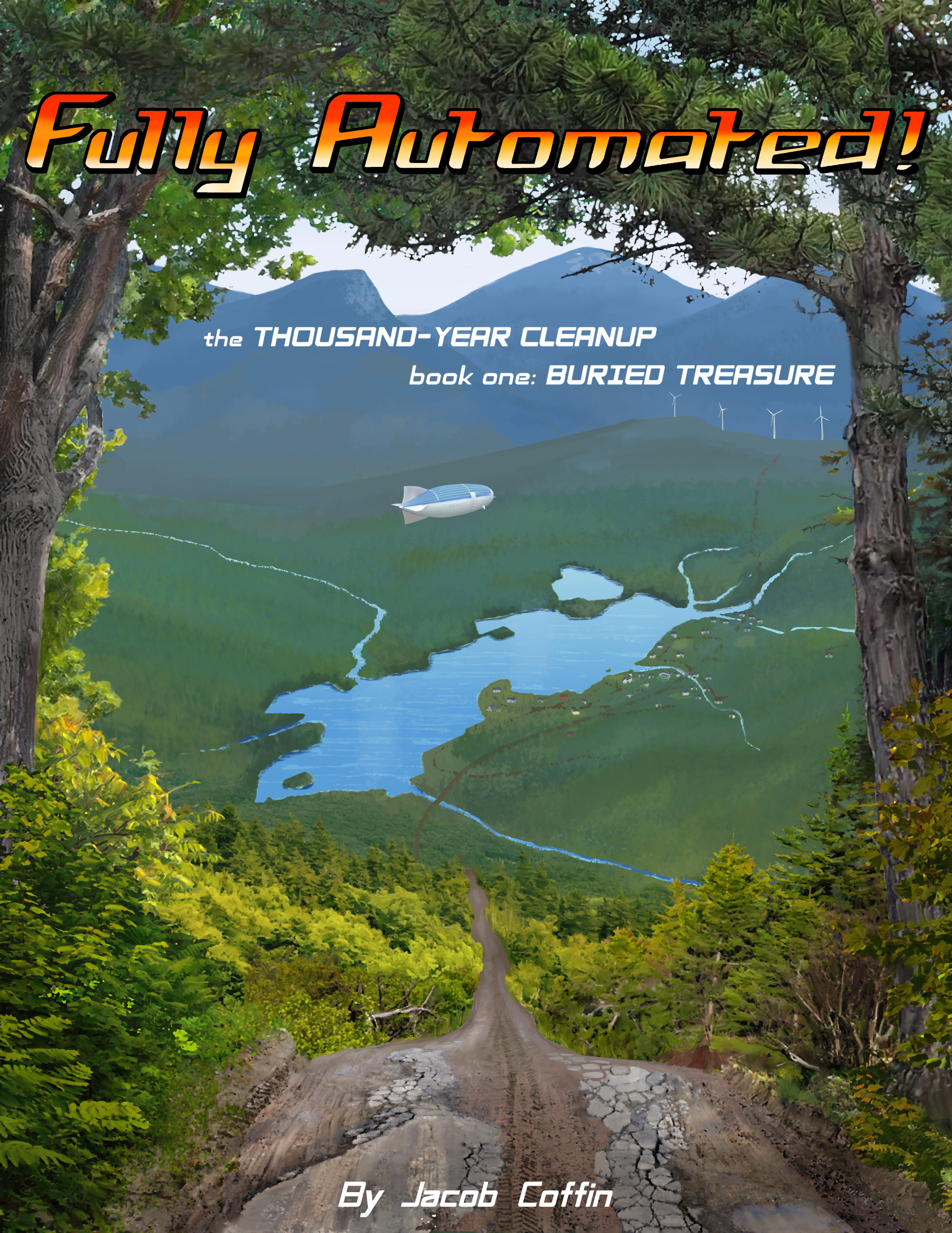
Hi, I'm Jacob Coffin, you might know me as the guy who posts solarpunk postcards, worldbuilding research, and other DIY/zerowaste projects sometimes. But that's all been something of a side project for me for the last two, almost three years. My main project has been researching, writing, playtesting, and making art for a TTRPG campaign, and we're finally launching it!

I should probably let the blurb we wrote introduce the thing:


A buried secret can stay dangerous for a long, long time… 

An investigator has a hot tip: rare waste. Dangerous to the environment and valuable on the reclamation market - a remediation co-op is already standing by to remove the contamination and restore the surrounding land. But time is running out to find it, as what’s left of the town is deep in a deconstruction boom. 

In Buried Treasure, players travel off the edge of the map to the mostly-abandoned town of Comity, New Hampshire to find an industrial dump site left over from the Global Climate Wars. But as work crews are in the process of removing the abandoned buildings and roads, there isn’t much time left before the trail disappears. It’s gonna be a challenge. But at least no one is going to be trying to stop them. Right? 

Buried Treasure is the long awaited second campaign for Fully Automated! Filled with interesting characters, locations, and plot hooks, this story has 20+ hours of content to delight solarpunk aficionados and newcomers alike! 

This adventure features: 

  • Original (human-made) art! 
  • An immersive rural solarpunk setting with resourceful homesteaders, radical work crews, and a village made from repurposed McMansions!
  • Maps, evidence, and an environmental sampling mini-game!

If that piques your interest, this is definitely for you! And if it doesn’t, you should check it out anyway because it’s free! As always, share any questions, feedback, and stories with our growing community on Discord, Mastodon, and slrpnk.net!


Like all the other solarpunk stuff I make, this campaign is CC-BY, so it's absolutely free. You can grab the files on DriveThruRPG, itch.io, or just download them from my folder here: https://mega.nz/folder/HUEA3TyB#jB2zQnczETliHMKGIDeSyw
21


It's really great news to see these animals thriving through the Wild Deserts program.

22
23
24


cross-posted from: https://feddit.org/post/34984919

cross-posted from: https://lemmy.ml/post/49499563

cross-posted from: https://lemmy.ml/post/49499558

Duration - 2:44
[a video about Cuba from the news collective Belly Of The Beast]

Electric tricycles have exploded across Cuba as the country faces extreme fuel shortages due to the U.S.-imposed oil blockade. But blackouts now last so long — 20 or more hours a day — there isn’t enough electricity to charge them.

So drivers are now installing solar panels on top of their tricycles.

“As long as the sun is out, it’s charging the battery,” says Evanys Peréz. “Now we can travel up to 90 miles.”

25


also see https://earthregenerators.substack.com/p/awakening-bioregional-imagination

Looks interesting, but don't know much about this.

view more: next ›