Solarpunk

8926 readers
360 users here now

The space to discuss Solarpunk itself and Solarpunk related stuff that doesn't fit elsewhere.

What is Solarpunk?

Join our chat: Movim or XMPP client.

founded 4 years ago
MODERATORS
1


I'm always looking for things to add to my RSS reader! I loved the Hundred Rabbits site that was posted here recently and thought others might have some nice submissions.

I recently found Sunshine and Seedlings which is substack, alas, but has some great content.

I'm also a fan of Low-tech Magazine.

2


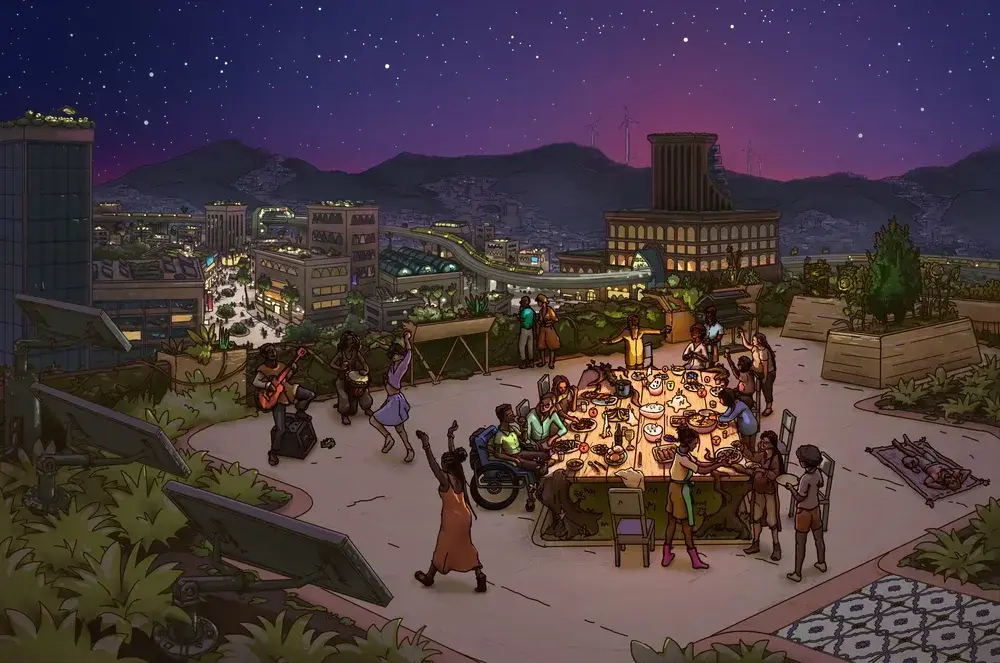
Solarpunk is a movement in speculative fiction, art, fashion, and activism that seeks to answer and embody the question “what does a sustainable civilization look like, and how can we get there?”

The aesthetics of solarpunk merge the practical with the beautiful, the well-designed with the green and lush, the bright and colorful with the earthy and solid.

Solarpunk can be utopian, just optimistic, or concerned with the struggles en route to a better world ,  but never dystopian. As our world roils with calamity, we need solutions, not only warnings.

Solutions to thrive without fossil fuels, to equitably manage real scarcity and share in abundance instead of supporting false scarcity and false abundance, to be kinder to each other and to the planet we share.

Solarpunk is at once a vision of the future, a thoughtful provocation, a way of living and a set of achievable proposals to get there.

  • We are solarpunks because optimism has been taken away from us and we are trying to take it back.
  • We are solarpunks because the only other options are denial or despair.
  • At its core, Solarpunk is a vision of a future that embodies the best of what humanity can achieve: a post-scarcity, post-hierarchy, post-capitalistic world where humanity sees itself as part of nature and clean energy replaces fossil fuels.
  • The “punk” in Solarpunk is about rebellion, counterculture, post-capitalism, decolonialism and enthusiasm. It is about going in a different direction than the mainstream, which is increasingly going in a scary direction.
  • Solarpunk is a movement as much as it is a genre: it is not just about the stories, it is also about how we can get there.
  • Solarpunk embraces a diversity of tactics: there is no single right way to do solarpunk. Instead, diverse communities from around the world adopt the name and the ideas, and build little nests of self-sustaining revolution.
  • Solarpunk provides a valuable new perspective, a paradigm and a vocabulary through which to describe one possible future. Instead of embracing retrofuturism, solarpunk looks completely to the future. Not an alternative future, but a possible future.
  • Our futurism is not nihilistic like cyberpunk and it avoids steampunk’s potentially quasi-reactionary tendencies: it is about ingenuity, generativity, independence, and community.
  • Solarpunk emphasizes environmental sustainability and social justice.
  • Solarpunk is about finding ways to make life more wonderful for us right now, and also for the generations that follow us.
  • Our future must involve repurposing and creating new things from what we already have. Imagine “smart cities” being junked in favor of smart citizenry.
  • Solarpunk recognizes the historical influence politics and science fiction have had on each other.
  • Solarpunk recognizes science fiction as not just entertainment but as a form of activism.
  • Solarpunk wants to counter the scenarios of a dying earth, an insuperable gap between rich and poor, and a society controlled by corporations. Not in hundreds of years, but within reach.
  • Solarpunk is about youth maker culture, local solutions, local energy grids, ways of creating autonomous functioning systems. It is about loving the world.
  • Solarpunk culture includes all cultures, religions, abilities, sexes, genders and sexual identities.
  • Solarpunk is the idea of humanity achieving a social evolution that embraces not just mere tolerance, but a more expansive compassion and acceptance.
  • The visual aesthetics of Solarpunk are open and evolving. As it stands, it is a mash-up of the following:
    • 1800s age-of-sail/frontier living (but with more bicycles)
    • Creative reuse of existing infrastructure (sometimes post-apocalyptic, sometimes present-weird)
    • Appropriate technology
    • Art Nouveau
    • Hayao Miyazaki
    • Jugaad-style innovation from the non-Western world
    • High-tech backends with simple, elegant outputs
  • Solarpunk is set in a future built according to principles of New Urbanism or New Pedestrianism and environmental sustainability.
  • Solarpunk envisions a built environment creatively adapted for solar gain, amongst other things, using different technologies. The objective is to promote self sufficiency and living within natural limits.
  • In Solarpunk we’ve pulled back just in time to stop the slow destruction of our planet. We’ve learned to use science wisely, for the betterment of our life conditions as part of our planet. We’re no longer overlords. We’re caretakers. We’re gardeners.
  • Solarpunk:
    • is diverse
    • has room for spirituality and science to coexist
    • is beautiful
    • can happen. Now!
3
4
 
 
5


It's worth starting at the beginning, but to save folks time I jumped ahead to the 11 min mark, where he starts building toward his point.

If you're really impatient, jump to the 12 minute mark, where he really starts cooking.

6


Have u read her books? I am right now & im absolutely amazed, so i contacted her agent: i wanna interview her for my small SF blog:

https://sfss.space/

If u love her & have good questions to ask her, please answer in the comments.

7


Excuse the boring title but I didn't want to editorialise. Actual headline should be:

We now have a biodegradeable plastic that's better than plastic

8


As I was going through this link, l got curious about this "bird".

Could you please make it ELI5 ??

I believe this is suited for the solarpunk instance in general.

9


Hello! Hopefully this is the right community for this question.

I’ve started small with solar by getting a 100W panel that connects to a battery that I charge daily and use it to charge things like my laptops or other devices.

I want to start adding additional panels and sending that solar power into our home to use throughout.

As I vaguely understand it, I can get a grid-tie microinverter and then plug panels into that? Will this work? Do I need different type of panels? Do all the panels need to match in specs/watts? It has MC4 (I think?) cables and bullet output.

How are yall sending solar to your home without getting a full on roof mounted solar system?

Thanks!

EDIT: in California

10
11
12


So i thought this fits here, he calls the boat Helios 11 and builds it with very little experience. He docunents the adventure quite well and shares what he learns, and also shares all the plans for the boat for free.

13
14
15
16
37
submitted 1 week ago* (last edited 1 week ago) by supersquirrel@sopuli.xyz to c/solarpunk@slrpnk.net


Woodcock, who spoke to librarians in Philadelphia, Salt Lake City, and western New York, has observed a rise in requests for DVDs, Blu-rays, video games, and 4K Ultra Discs at ‘braries all around the country.

17
18
19


The various interventions have, over the past five years, halved incidents of human-carnivore conflict across three districts where WCA works, Mbizah says. In at least two wards, conflict has been eradicated almost entirely. This year, her organization started working in a fourth conflict-prone district, Hurungwe, whose northern end juts into the Zambezi Valley.

Mbizah says that women are proving themselves especially effective as community guardians.

“You have to be that kind of person who really cares about people, who really cares about the communities, and you are constantly interacting with people,” she says. “Even when they give the advice to the farmers, [women] give it in a way that the farmers would understand.”

20


Nurse here! This keeps popping into my mind, keeps leaving me drawing a blank. Healthcare is a massive and resource-devouring industry, but is stuffed with people who actually give a shit about the people around them: the industry is a good candidate for improvement, and the people in it are likely to actually embrace those improvements (well, barring the odd salty af mofo who loses their shit at the first signs of change, but that person's in every industry - they'll figure it out eventually.)

I work in a run-of-the-mill hospital in the US, which encourages staff to take on system improvement projects, and these are were I see potential - especially for new nurses gunning for promotions.

The problem is what and how. All I can think of are things like recycling programs to tackle medical waste, but (at my facility at least) the waste that isn't already being recycled is either biohazardous or risks becoming biohazardous (like medication waste is huge, but we can't save half a vial of unused injection due to the possibility of that being contaminated by the first needle that drew from it).

So, looking for project ideas, both that I can start to implement myself, or to suggest to other staff looking to polish their resume. Smaller scale stuff is great for newer nurses; big scale stuff I can throw at management and see what sticks.

Let me know if you think of anything! Thanks all!

21


Found even more nice art from Sean: https://seanbodley.com/

22
23


cross-posted from: https://mander.xyz/post/51260546

...

The European Commission quietly banned funding for projects using solar PV inverters from ‘high risk’ countries from all major EU financing instruments, including the European Investment Bank (EIB) and the European Investment Fund.

...

The ban will reportedly cover all European projects and any in neighbouring regions like the Balkans and North Africa that are connected to the European grid. The affected countries are reportedly China, Russia, Iran and North Korea, though for renewable energy, the only major source country is China.

Responding to the news, Christoph Podewils, secretary general of the European Solar Manufacturing Council (ESMC), said: “This is a truly bold decision with the potential to help revitalise manufacturing in Europe and other like-minded economies”

...

The move is more far-reaching than previous Commission actions on inverter supply. Its revised Cybersecurity Act proposed plans to identify “high-risk” products and suppliers to be excluded from the European grid, but did not specify China or a blanket ban on funding.

...

Erika Langerova, head of the energy systems department at the technical university of Prague, told PV Tech: “This is a necessary and justified move by the European Commission. Inverters sit at the heart of grid control, and allowing high-risk vendors into that layer is an avoidable vulnerability. Given persistent concerns around state-linked cyber activity, treating Chinese suppliers and operators as high risk in critical infrastructure is simply basic risk management, not protectionism.”

...

However, restrictions on funding for projects with Chinese inverters may not be a clear-cut cybersecurity win. Ryan Davidson, principal consultant for grid digitalisation and cybersecurity at DNV, told us that: “This move helps energy sovereignty but does very little to address the cybersecurity of the infrastructure, as it does not address critical cybersecurity controls needed for all distributed energy infrastructure.

“While it would improve energy sovereignty by increasing the percentage of capacity from Western manufacturers, China will still have enough capacity of installed inverters, that, if they really wanted to, would have the ability to cause disruptions.”

...

Moreover, the measures will only affect the parts of the solar market that receive funding from the EIB or other EU institutions. Chinese products are a huge majority of the inverters in the European market, and that may shrink somewhat with the removal of EIB backing, with possible ripple effects into private asset owners’ purchasing habits.

...

Meanwhile, switching to Western inverters is highly cost-competitive, as ESMC says on its website:

According to a Wood Mackenzie analysis, residential and small commercial PV projects using Western inverters come at a small additional investment of just 1.7% to 4.3% of total project costs, depending on project size and location. For large utility-scale projects — which receive the bulk of EIB financing — this amounts to below 2% in Germany, Spain and Eastern Europe alike. This minimal cost difference delivers exceptional value: enhanced supply security and significantly strengthened cyber resilience across Europe’s energy infrastructure.

ESMC calls on EU member states and all public funding bodies to implement the Commission’s decision consistently and to align existing support programmes accordingly. ESMC also urges EU member states to fully support the current proposal of the European Commission to revise the Cyber Security Act (CSA 2) to structurally address the increasing supply chain and cyber security risk posed by inverters from high-risk countries.

Web Archive link
24
25
view more: next ›