126
Concatenative Programming
206 readers
1 users here now
Hello!
This space is for sharing news, experiences, announcements, questions, showcases, etc. regarding concatenative programming concepts and tools.
We'll also take any programming described as:
- pipelined
- stack-oriented
- tacit
- postfix / reverse Polish notation (RPN)
- fluent
- cascading
- chained
From Wikipedia:
A concatenative programming language is a point-free computer programming language in which all expressions denote functions, and the juxtaposition of expressions denotes function composition. Concatenative programming replaces function application, which is common in other programming styles, with function composition as the default way to build subroutines.
For example, a sequence of operations in an applicative language like the following:
y = foo(x)
z = bar(y)
w = baz(z)
...is written in a concatenative language as a sequence of functions:
x foo bar baz
Active Languages
Let me know if I've got any of these misplaced!
Primarily Concatenative
Concatenative-ish, Chain-y, Pipe-y, Uniform Function Call Syntax, etc.
- Nim
- Roc
- Unix Pipes
- Cognate
- D Programming Language
- Koka
Cheat Sheets & Tutorials
Discord
IRC
- #concatenative on irc.libera.chat
Wikis
Wikipedia Topics
- Reverse Polish Notation
- Uniform Function Call Syntax
- Stack-Oriented Programming
- Tacit Programming
- Method Chaining
- Method Cascading
- Fluent Interface
Subreddits
GitHub Topics
- Stack-Based Language
- Concatenative
- Concatenative Language
- Concatenative Programming Language
- Concatenative Interpreting Language
- Fluent Interface
- Method Chaining
Blogs
Practice
- Codewars (Forth, Factor, Nim)
- Advent of Code
- Code Golf (Forth, Factor, Nim)
- Project Euler
- Exercism (8th, Nim)
- Perl Weekly Challenge
founded 2 years ago
MODERATORS
127
128
129
130
131
132
133
134
Alright, show me I'm not the only one in this community, and show off some solutions!
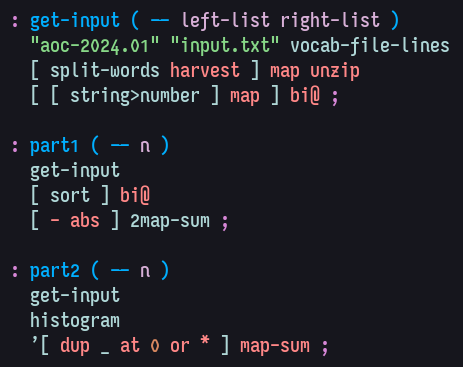
Here's my Day 1 solution in Factor (minus imports):
spoiler
: get-input ( -- left-list right-list )
  "aoc-2024.01" "input.txt" vocab-file-lines
  [ split-words harvest ] map unzip
  [ [ string>number ] map ] bi@ ;

: part1 ( -- n )
  get-input
  [ sort ] bi@
  [ - abs ] 2map-sum ;

: part2 ( -- n )
  get-input
  histogram
  '[ dup _ at 0 or * ] map-sum ;
Sadly, Factor doesn't get highlighted properly here, so here it is again as an image:
spoiler
I probably won't last the week, but what solutions I do have will be up on GitHub.
135
136
137
138
139
140
141
142
143

145
146
147
148
149
150