Space

2613 readers
1 users here now

A community to discuss space & astronomy through a STEM lens

Rules

  1. Be respectful and inclusive. This means no harassment, hate speech, or trolling.
  2. Engage in constructive discussions by discussing in good faith.
  3. Foster a continuous learning environment.

Also keep in mind, mander.xyz's rules on politics

Please keep politics to a minimum. When science is the focus, intersection with politics may be tolerated as long as the discussion is constructive and science remains the focus. As a general rule, political content posted directly to the instance’s local communities is discouraged and may be removed. You can of course engage in political discussions in non-local communities.


Related Communities

🔭 Science

🚀 Engineering

🌌 Art and Photography


Other Cool Links


founded 4 years ago
MODERATORS
1


wired.com Japan Is Launching a Probe to Collect the First-Ever Samples From a Martian Moon Ritsuko Kawai 5–6 minutes

A Mars probe from the Japan Aerospace Exploration Agency (JAXA) may answer some longstanding questions about the Red Planet and its moons. The mission—dubbed MMX for “Martian Moons eXploration”—aims to collect at least 10 grams of samples from Phobos, one of two moons orbiting the planet, and if successful, these will be the first rocks from a Martian moon ever brought to Earth.

They won’t arrive quickly, however. The MMX probe will take approximately one year to reach Mars. It will then collect samples during three years of operations while orbiting the red planet before taking another year to return to Earth. If all goes well, scientists expect to receive the moon rocks in 2031.

One of the most interesting questions the probe can answer is how Mars’ moons, Phobos and Deimos, formed. There are two main possibilities. One is that the moons condensed from material ejected during a massive collision with Mars. The other hypothesis is that the moons were asteroids from the outer solar system that were captured by Mars’ gravity.

The moons are dark in color, and their light-reflecting properties closely resemble those of asteroids rich in water and carbon. Their orbits, however—which are nearly circular along Mars’ equatorial plane in the same direction as the planet’s rotation—are better explained by the giant impact hypothesis. Comparing samples from Mars’ moons to those previously collected from the Martian surface could help settle this debate.

To get the Martian moon rocks and transport them back to Earth, however, means overcoming some significant technical challenges in space flight and communication. At launch, the spacecraft will have a mass of 4,480 kilograms (9,900 pounds). More than half of this weight will be fuel, divided into three reserves: one for the outbound leg, one for exploration, and one for the return leg. Once in the vicinity of Mars, MMX will jettison the outbound module after its propellant is exhausted; following the flyby of Deimos, the exploration module will also be jettisoned.

The probe, designed by Mitsubishi Electric, will then land on the surface of Phobos, a delicate procedure given the moon’s size, with an approximate radius of just 11 kilometers. (In comparison, Earth’s moon has a radius of more than 1,700 kilometers.) Descent methods used on Earth’s moon rely on its specific gravity, which is about 300 times as strong as that of Phobos. However, Phobos’ gravity is approximately 50 times greater than that of the asteroid Ryugu, where JAXA has previously landed probes. Landing on Ryugu involved prolonged hovering, a typical method for landing on smaller celestial objects, but this is not feasible for MMX as it would consume too much fuel given Phobos’ greater pull.

To overcome this challenge, the probe is equipped with high-precision autonomous navigation, which it will need, given that there will be a delay of up to 20 minutes for radio signals to travel between Earth and MMX. The probe must therefore autonomously decide on and execute the descent, landing, and later takeoff sequences.

During the descent, the probe will compare the terrain to data on the topography of Phobos’ craters, using this information to adjust its position toward the target landing site. Once it’s reached an altitude under 300 meters, the probe will also detect whether parts of the surface have changed in elevation, labeling significant discrepancies as hazardous areas. This mechanism allows the probe, if necessary, to change the landing site or abort the landing and temporarily ascend.

Just ahead of the main spacecraft’s landing, the IDEFIX rover—jointly developed by the French and German space agencies—will be deployed onto the surface of Phobos to conduct approximately 100 days of independent exploration. This preliminary survey by the rover will serve as a scout to ensure a safer landing.

Once on the surface, a robotic arm will drill cylindrical tubes into the surface to collect samples. The probe is also equipped with a device first developed by NASA that uses a stream of nitrogen gas to collect fine particles from the very top layer of dust. Whether or not Phobos originated from an impact with the planet, experts believe Martian sand can be obtained from the lunar surface. Over time, meteorite impacts have blasted materials off Mars, coating its moons. Scientists expect about 0.1 percent of the samples collected will be debris from Mars itself.

Costing about $345 million US, this mission marks Japan’s first Mars probe launch in 28 years. Beyond the scientific insights it’s expected to provide, from an engineering perspective, the mission aims to test new technologies that could aid future sampling and round-trip travel to Mars.

MMX is scheduled to launch from the Tanegashima Space Center on October 20, 2026.

This story originally appeared on WIRED Japan and has been translated from Japanese.
2


Two Mercury-bound spacecraft left their mother ship behind on Thursday and headed down the home stretch of their nearly decade-long voyage to the solar system’s smallest and closest-to-the-sun planet.

The linked European and Japanese spacecraft separated as planned from their cruiser, but controllers had to wait two anxious hours to receive confirmation via radio signals. The crucial operation was broadcast from the European Space Agency’s control center in Germany, more than 124 million miles (200 million kilometers) away.

“It’s a brilliant moment,” said lead project scientist Geraint Jones.

If all goes well, the conjoined spacecraft known as BepiColombo will enter orbit around Mercury in November and split from each other in December to map and study the entire planet from different altitudes. As of Thursday, the spacecraft still had 2 million miles (3.3 million kilometers) to go before reaching its destination.

Launched in 2018, the BepiColombo mission is named for the Italian mathematician who took part in NASA’s Mariner 10 mission to Mercury in the 1970s. Only one other spacecraft, NASA’s Messenger, has explored the puzzling, scorching planet that is just a little bigger than our moon.

“How tiny Mercury is and still it holds some of the biggest mysteries of our solar system,” mission manager Santa Martinez said earlier this week.

Added Jones: “There’s a huge amount still left to be learned.”

3


On August 30, the Nancy Grace Roman Space Telescope successfully launched from Florida and will spend the next three months heading to its new home: a Sun-Earth Lagrange point, a million miles from Earth, where the gravity of the two larger bodies are in equilibrium. It's a comfy place to be for a space telescope; Roman can say hi to her old classmate Webb, who got there four years ago and has been sending back brilliant images and doing good science.

Roman's a strange bird by NASA standards. It came in under budget and ahead of schedule. Its primary mirror, donated from the National Reconnaissance Office, is from a canceled spy program. There'll be a shakedown period to make sure everything's working OK, so Roman won't officially enter service until some time next year. I'm sure I'll fawn over its debut images—half of Roman's job description is to look for new planets—but the other half is pretty valuable too. Without any hyperbole: What Roman sees could help us figure out what the universe is made of, and its ultimate fate. Big questions! Hope the plucky telescope is up to the job.

4
5
6
7


Article textJeff Foust

8–10 minutes

Updated 11:15 a.m. Eastern with postlaunch press conference comments.

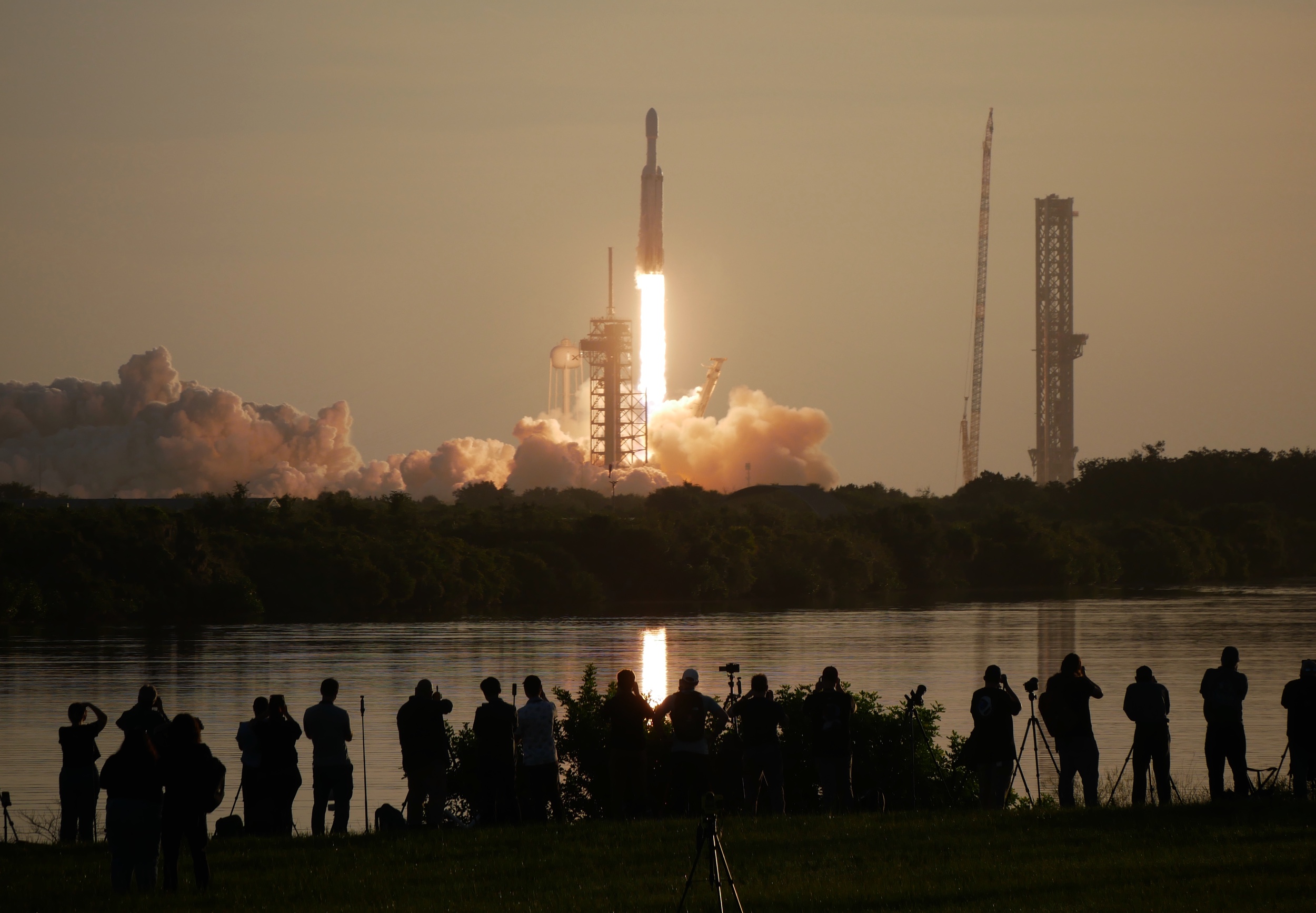
KENNEDY SPACE CENTER, Fla. — A Falcon Heavy launched NASA’s newest flagship telescope Aug. 30 on a mission to study the nature of the universe and discover thousands of exoplanets.

A SpaceX Falcon Heavy lifted off from Kennedy Space Center’s Launch Complex 39A at 7:26 a.m. Eastern. The rocket’s payload, the Nancy Grace Roman Space Telescope, deployed from the upper stage 31 minutes later. The rocket’s two side boosters landed at separate pads at Cape Canaveral Space Force Station, while the central booster was expended.

This was the 13th launch of the Falcon Heavy, dating back to its debut in 2018. It was the third NASA mission for the rocket, after the launch of the Psyche asteroid mission in October 2023 and the Europa Clipper mission to Jupiter a year later.

Roman will spend the next 100 days traveling to the Earth-sun L-2 Lagrange point, 1.5 million kilometers from Earth. During that journey, engineers will be commissioning the 9,200-kilogram spacecraft and its instruments.

That work will begin within an hour of deployment, with deployment of the spacecraft’s solar arrays and sunshield. A course-correction burn is planned a day after launch and a second three days later, but Jackie Townsend, Roman’s project manager, said at an Aug. 29 briefing that, depending on the accuracy of the launch, the first maneuver could be reduced and the second skipped entirely.

She confirmed at a press conference two hours after liftoff that the launch went as planned and that Roman was operating well. “The ride was magnificent and put us right where we wanted to be,” she said, but added it was too early to know how that would affect plans for upcoming course-correction maneuvers.

The first 10 days of commissioning will be devoted to spacecraft deployments and outgassing, she said. The following 30 days will be focused on commissioning the spacecraft, “making sure that all of the infrastructure parts of the bird are doing their jobs properly.”

Another 45 days will be devoted to commissioning the spacecraft’s instruments. At the 90-day mark after launch, she said Roman should be ready “to power into our early science operations.”

Isaacman phone call

NASA Administrator Jared Isaacman holds a phone during an Aug. 30 briefing about the Roman Space Telescope launch. President Trump was on the line congratulating NASA on the launch. Credit: SpaceNews/Jeff Foust

Presidential phone call

During the postlaunch press conference, NASA Administrator Jared Isaacman received a call and stepped out of the room briefly. He returned a minute later and said he had President Donald Trump on the phone.

“I just want to thank everybody, congratulate you. It looked beautiful on television,” Trump said, adding he called to see if there was “anything negative” about the launch he needed to know about. “It was another great success.”

“We’re the hottest in space,” he said later. “Let’s keep it all going. Congratulations.”

The praise from the president, though, contrasted with past actions by the administration regarding Roman. In his first term, three consecutive NASA budget requests, from fiscal years 2019 through 2021, proposed canceling WFIRST. In all three cases, Congress rejected the proposal and appropriated full funding for the mission.

The administration’s fiscal year 2026 budget request for NASA also proposed a significant cut for Roman after a “passback” document from the Office of Management and Budget again targeted the mission for cancellation, despite the fact the spacecraft was nearly complete and ahead of schedule. Congress again fully funded Roman.

Asked about what changed between the administration’s past budget proposals and the president’s current praise for the mission, Isaacman emphasized the support from Trump. “The President of the United States is excited about our next great exploration asset that’s underway,” he said. “It’s a great moment for the nation. It’s a great moment certainly for NASA to have a president so interested in our space program.”

“I’m incredibly grateful for his support, the space policy, the resources,” he said. “It sounds like from that call maybe even more resources.” Discovering what the universe is made of

The $4.3 billion Roman is NASA’s latest flagship space telescope, with a five-year prime mission but enough propellant to operate in a halo orbit around the L-2 point for at least 10 years.

Roman’s main science instrument is the Wide-Field Imager, a 300-megapixel camera. It will be used primarily for several surveys planned by astronomers for the telescope’s five-year prime mission.

Roman has a field of view 100 times larger than the Hubble Space Telescope and can shift fields more quickly. “We can survey the sky more than 1,000 times faster than Hubble,” said Julie McEnery, Roman telescope senior project scientist, at an Aug. 29 briefing. “A survey that would take Roman a month would take a century for Hubble.”

That will allow Roman to tackle “entirely new, ambitious science questions,” she said. That includes a focus on understanding dark energy and dark matter, which combined comprise about 95% of the universe but remain largely mysterious to astronomers.

“We’re about to discover what the universe is made of,” said Lucas Paganini, Roman telescope program executive at NASA Headquarters.

A key area of interest is growing evidence that the cosmological standard model of the universe may not be accurate. One possibility is that a factor called the cosmological constant, linked to dark energy, may not be constant over the history of the universe.

“That means that the properties of dark energy may change as the universe expands,” McEnery said. “It could mean that we need to revisit how gravity itself works, that maybe our understanding of how gravity works on very, very large scales is, in fact, not very well described by general relativity.”

“What I’m sure of is that Roman’s observations are going to definitively address at least some of those questions,” McEnery said, “because it will definitively say the model works or it doesn’t.”

Roman’s surveys, beyond addressing cosmological studies, will provide a wealth of data for astronomers. That includes observations of 20 billion stars in the Milky Way and 2 billion galaxies. Astronomers expect to detect 100,000 exoplanets, about 40 times the number currently known. “Think of this as the largest census we’ve ever done of other planets in our galaxy,” she said.

Roman will generate up to 1.4 terabytes of data per day, downlinked to dedicated ground stations in New Mexico, Australia and Japan. The data will be made publicly available through a cloud-based system shortly after it is received, with no proprietary periods for astronomers who have been working on the mission.

Roman carries a second instrument, a coronagraph. It is designed to precisely block light from an individual star, revealing any planets or dust disks around it.

Trying to observe an exoplanet around a star is like detecting a firefly next to a lighthouse from hundreds of kilometers away, said Vanessa Bailey, Roman Coronagraph Instrument scientist at the Jet Propulsion Laboratory.

Coronagraphs used today allow the detection of exoplanets a million times fainter than their star, she said, but an Earth-like exoplanet would be 10 billion times fainter. “That’s too great of a leap in a single generation of instrumentation,” she said.

Roman’s coronagraph, using active deformable mirrors, will try to bridge that gap, detecting exoplanets 100 million times fainter than their stars. That would enable detections of planets similar to Jupiter.

The coronagraph is a technology demonstration with 2,000 hours of observing time over Roman’s first 18 months. “We’ll interleave our observations with those of the various surveys,” Bailey said.

“We’re going to try to push as hard as we can as fast as we can to understand what the instrument and the observatory are capable of,” she said, “and then plan an ambitious portfolio for the remainder of the 2,000 hours after that.”

McEnery noted that the telescope’s namesake, Nancy Grace Roman, was a proponent of space telescopes. She published a journal paper in 1959 that examined the potential of directly observing planets with such an observatory but concluded it was impossible given the state of technology at the time.

“If she was here now,” McEnery said, “she would really enjoy having been proved wrong.”

8
9
10
11


NASA's Nancy Grace Roman Space Telescope launches Aug. 30 and is probably the space-thing I've been most excited about since the deployment of the JWST. Build from a leftover reconnaissance telescope (like Hubble was), Roman is designed to make catalogs of large swaths of the sky, find new planets (including in very bright areas like the center of our own galaxy), and study supernovae and their remnants.

12
13
14
15
16
17
18
19
20
21
22


Nuking a ‘City Killer’ Asteroid Might Not Be the Worst Idea. Scientists Tested It.

No actual asteroids or Bruce Willises were harmed in the making of this research paper.

By Luis Prada August 22, 2026, 7:30am Share:

If your concept of eradicating a potential “city killer” asteroid begins and ends with the plot of Armageddon, well, you’re actually not that far off from one proposed method of asteroid obliteration—just without actually putting anyone on the asteroid. Nuking an asteroid to smithereens is such a viable, if completely theoretical, tactic that scientists publishing their findings in The Planetary Science Journal just tested it out. In a computer simulation. No actual asteroids or Bruce Willises were harmed in the making of this research paper.

The team, led by Lawrence Livermore National Laboratory astrophysicist Isaiah Santistevan, simulated detonating a one-megaton nuclear weapon near (not on or in) a 525-foot-wide asteroid modeled after Bennu, an asteroid which passes by Earth about every six years. What Happened When Scientists Simulated Nuking an Asteroid

In their simulations, the researchers found that the detonation’s burst of X-rays could vaporize the asteroid’s surface. All the material that will be blown off of its surface would act like tiny rocket engines, changing the asteroid’s trajectory and creating a shockwave that could fracture the rock from the inside.

The team ran three simulations using different distances and asteroid fracture properties. In a 10-meter scenario, 98.2 percent of the asteroid material was damaged, and about 97 percent was moving faster than the asteroid’s escape velocity. Moving the bomb further away produced more widespread damage because the X-rays spread out over more of its surface.

The other pretty good tactic, if a bit nuts. But there is a catch: the simulations covered only the immediate aftermath of an asteroid’s obliteration. That means they don’t yet know whether the asteroid would safely break apart, or maybe reform itself, or maybe be reduced down from one big killer asteroid to thousands of smaller asteroids. So, there are some kinks to work out. But the study does suggest that if humanity ever truly discovers a giant killer rock barreling toward us, the dumb guy tactic of just throwing a nuke at it might not be the dumbest idea.

23
24
25


I believe that a Korean orbiter had images on the 6th but these seem higher resolution.

view more: next ›