this post was submitted on 21 Aug 2026
1 points (100.0% liked)
Cool Guides
6708 readers
1 users here now
Rules for Posting Guides on Our Community
1. Defining a Guide Guides are comprehensive reference materials, how-tos, or comparison tables. A guide must be well-organized both in content and layout. Information should be easily accessible without unnecessary navigation. Guides can include flowcharts, step-by-step instructions, or visual references that compare different elements side by side.
2. Infographic Guidelines Infographics are permitted if they are educational and informative. They should aim to convey complex information visually and clearly. However, infographics that primarily serve as visual essays without structured guidance will be subject to removal.
3. Grey Area Moderators may use discretion when deciding to remove posts. If in doubt, message us or use downvotes for content you find inappropriate.
4. Source Attribution If you know the original source of a guide, share it in the comments to credit the creators.
5. Diverse Content To keep our community engaging, avoid saturating the feed with similar topics. Excessive posts on a single topic may be moderated to maintain diversity.
6. Verify in Comments Always check the comments for additional insights or corrections. Moderators rely on community expertise for accuracy.
Community Guidelines
-
Direct Image Links Only Only direct links to .png, .jpg, and .jpeg image formats are permitted.
-
Educational Infographics Only Infographics must aim to educate and inform with structured content. Purely narrative or non-informative infographics may be removed.
-
Serious Guides Only Nonserious or comedy-based guides will be removed.
-
No Harmful Content Guides promoting dangerous or harmful activities/materials will be removed. This includes content intended to cause harm to others.
By following these rules, we can maintain a diverse and informative community. If you have any questions or concerns, feel free to reach out to the moderators. Thank you for contributing responsibly!
founded 3 years ago
MODERATORS
you are viewing a single comment's thread
view the rest of the comments
view the rest of the comments
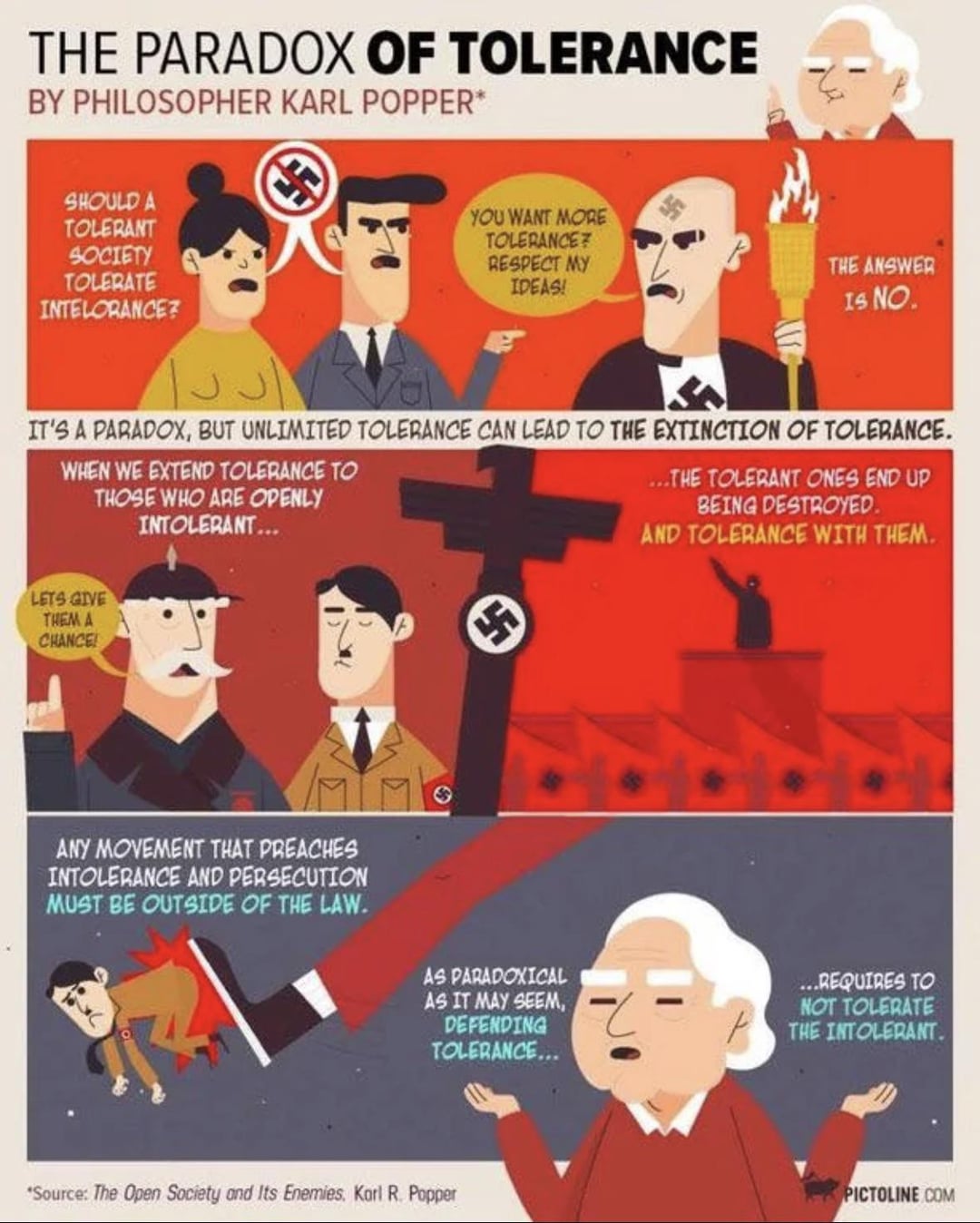
There are also a plurality of underlying issues not explored by this, because it's treated as first order only problem. Like... why is it that people become intolerant and why they blame certain groups for things.
And usually that's underlying economic or inequality conditions in the society or other forms of social upheaval.... which people generally don't want to address so much as they want to focus on the social sorting of hating and being hateful as the 'solution'. It's much easier to be tolerant when you are in an environment where members are all roughly of equal status, harder when there are perceived or real inequalities and abuses of power.
Real world is more complicated because people don't hate for no reason. They may, have very legit reasons, and you likely may have the same reasons directed towards a different group.
Everyone does vastly over simplify this, because well, they want to use is as a litmus test to prove they are good and other people are bad, and that's the only 'use' of this principle. Which is what folks do with a lot of moral/social guidelines... they want to reduce them to sorting mechanisms with themselves on the 'right' side of the sort... and if you challenge that notion maybe it's not that simple... you must be one of the 'bad' people.
Further, everyone is intolerant of something. Even if they won't admit it. Nor will they admit... that they and everyone else make mistakes. People's mind and behaviors change... a whole other second order factor also totally outside the scope of this 'paradox'. and for a lot of folks on lemmy... you can't ever change or be reformed from your previous views... etc.
We also have the wonderful case of social movements that seek to turn innocuous behaviors into intolerable assaults on themselves, like the 'manspreading' nonsense from Tumblr.