Mars (Planet)

177 readers
1 users here now

This is a place to discuss everything about the planet Mars.

Art, community discussion & scientific data are all welcome.

Related communities:

AI content is not allowed here. Post it to !mars_ai_pics@discuss.tchncs.de instead.

founded 10 months ago
MODERATORS
1


Mars captured by NASA's Psyche spacecraft on May 16th, 2026 after its gravity assist.

We see the south permanent cap, Hellas Bassin (bright disk in the middle) and Terra Sabaea (bright plains on the left) with Schiaparelli crater.

RGB composite made with pictures through IR1 (723 nm), Green (550 nm) and Blue (495 nm) filters.

© NASA/JPL-Caltech/ASU/Thomas Appéré

2
3


This is huge!

Spirulina, a type of algae, is considered one of the best sources of food on Mars, because it can grow in small containers and doesn't need big greenhouses. It is also very nutrient-rich, containing both lots of energy and protein.

However, vitamin B12 so far has been assumed to only exist in animal food products, such as beef and dairies.

This research project investigates genetically modified spirulina algae that contain levels of B12 comparable to beef!

This is not only a big breakthrough for food security on Mars but it also opens up the door another step to the broader approach of genetically engineering food sources on Mars. What might be next?

4


In engineering and many branches of economy, it is custom to provide a minimum viable product:

A minimum viable product (MVP) is a version of a product with just enough features to be usable by early customers who can then provide feedback for future product development.

This maximizes development speed as basic features can be tried out and tested while new features are being developed, thus minimizing feedback time and maximizing deployment speed.


What is the minimum viable product for a mars mission? I think it is reasonable to guess that it is a life support system, as it is already being deployed on the ISS, just on another planet. This minimizes new development work before a usable variant can be deployed and allows re-use of established technologies.

This would mean that the type of life support system that's already being used on the ISS today is simply re-packaged into a new ship and used on-ship and on-destination as it is being used on the ISS today.

Apart from the minimal feature set, there is some valid criticism with this approach, such as:

  • in case of emergency, no quick rescue mission is possible because of the long distance.
  • the mission duration would probably have to be longer until enough fuel can be produced for a journey back, which increases exposure to radiation and unknown variables

Essentially, it would be a leap of faith that the type of mission that has already been happening on the ISS for the last 25 years, can also still function well enough if it's deployed at a much more remote location, and for significantly longer durations.

5


Due to overwhelming user votes, no AI generated pictures will be allowed on this community. Post them to !mars_ai_pics@discuss.tchncs.de instead.

6


To explain my reasoning:

  • Every post must make sense. We don't accept slop without purpose. Every post must be backed up by human intelligence, provide meaningful arguments or link to relevant (trustworthy, non-clickbait) articles.
  • What's not accepted is long walls-of-text of AI-generated nonsense.
  • The fair use doctrine applies: "Fair use" of copyrighted material is usage that has educational or transformative properties: If you use AI to visualize your own ideas, that's "transformative use" because you're using the visualization skills of somebody else in new ways. Furthermore, all AI-generated media must not be used for commercial purposes.
  • This means that you should always put your own spirit into every post, instead of using a dumb machine to generate content for you. Using the machine to express your own spirit, however, is fair use.

Edit: Due to popular vote, no AI pictures will be allowed on this community after all. See this post.

7


This is a sub-section of the "geometrically improved, color enhanced" version of the 360-degree panorama heretofore known as the "Gallery Pan," the first contiguous, uniform panorama taken by the Imager for Mars Pathfinder (IMP) over the course of Sols 8, 9, and 10. Different regions were imaged at different times over the three Martian days to acquire consistent lighting and shadow conditions for all areas of the panorama.

The IMP is a stereo imaging system that, in its fully deployed configuration, stands 1.8 meters above the Martian surface, and has a resolution of two millimeters at a range of two meters. In this geometrically improved version of the panorama, distortion due to a 2.5 degree tilt in the IMP camera mast has been removed, effectively flattening the horizon.

The IMP has color capability provided by 24 selectable filters -- twelve filters per "eye." Its red, green, and blue filters were used to take this image. The color was digitally balanced according to the color transmittance capability of a high-resolution TV at the Jet Propulsion Laboratory (JPL), and is dependent on that device. In this color enhanced version of the panorama, detail in surface features are brought out via changes to saturation and intensity, holding the original hue constant. A threshold was applied to avoid changes to the sky.

On the horizon the double "Twin Peaks" are visible, about 1- 2 kilometers away. The rock "Couch" is the dark, curved rock at right of Twin Peaks. A Lander petal is visible on the left, showing the fully deployed rear ramp, which rover Sojourner used to descend to the surface of Mars on July 5. Immediately to the left of the rear ramp is the rock "Barnacle Bill," which scientists found to be andesitic, possibly indicating that it is a volcanic rock (a true andesite) or a physical mixture of particles. Just beyond Barnacle Bill, rover tracks lead to Sojourner, shown using its Alpha Proton X-Ray Spectrometer (APXS) instrument to study the large rock "Yogi." Yogi, low in quartz content, appears to be more primitive than Barnacle Bill, and appears more like the common basalts found on Earth.

The tracks and circular pattern in the soil leading up to Yogi were part of Sojourner's soil mechanics experiments, in which varying amounts of pressure were applied to the wheels in order to determine physical properties of the soil. During its traverse to Yogi the rover stirred the soil and exposed material from several centimeters in depth. During one of the turns to deploy Sojourner's Alpha Proton X-Ray Spectrometer, the wheels dug particularly deeply and exposed white material. Spectra of this white material show it is virtually identical to the rock "Scooby Doo," and such white material may underlie much of the site. Deflated airbags are visible at the perimeter of the Lander petals.

Mars Pathfinder is the second in NASA's Discovery program of low-cost spacecraft with highly focused science goals. The Jet Propulsion Laboratory, Pasadena, CA, developed and manages the Mars Pathfinder mission for NASA's Office of Space Science, Washington, D.C. JPL is a division of the California Institute of Technology (Caltech). The IMP was developed by the University of Arizona Lunar and Planetary Laboratory under contract to JPL. Peter Smith is the Principal Investigator.

Photojournal note: Sojourner spent 83 days of a planned seven-day mission exploring the Martian terrain, acquiring images, and taking chemical, atmospheric and other measurements. The final data transmission received from Pathfinder was at 10:23 UTC on September 27, 1997. Although mission managers tried to restore full communications during the following five months, the successful mission was terminated on March 10, 1998.

8


This is part 2 in a longer series on the economics on mars. I haven't written part 1 yet, but i'll publish it as soon as i do.

Lemmy might be the worst place to discuss this subject because lots of people here identify as politically left so anything that touches private company ownership and banks might be a bit of a sensitive issue here. But i'll write it anyways because my target audience is not lemmy as a whole, but whoever thinks the same way i do.

Mars will not be communist, nor will it be socialist (no "luxury gay space communism"). It will be ultra-capitalistic, probably more so than the US already is today. Why? Because i believe that expanding a settlement requires lots of hard work to be put into it; And if the experiences on earth are anything to go by, people avoid doing hard work except if it's 1. their hobby or 2. they get a reward for it. Experience has shown that 1. is a feasible way of doing things as long as you don't expect maximum performance to be done. Like, schools are still being operated even without a profit incentive because some people like teaching but you'd have to accept that the teachers will be less willing to put up with daily bullshit if they don't get paid. Also houses would be less big, streets would be less wide, cars would be less fast if people didn't get paid enough to actually crunch the numbers and do the hard work.

Mars is going to be a high-growth environment. This means that putting in hard work will be preferable to doing everything as a hobby, which is why the concept of being paid according to your work output will still be upheld, which is the core concept of ableism, at-will employment, and private ownership.

This time i want to discuss the role of banks and how they might form. Banks, in essence, provide an abstraction layer by replacing natural resources (like water) with abstract resources, in other words: money. So a bank might offer to store water for you in a big tank and hand it out to you later, in exchange for a fee. The transaction mechanism might involve giving out certificates that you gave your water to them, in other words: money. You give 1 kg of water to the bank, the bank gives 1 $ (issued by the bank) to you, and later you can give 1 $ back to the bank and they give you back almost 1 kg of water (minus a "transaction fee"). The advantage of such a transaction to the end user might be that storing large amounts of water is both 1. important, because you might need the water later and 2. expensive, if you want to store lots of it, since it requires space and might get stolen.

Water is an especially interesting product since it has lots of uses (you can generate oxygen through electrolysis and use it in green-houses for agriculture) and at the same time is kinda expensive, because it has to be extracted out of the ground, which is an expensive operation to do. So it has both high cost to produce and high usefulness which creates high demand, which are both rather stable, which makes it an ideal exchange commodity with almost stable value over time. Abstract money might reflect that commodity by mapping a certain amount of currency to a certain amount of water.

9
10
1
Energy systems on mars (discuss.tchncs.de)
submitted 5 months ago* (last edited 3 months ago) by gandalf_der_12te@discuss.tchncs.de to c/mars@discuss.tchncs.de


There's only two sources of power on other planets/outer space, and that is nuclear and solar.

Wind and water and biomass and geothermal and fossil fuels are out of the question, because of lack of said things or lack of oxygen to burn anything.

That being said, "nuclear" only works if it's steady-state and does not use water/air input. That excludes steam engines and such, and basically only leaves RTGs (Radioisotope Thermoelectric Generator).

These are solid-state devices (meaning they have no moving parts) and convert the heat directly into electricity using TEGs (Thermoelectric Generator). They don't need water or air input.

RTGs have an overall fuel efficiency of around 3-5%, meaning they translate around 3-5% of the radioactive decay heat of the nuclear material into electric power output.


Edit: For the sake of documenting stuff, i'd like to point out that my comment that "nuclear only works if it’s steady-state and does not use water/air input" is probably wrong, as some engines such as stirling engines can deal with normal-pressure air, no water needed. NASA is indeed building closed-loop stirling generators to be used on the moon with efficiencies around 20% IIRC instead of 5% which RTGs would have, so they're more efficient.

11
 
 
12


This map shows the distribution of water across the martian surface. Precisely, it does that by measuring how much hydrogen atoms are in the ground. The hydrogen could be bound in water molecules, but also in other chemicals. The map shows the water-equivalent amount of hydrogen, i.e. how much water would there be in the martian surface if it was all bound in water molecules.

The data is based on the MONS (Mars Odyssey Neutron Spectrometer) instrument which is part of the GRS (Gamma Ray Spectrometer) instrument aboard the Mars Odyssey orbiter spacecraft. link

If you wanna learn more about neutron spectrometers, check this article:

https://www.nasa.gov/solar-system/moon/wheres-the-water-two-resource-hunting-tools-for-the-moons-surface/

The Neutron Spectrometer System

Sensing the amount of hydrogen in the subsurface is the job of the Neutron Spectrometer System, or NSS. It can measure the total volume present, up to three feet below the surface. NSS works by measuring changes in the number and energy of particles called neutrons that are always coming from the Moon. When these tiny particles strike something that’s about their size – like a hydrogen atom – they lose a lot of their energy. That’s a change that NSS can detect and use to infer the presence of hydrogen.

13
14


© CC BY SA 3.0 IGO, ESA/DLR/FU Berlin for HRSC, ESA/TGO/CaSSIS for CaSSIS

15


to successfully settle mars, lots of different technology is needed. people need to figure out how do grow food and build houses on mars. spaceships is only a part of the story.

we need more research into these things. We need a Mars Technology Institute to research these things. like, a public/private research facility.

16


Between 1 and 7 October, ESA’s ExoMars Trace Gas Orbiter (TGO) and Mars Express spacecraft turned their eyes towards interstellar comet 3I/ATLAS, as it passed close to Mars.

CaSSIS could not distinguish the nucleus from the coma, because 3I/ATLAS was too far away. Imaging this kilometre-wide nucleus would have been as impossible as seeing a mobile phone on the Moon from Earth.

But the coma, measuring a few thousand kilometres across, is clearly visible. The coma is created as 3I/ATLAS approaches the Sun. The Sun’s heat and radiation is bringing the comet to life, causing it to release gas and dust, which collects as this halo surrounding the nucleus.

The full size of the coma could not be measured by CaSSIS because the brightness of the dust decreases quickly with distance from the nucleus. This means that the coma fades into the noise in the image.

Typically, material from the coma is swept into a long tail, which can grow up to millions of kilometres long as the comet moves closer to the Sun. The tail is much dimmer than the coma. We can’t see the tail in the CaSSIS images, but it may become more visible in future observations as the comet continues to heat up and release more ice.

Nick Thomas, Principal Investigator of the CaSSIS camera explains, “This was a very challenging observation for the instrument. The comet is around 10 000 to 100 000 times fainter than our usual target.”

The work continues

3I/ATLAS has not yet revealed itself in the Mars Express images, partly because these were taken with an exposure time of just 0.5 seconds (the maximum limit for Mars Express) compared to five seconds for ExoMars TGO.

Scientists will continue to analyse the data from both orbiters, including adding together several images from Mars Express to see if they can spot the faint comet.

They also tried to measure the spectrum of light from comet 3I/ATLAS using Mars Express’s OMEGA and SPICAM spectrometers, and ExoMars TGO’s NOMAD spectrometer. At this point, it is uncertain whether the coma and tail were bright enough for a spectral characterisation.

Scientists will keep analysing the data over the next weeks and months to try to figure out more about what 3I/ATLAS is made of and how it is behaving as it approaches the Sun.

Colin Wilson, Mars Express and ExoMars project scientist at ESA says: “Though our Mars orbiters continue to make impressive contributions to Mars science, it’s always extra exciting to see them responding to unexpected situations like this one. I look forward to seeing what the data reveals following further analysis.” A rare visitor

Originating from outside our Solar System, comet 3I/ATLAS is only the third interstellar comet ever seen, following 1I/ʻOumuamua in 2017 and 2I/Borisov in 2019.

These comets are absolutely foreign. Every planet, moon, asteroid, comet and lifeform in our Solar System share a common origin. But interstellar comets are true outsiders, carrying clues about the formation of worlds far beyond our own.

Comet 3I/ATLAS was first spotted on 1 July 2025 by the Asteroid Terrestrial-impact Last Alert System (ATLAS) telescope in Río Hurtado, Chile. Since then, astronomers have used ground-based and space telescopes to monitor its progress and discover more about it.

Based on its trajectory, astronomers suspect that 3I/ATLAS could be the oldest comet ever observed. It may be three billion years older than the Solar System, which is itself already 4.6 billion years old. What’s next?

Next month, we will observe the comet with our Jupiter Icy Moons Explorer (Juice). Though Juice will be further from 3I/ATLAS than our Mars orbiters were last week, it will see the comet just after its closest approach to the Sun, meaning that it will be in a more active state. We don’t expect to receive data from Juice’s observations until February 2026 – find out why in our FAQs.

Icy wanderers such as 3I/ATLAS offer a rare, tangible connection to the broader galaxy. To actually visit one would connect humankind with the Universe on a far greater scale. To this end, ESA is preparing the Comet Interceptor mission.

Comet Interceptor is due to launch in 2029 into a parking orbit, from where it will lie in wait for a suitable target – a pristine comet from the distant Oort Cloud that surrounds our Solar System, or, unlikely but highly appealing, an interstellar object like 3I/ATLAS.

Michael Kueppers, Comet Interceptor project scientist expands: “When Comet Interceptor was selected in 2019, we only knew of one interstellar object – 1I/ʻOumuamua, discovered in 2017. Since then, two more such objects have been discovered, showing large diversity in their appearance. Visiting one could provide a breakthrough in understanding their nature.”

While it remains improbable that we will discover an interstellar object that is reachable for Comet Interceptor, as a first demonstration of a rapid response mission that waits in space for its target, it will be a pathfinder for possible future missions to intercept these mysterious visitors.

Follow the link for more details

17
18


The composition of the atmosphere is one of the most significant long-term changes that human settlement brings to a planet. A thicker atmosphere rich in oxygen leads to a stabler day-night-temperature, but also provides oxygen for plants and animals to thrive outside of shielded habitats, on the bare surface. On top of that, in increases the total pressure of the atmosphere, making liquid water on the surface possible.

If CO~2~ from the martian atmosphere is reduced and turned into O~2~ (the carbon could be stuck in plants or plastics, deposited in landfills), then new CO~2~ would evaporate from the poles to refill what was lost, because the solid CO~2~ from the poles is in balance with the gaseous CO~2~ of the atmosphere. But the atmosphere would still be enriched in O~2~, so the total atmospheric pressure would increase.

The industrial revolution has added 200 μbar (20 Pascal) of CO~2~ to Earth's atmosphere, at a rate of 3.5 μbar per year since 2000.

Assuming that martian settlers will emit O~2~ instead of CO~2~ at a similar rate, it would take roughly 286 000 years to reach an atmospheric pressure of 1 bar (what we have on Earth today) on Mars.

19
20


It's a long read, and i'm sorry for that. I try to keep myself short.


The goal here is to estimate the cost of a ticket to mars if you intend to live there permanently.

The goal for the price of the ticket is less than 1 billion, ideally around 10 million USD per person, at a launch cost of $1000/kg, which would mean you could bring 10 t of stuff (besides the rocket itself) with you. This sounds both much and little at the same time, depending on how you look at it. It might sound much because you're not used to carrying a backpack that big, or you're not thinking that when you move houses on earth, your stuff that you carry around weighs 10 tonnes in total. But, you have to remember that most of this stuff is going to be machinery. We're literally trying to build factories on Mars, and that factory machinery has a certain weight attached to it, so it cannot be avoided.

At the same time, 10 tonnes might sound like incredibly little if you're aware of how factories are typically being built on earth today. Factories on earth today use very heavy machinery that is significantly more massive than 10 tonnes even for a single process, even for rather trivial workflows. The reason is simply because today, on earth, nobody gives a crap about designing lightweight machinery for factories. Even the most basic industrial processes use incredibly bulky and heavy-weight machines that weight around a 1000 tonnes, even for as simple processes as producing ammonium from hydrogen and nitrogen. The same process could be done in a microwave-sized machine weighing no more than 10 kg, but industry today insists on using big, bulky machinery for doing large-scale processing. This could and needs to change dramatically with spaceflight and martian settlement. Every piece of machinery needs to be optimized towards being lightweight, to the point of even "hollowing out the bones", if you enjoy the analogy to birds in nature. You might also enjoy remembering that the liver organ in the human body weighs barely more than a single kg, but catalyses at least a hundred different chemical reactions, producing at least a hundred different chemical outputs in moderate amounts. Small-scale chemical processing is possible, and nature has perfected it; it is merely our human superstition that tries to make machines huge and bulky, instead of small and weight-efficient.


Call me a fool, i don't care. :D if you have helpful comments, please post them

21
1
submitted 9 months ago* (last edited 9 months ago) by gandalf_der_12te@discuss.tchncs.de to c/mars@discuss.tchncs.de


This post was inspired by this post.


If we grow algae in a plastic bag directly under the sunlight and genetically modify these algae to be non-toxic (or at least contain only toxins that can be deactivated by cooking) and produce gluten, we could grind them to powder and use that to bake bread.

this could be useful for a future mars settlement, where conventional greenhouses would be expensive because they would have to be completely air-tight, but air-tight plastic bags might be cheap.

I used AI (gulp) to generate an image of this:

I hope you all won't decapitate me for using AI to generate an image.

Btw here's a list of typical algae's nutrient content:
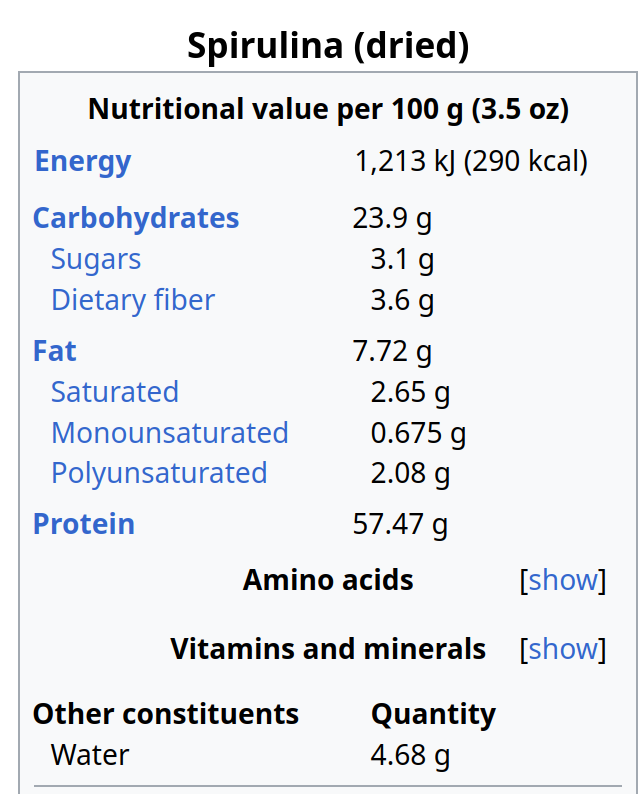
Source is Wikipedia. Spirulina are a type of algae that is a potential food candidate for spaceflight missions and mars settlement. You can find more using your favorite search engine using the keyword "spirulina".

22
23


Extract....

While Mars may be a desiccated place where water no longer flows, the planet still has glaciers slowly moving across its surface. Previously, it was thought that Martian glaciers were pure ice with a thin cover of rock and dust. But after 20 years of exhaustive research, scientists have concluded that glaciers all over the planet contain more than 80% water ice, meaning they are nearly pure. These findings could alter our understanding of Mars' climate history and have significant implications for future crewed missions dependent on in-situ resource utilization (ISRU)......

24


cross-posted from: https://discuss.online/post/24399349

http://www.smbc-comics.com/comic/a-city-on-mars-now-in-paperback

Alt textCan you make babies in space? Should corporations govern space settlements? What about space war?

No bonus panel

25


Here's a short timelapse movie I made of Mars emerging from behind the Moon after the occultation. Not the best quality, but my setup wasn't great and it was -20C outside. (Look right at the top of the Moon if you aren't seeing it).

view more: next ›